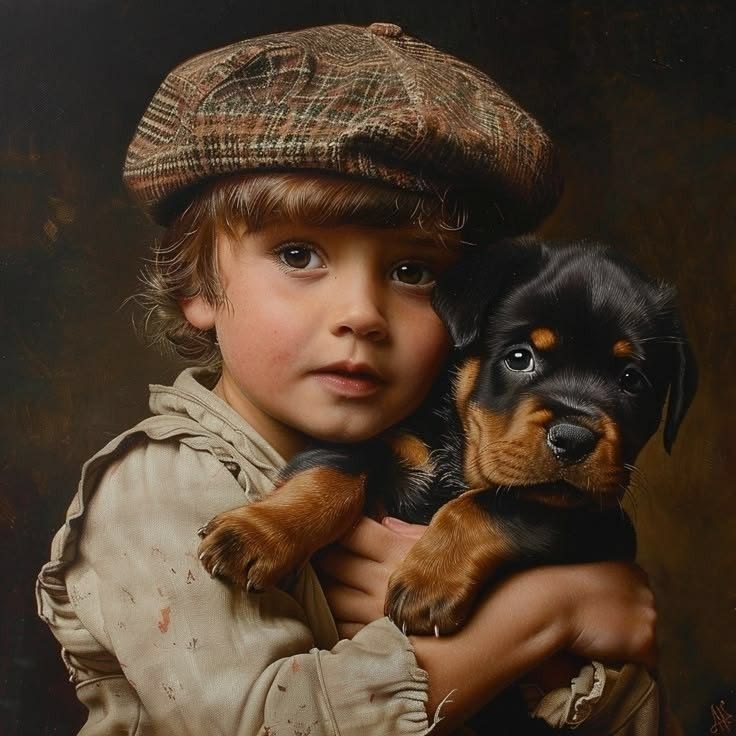
Theo Marsh was seven years old and he had never been good at lying, but he was getting better at it fast.
The puppy had been in his room for three days.
He had found it on a Tuesday morning behind the old feed store on Clement Road, tucked inside a cardboard box that someone had left beside the dumpster with no note, no explanation, no acknowledgment that the thing inside it was alive and warm and looking up at the world with the wide, dark, slightly baffled eyes of something that has not yet decided whether to be afraid. It was black with rust-colored markings above its eyes, paws the size of half-dollars, ears that hadn’t figured out yet whether to stand up or fold over. A Rottweiler pup, maybe six weeks old, maybe seven. Small enough still to fit in the front pocket of Theo’s canvas jacket, which was how he had carried it home.
He had named it Duke before he reached the end of the block.
The decision to hide Duke was not a calculated one. It arrived the way most decisions arrive for seven-year-olds — instantly, completely, with no consultation from the rational part of the brain. He knew, in the wordless way children know the architecture of their households, that his father would say no. Not cruelly. Frank Marsh was not a cruel man. He was a careful man, a precise man, a man who ran the numbers on everything before committing, and right now the numbers in the Marsh house on Decatur Street were not running well. His mother had been sick since winter. The medical bills had changed the way his parents talked to each other — quieter, more careful, as though they were moving through a room full of things that might break. A dog was not in the numbers. Theo understood this without being told, the way children understand the financial weather of their households without ever seeing a single bill.
So he said nothing. He carried Duke upstairs in his jacket pocket. He arranged his room.
The operation was, by any objective standard, impressive for a seven-year-old. He lined the bottom drawer of his dresser with his old football jersey, the soft one, and that became Duke’s bed. He saved half of every meal — tucking pieces of chicken or bread into his napkin when his father wasn’t watching, sliding green beans into his jacket pocket, becoming a small and earnest smuggler of table scraps. He filled a plastic cup with water and kept it behind the dresser. He learned to sneeze at precisely the moment Duke made noise, which was often, and which required a level of timing that he felt deserved more credit than he was able to receive.
His father thought he was getting a cold. His father brought him orange juice.
Theo drank the orange juice and felt terrible about it.
At night, with the door closed and the lights off, he lay in his bed and let Duke out of the drawer and the puppy climbed his chest and settled there, a warm dense weight over his heart, and Theo would talk to him the same way he used to talk to his mother before she got too tired for long conversations. He told Duke about school — about Marcus Teller, who was fast but not as fast as he thought he was, and about Mrs. Abernethy, who was strict but fair, which Theo had decided was the best possible combination in a teacher. He told Duke about his father, who used to whistle in the mornings and had stopped. He told Duke about his mother, who still smiled when she saw him, every single time, even on the bad days, and how that smile was the thing he organized the rest of his world around.
Duke listened with his whole body, the way dogs listen.
On the fourth day, his father found out.
Not through any failure of the operation — Theo’s operational security had been genuinely solid. Frank Marsh found out because he had gotten up at two in the morning to get a glass of water and had passed Theo’s room and heard, through the door, the specific sound of a very young child having a serious conversation with someone, and had opened the door quietly, the way fathers do, and seen his son lying in bed in the dark with a puppy on his chest, telling it, in the low serious voice of someone conducting important business, that everything was going to be okay, that he was going to figure it out, that Duke didn’t need to worry, because Theo was working on it.
Frank stood in the doorway for a long time.
Theo saw him. He went very still. The numbers ran through his head — the bills, the careful quiet conversations, the orange juice he had drunk under false pretenses. He tightened his arms around Duke and waited for what came next.
His father sat down on the edge of the bed. He didn’t turn on the light. He looked at the puppy on his son’s chest, at the flat cap Theo wore even indoors because he said it helped him think, at the smudges on his canvas jacket that were always there no matter how many times it was washed.
“How long?” his father said.
“Four days,” Theo said. No point now.
Frank nodded slowly. He reached out and put one finger against Duke’s nose. Duke sniffed it with great seriousness.
“He’s a Rottweiler,” his father said.
“Yes sir.”
“They get big.”
“I know.”
Frank was quiet for a moment. In the dark, Theo couldn’t read his face, and he was usually good at reading his father’s face. He held Duke a little tighter.
Then his father said, very quietly: “Your mother always wanted a dog.”
Theo had not known that. In seven years, it had never come up. He turned it over in his mind, this new fact, this thing that had always been true without him knowing it — his mother, wanting something, all this time, in the quiet way she sometimes wanted things, without asking.
“Really?” he said.
“Really.” His father took his hand back. He sat there another moment. “Duke’s a good name,” he said finally.
He stood up. He went to the door.
“Keep him out of the kitchen,” he said. “And for the love of God, Theo, you’ve been feeding him table scraps, haven’t you.”
It was not a question.
“Yes sir,” Theo said.
His father made a sound that was almost a laugh — the first one in a while, the first one that sounded like the old kind, the kind from before winter. Then he went back down the hall, and Theo heard his footsteps, and then the quiet.
Duke put his chin on Theo’s collarbone and sighed.
Theo stared at the ceiling and thought about his mother wanting a dog all this time. He thought about how many things people carry quietly, for years, because the moment never seemed right to put them down.
He pulled Duke a little closer.
Tomorrow he would ask his father if they could bring Duke to her room. He already knew, somehow, what she would do when she saw him. She would smile — that specific smile, the one that organized his world.
He was right. She did.
