Nobody asked Owen if he was ready.
That was the thing he kept coming back to, afterward, in the way children return to the thing that felt unfair not because they want to stay angry but because the unfairness was real and deserves at least to be acknowledged before you let it go. Nobody had asked. His father had simply appeared in the doorway of his bedroom at five-forty in the morning — still dark outside, the March cold pressing against the windows — and said, “Owen. Barn. Now.” And that had been the entirety of the conversation.
Owen was ten years old and he had grown up on the Caswell farm in rural Vermont, which meant he understood, in his bones, that the farm did not wait for you to be ready. The farm had its own calendar, its own demands, its own particular disregard for the feelings of the people who served it. Calving season did not reschedule itself. Fences did not mend themselves at a convenient time. And lambing, his father had explained to him every year since he was old enough to understand, lambing least of all.
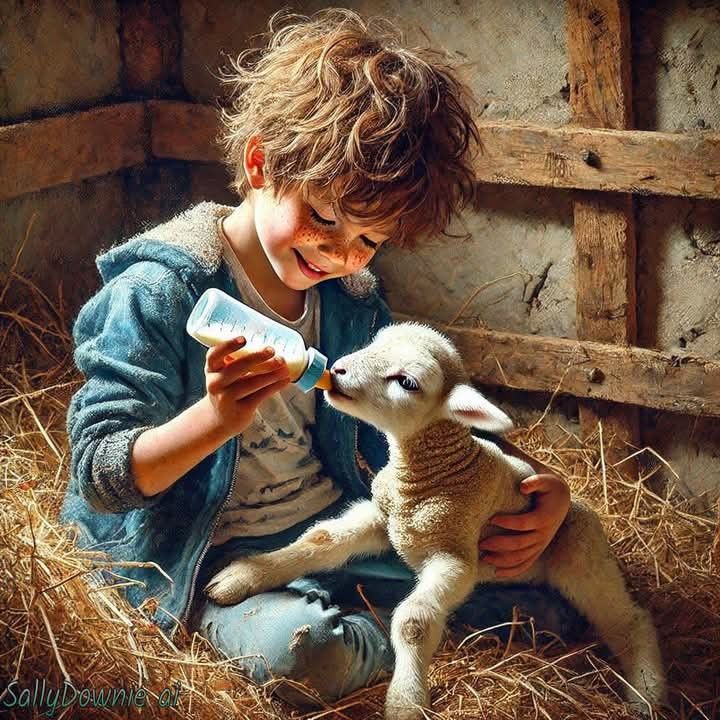
He had pulled on his jeans and his blue hoodie and gone to the barn.
The ewe was in the corner stall, and she was not well. Owen’s father, Cal Caswell, was already crouched beside her, sleeves rolled, face carrying the particular expression he wore when he was assessing something he couldn’t fully control — a focused, inward look, all the ordinary parts of him temporarily set aside. The veterinarian was forty minutes away. The lamb was coming now.
“Stay back,” his father said, and Owen stayed back and watched.
The lamb came into the world the way difficult things come — slowly, then all at once, with a final effort that seemed to cost everything available. It landed in the straw and lay there, wet and folded, improbably small, its ribs barely moving. The ewe turned to it and then turned away. Turned back. Turned away again. There was a stillness in her that Owen recognized without being able to name — the stillness of a creature that has spent everything it had and is not sure it has anything left for what comes next.
His father looked at the lamb for a long moment. Then he looked at Owen.
“She’s not going to take it,” he said. Flat. Matter-of-fact. The way he said things that were hard but true.
“What does that mean?” Owen said, though he already knew.
“Means it needs to be fed by hand or it won’t make it.” His father stood up, knees cracking, and reached for the shelf where the feeding supplies were kept — the small bottles, the powdered milk replacer, the rubber nipples in a zip-lock bag. He began to prepare a bottle with the efficient movements of someone who has done this before, who knows exactly what the next thirty minutes require and has already organized himself around them.
He handed the bottle to Owen.
“Sit in the straw,” he said. “Hold it steady. If it doesn’t latch in the first minute, rub its nose gently. Don’t force it. Let it find the bottle on its own.”
“Are you staying?” Owen said.
His father looked at him. “I’ve got the others to check,” he said. “You’ve got this one.”
And then he was gone, and Owen was alone in the corner stall with a lamb that was still deciding whether to live and a bottle of warm milk replacer and the sounds of the barn settling around him — the shifting of animals, the creak of old timber, the specific quiet of a place where things are always beginning and ending and the distance between the two is very small.
He sat in the straw.
He brought the bottle to the lamb’s nose the way his father had shown him, not pushing, just offering. The lamb turned its head away. Turned back. Its nostrils moved — the smell of something warm and nourishing reaching some deep wired part of it that was older than any decision.
It latched.
The pull on the bottle was weak at first, uncertain, the kind of trying that isn’t sure it believes in itself yet. Owen held steady. He kept the angle right, the way his father had demonstrated. He watched the small ribcage working, watched the lamb’s front legs scramble in the straw as it found its footing, the whole creature rearranging itself around the fact of eating, around the discovery that it was hungrier than it was tired.
Owen felt something move in his chest that he didn’t have a word for.
He talked to the lamb the way he found himself talking to things when nobody was listening — without embarrassment, without self-consciousness, in the direct and practical tone of someone conducting important business. He told it that it was going to be okay. He told it that Vermont in March was cold and confusing but that it got better, that by May the fields were green in a way that made you understand why people stayed their whole lives in a place like this. He told it that he would be there every morning with the bottle for as long as it needed, that it could count on that, that he was not going anywhere.
He named it Scout, because it had come into the world ahead of everything that should have been there to meet it and had kept going anyway.
The bottle emptied. Scout pulled at the empty nipple for a moment, then stopped, then looked up at Owen with the large, extraordinarily calm eyes that lambs have — eyes that contain, somehow, both complete innocence and something very old, something that has been looking at the world a long time and has decided not to be alarmed by it.
Owen looked back.
“Okay,” he said softly. “Okay. I’ve got you.”
He refilled the bottle from the thermos his father had left on the shelf. He sat back down in the straw. Scout folded its legs and leaned its small warm weight against Owen’s knee, and the boy sat in the corner of the barn with the March cold pressing at the walls and the old timber creaking and the light coming up slowly through the gaps in the siding, the pale particular light of early spring in Vermont, the light that means the worst of winter is over even if it doesn’t feel like it yet.
His father came back an hour later and stood in the doorway of the stall and looked at his son in the straw with the lamb asleep against his leg and the empty bottle in his hand, and he stood there long enough that Owen looked up.
“She took the bottle,” Owen said. As though the report were the point, not the boy delivering it, not the change that was already visible in the set of his shoulders, the steadiness of his face.
“I can see that,” his father said.
He came into the stall and crouched down and checked the lamb with practiced hands — weight, color, the quality of its breathing — and Owen watched him do it, the same way he had been watching his father do things his whole life, filing away the knowledge without knowing he was doing it.
“She’ll need the bottle every four hours for the next two weeks,” his father said. “Including nights. You understand what that means.”
“I understand,” Owen said.
His father looked at him for a moment with the same assessing look he turned on everything he was trying to understand.
“She’d have died this morning,” he said. “Without you.”
Owen looked at Scout, asleep in the straw against his knee, breathing in the slow steady rhythm of a thing that has eaten and is warm and has decided, for now, to rest.
“I know,” he said.
He said it quietly, without drama, the way you say the things you know down to the bottom of yourself. And his father heard it that way, received it that way, the way the truth sounds when it comes from someone who has earned it.
Outside the barn, the March light was getting stronger.
Spring was coming whether anyone was ready or not. But Owen Caswell, ten years old, was ready.
He had been for about an hour.
