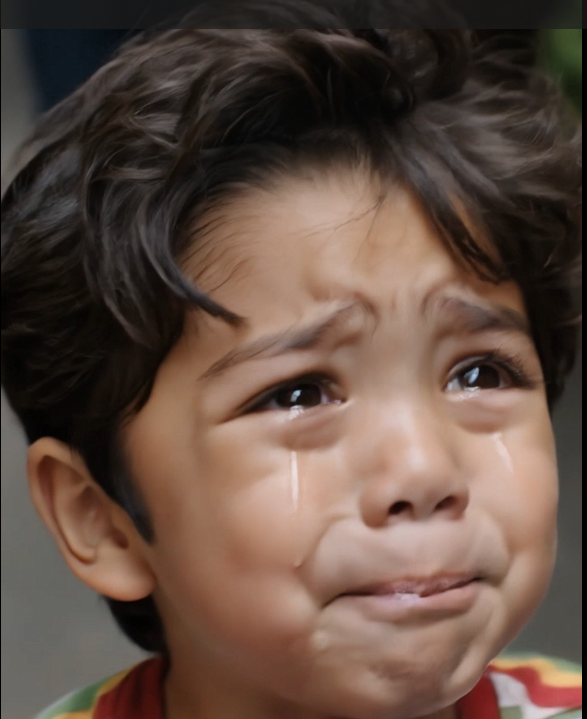
The farmer’s market on Clement Street was the kind of organized chaos that Nora had learned, over the years, to move through like water — finding the gaps, reading the currents, never stopping long enough to become an obstacle. She had a system. Greens first, then fruit, then the cheese vendor at the far end who always ran out of the aged gouda by eleven. She had been doing this every Saturday for two years, ever since she’d moved to the neighborhood, and in that time it had become the closest thing she had to a ritual. She felt the hand close around hers between the flower stall and the bread table. Small. Warm. Fingers that gripped with the instinctive, total confidence of a child who has never once doubted that the hand they’re reaching for will be there. “Mom, where did you go?” Nora stopped. The boy was perhaps four years old, maybe just turned five — that ambiguous age where children seem to exist in two sizes simultaneously, too big for certain things and too small for others. He had dark hair pushed flat on one side as though he’d slept on it and no one had fixed it. He was wearing a green raincoat despite the clear sky, unbuttoned, flapping open over a shirt with a dinosaur on it. He was looking up at her with the absolute, uncomplicated trust of someone who had found what they were looking for. Then he took in her face. It lasted only a second, the recognition recalibrating itself, but she saw it — the flicker of wrongness crossing his features, the small recalibration of his eyes as they measured the distances between her features and the ones he was looking for and found them insufficient. “I’m not your mom,” she said carefully. His face collapsed. Not the dramatic, performative crying of a child seeking effect. The real kind. The kind that starts somewhere deep and rises without permission, that takes over the whole face, that a child cannot strategize their way into or out of. His chin went first, then his eyes, then the sound — a high, soft, devastated sound, nothing like a wail, more like something being let out of a small and pressurized space. “You left me,” he cried. “Just like before.” Nora crouched down. Around her, the market continued its business, though a few people had slowed, had half-turned, were performing the communal calculus of strangers in proximity to a crying child — the assessment of whether to intervene, whether someone was already handling it, whether they were needed or would only complicate things. She held up one hand slightly, a gesture that said I have this, and they moved on. “Hey,” she said. “Hey, look at me.” He looked. His face was wet, his breath coming in the lurching intervals that follow hard crying. “What’s your name?” A pause, a hiccup. “Theo.” “Theo. Okay. My name is Nora.” She kept her voice low and even, the register she’d learned years ago to reach for in moments like this — not artificially bright, not aggressively calm, just level. A thing to hold onto. “You got separated from your mom?” He nodded, miserable. “That’s really scary. But I promise you, it happens all the time here, and moms always find their kids. Okay? She’s looking for you right now.” She paused. “Do you know her phone number?” He shook his head. “That’s okay. How about her name?” He looked at her with an expression of profound blankness, the particular look of a child who has never once had cause to think of their mother as a person with a name. She almost smiled. “Okay. Can you tell me what she looks like?” “She has brown hair,” he said, in the careful tone of someone delivering important intelligence. “And a red bag. And she’s a mom.” “Perfect. That’s really good, Theo.” She stood and took his hand — he allowed it immediately, without hesitation, which broke something in her chest a little. “Let’s go find someone who works here, and we’ll get them to call for her. Is that okay?” He nodded and wiped his nose with the back of his wrist. They walked together toward the information table near the market entrance, Theo’s small hand in hers, his green raincoat flapping. The crowd moved around them. Nora kept her eyes open for a woman with brown hair and a red bag moving with the urgent, controlled panic of a parent who has lost a child — that particular gait she recognized, the way searching is different from walking. “You left me,” he had said. Just like before. She didn’t ask. She kept walking. The market manager, a broad-shouldered woman named June with a lanyard and a radio, took Theo’s description with practiced efficiency and made the announcement within three minutes. They waited near the entrance, Theo standing close to Nora’s leg with the unselfconscious proximity of a child who has decided she is currently safe harbor. “Do you like dinosaurs?” Nora asked, nodding at his shirt. He looked down at it as though he’d forgotten it existed. “The long-neck ones.” “Brachiosaurus.” He looked up at her with sudden respect. “Yeah.” “My favorite is the ankylosaur. The ones with the club tails.” He considered this seriously. “They’re good,” he conceded. “But they’re slow.” “Speed isn’t everything.” He seemed to be weighing this philosophical position when they both heard it — a sound cutting through the ambient noise of the market, not a shout but something close to one, a voice stretched thin by relief and fear arriving simultaneously. “Theo —” The woman was maybe mid-thirties, brown hair loose around her shoulders, a red canvas bag swinging from one arm, and she was moving through the crowd the way Nora had expected: not running, because you cannot run in a crowd, but something that was running’s first cousin. Her face was doing several things at once — crying already, or almost, and also still searching, still scanning, until she saw him and everything else her face was doing stopped. Theo let go of Nora’s hand. He crossed the distance between them at a dead sprint, green raincoat streaming out behind him, and hit his mother at full force around the knees. She went down to the ground without seeming to notice, gathering him in, saying his name into his hair, and the red bag fell off her shoulder and nobody picked it up because the moment required that nobody do anything practical for several seconds. Nora stood and watched. The mother looked up, still holding him, and found Nora’s eyes. She mouthed something — thank you — and Nora nodded. She stayed long enough to make sure there was nothing else needed, and then she picked up the red bag and set it beside them and walked back into the market. She didn’t go back to the cheese vendor. She bought the greens and the fruit by habit, her hands moving through the familiar sequence while her mind moved through a different one. She found a bench at the edge of the market near a stand of plane trees and sat down with her bags and watched the crowd. You left me. Just like before. He hadn’t meant her. She knew that. He had been frightened and reaching for his mother and his mother had not been there and she, Nora, had simply been the nearest hand, the nearest face — a placeholder, a stand-in, a woman-shaped thing that would do until the real thing arrived. Children did this. It was practical and uncomplicated and said nothing about her specifically. She knew all of that. She sat with her grocery bags and watched a pigeon investigate the base of a nearby trash can, and she thought about the children she had known. Not many. She was thirty-one and had spent most of her twenties in graduate school and then in the tunnel of early career, the years when you are building something and cannot afford to look up. She had nieces — her brother’s daughters, seven and ten now, girls she saw at Christmas and who sent her crayon drawings in the mail, which she kept in a folder on her desk with a solemnity that would have embarrassed her to explain. She had made choices. Not dramatically, not all at once, but incrementally, the way most permanent things happen — a series of small decisions that, accumulated, pointed in a direction. She did not have space for more, she had told herself, and then she had told herself again, and again, and the years had done what years do. She was not sad about it. She had told herself this often enough that she mostly believed it. Just like before. The thing was, she understood something about that sentence that she hadn’t expected to understand. The before was the part that had found her. Not the fear of losing something in the present — that was ordinary and survivable, that was just a crowded market and a small hand and temporary separation. The before was the part that meant it had happened enough to have a pattern. The before meant the loss was familiar. The child had not said you left me with surprise. He had said it with a particular devastated recognition, the grief of a thing confirmed. That was the part she had crouched down and not asked about. She wondered about him, about Theo with his hair pressed flat on one side and his excellent opinions about ankylosaurs. She wondered about his before, and his mother, and what it looked like in that house when things went wrong. She wondered if he was alright, in all the ways that alright was a complicated word. She would never know. That was the nature of strangers — you were given a frame and no painting. A beginning and no rest of it. A small child nearby, walking with a man who was clearly his grandfather, turned and looked directly at Nora for no apparent reason with the frank, unself-conscious stare that belongs exclusively to very small children. She looked back. He raised one hand in a wave so solemn it was nearly ceremonial. She raised hers in return. He turned away, satisfied, and kept walking. Nora picked up her grocery bags. She thought about the way his hand had felt — Theo’s — when he’d grabbed hers. The total confidence of it. She was aware that she was doing something she rarely allowed herself to do, turning the moment over and examining it too closely, but she was already doing it and the damage was already done. She thought: nobody tells you it will be the small things. Not the large, named, consequential moments of choice. The small ones. A hand in a crowd. A child’s face recalibrating. The particular weight of being reached for, and the particular weight of handing that back. She walked home through the neighborhood that she had chosen for its distance from somewhere else, the street she had walked every Saturday for two years, past the bakery and the corner with the good light in the mornings, past the apartment windows with their plants and their ordinary glimpses of other people’s ordinary lives. In her kitchen she put the greens in water and the fruit in the bowl and stood at the window for a while looking at the street below. Then she got out her phone and opened her contacts and found her brother’s name and typed: Are the girls free next weekend? I was thinking I’d come up. She put the phone down on the counter. Through the window, the street went on doing what streets do — people moving through their Saturdays, carrying their bags, reaching for each other, letting go, reaching again. The ordinary and relentless traffic of people trying to find the hands they were looking for. Her phone lit up. Her brother, already answering. She picked it up
