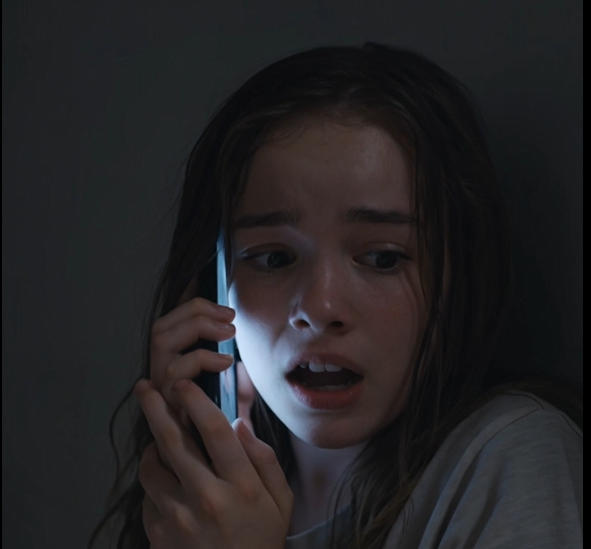
A girl hides in a bathroom, shaking, crying. Someone is breaking into the house. “Please… go away…” The door handle slowly turns. A voice behind her whispers: “He’s already inside.” She turns — someone is standing right behind her. The sound that woke Jessie was not loud. That was the thing she kept returning to, later — how quiet it had been. A single sound, low and deliberate, like something being tested rather than forced. She had lived alone long enough to know the language of her house at night: the water heater clicking on, the oak tree’s branch that scraped the east gutter in wind, the settling of old joists reading as footsteps if you weren’t paying attention. She had catalogued all of it. She knew what her house sounded like when it was just itself. This was not that. She lay still for eleven seconds — she counted, later, reconstructing it — listening for repetition. When it came again, lower, closer to the ground, she understood what she was hearing: the side door’s lock being worked. Not kicked, not broken. Worked, the way you work a thing if you know how and have patience and don’t want anyone to hear. She was out of bed before she’d decided to move. The bathroom was closest. She had never thought about this before — had never performed the calculus of a house in danger — but proximity was all she had, and the bathroom had a lock, and she was inside it with the door closed and her back against the far wall before she heard the side door open downstairs. Soft. Controlled. The door of someone who had done this before. Jessie pressed herself into the corner between the wall and the cabinet, the cold tile reaching through her socks, and she held her phone in both hands and tried to make herself small and she called 911 with the screen brightness turned all the way down. The dispatcher answered in two rings. “911, what’s your emergency?” She put her mouth close to the phone and said, barely above nothing: “Someone is breaking into my house. 14 Marsh Road. I’m in the upstairs bathroom. He’s inside. He’s downstairs.” “Okay, I’m sending units now. Stay on the line with me. Is the bathroom door locked?” “Yes.” “Good. Keep it locked. Don’t open it for anyone until police identify themselves. Can you hear movement?” Below her, something moved. Deliberate footsteps crossing the kitchen. Not rushing. “Yes,” she breathed. “He’s in the kitchen.” “Units are four minutes out. I need you to stay quiet and stay on the line. You’re doing great.” She pressed herself harder into the corner. The bathroom was small — she could touch the opposite wall with her foot if she stretched — and in the dark it felt smaller still. She had turned on no lights. Some instinct she didn’t know she had told her that light under a door was a signal, and she wanted to give him nothing. Four minutes. She counted her own breathing, tried to slow it, felt it resist. Below, the footsteps moved from the kitchen toward the front room. She tracked them through the ceiling. He wasn’t searching frantically — wasn’t throwing things, wasn’t room-to-room rapid. He was moving through the house the way you move through a house you know, methodically, with the patience of someone not concerned about time. Why isn’t he concerned about time? The thought arrived and would not leave. People who broke into houses in the night were scared of time — every second was risk, every moment unresolved increased exposure. They moved fast. They took what they could and they left. This one was not moving fast. “Ma’am?” The dispatcher’s voice, thin through the speaker. “Are you still with me?” “Yes,” she breathed. “Units are three minutes out. Can you still hear him?” She listened. The footsteps had stopped. She wasn’t sure when — she’d lost track of them while managing her own breathing, her own fear. “I —” She paused. “I can’t hear him anymore.” “Okay. That’s okay. Don’t move. Keep —” The bathroom door handle turned. One smooth, slow rotation. Testing the lock, finding it, stopping. Jessie stopped breathing entirely. On the phone, the dispatcher was saying something she could no longer parse. She watched the handle. It turned back to neutral. Paused. “Please,” she whispered, so quietly it was barely sound at all. “Please go away.” The handle was still. She exhaled by degrees. And then a voice came from directly behind her left shoulder, so close she felt the shape of it against her ear. “He’s already inside.” She did not scream. She would not understand how, later — the sound was somewhere in her body fully formed, had been there since she’d heard the side door open, and yet it did not come. What came instead was something worse than a scream: total silence. Complete arrest. Every system she had shutting down simultaneously, refusing to process what was directly behind her, what had been behind her, in this locked room, in this small dark space where she had gone to be safe. She turned. The girl was perhaps sixteen. She was pressed into the gap between the wall and the back of the door, which was where the darkness was thickest, and she was wearing a grey hoodie and jeans and her face was streaked with something that had dried, and she was shaking — Jessie could see it from three feet away, the tremor in her shoulders, the instability of her hands. She was more frightened than Jessie was. “Who are you,” Jessie breathed. The girl shook her head, a minimal movement. She pointed at the floor. At the space below the bathroom door. She held one finger to her lips. Jessie looked down. In the half-inch gap between the door and the tile, no light, no shadow. She raised the phone back to her ear. The dispatcher was still there, saying her name, controlled but with an edge to it now. “I’m here,” Jessie whispered. “There’s — there’s a girl in the bathroom with me. A teenager. She came in through —” She looked at the window. It was a small window, high on the wall, designed for ventilation rather than access, but it was unlatched. She hadn’t noticed. “She came in through the window. She’s frightened.” A pause on the line. “Is she a threat?” Jessie looked at the girl, who was still pressed against the wall, who was watching the gap under the door with the focused, animal attention of someone who has been afraid for long enough that the fear has become entirely functional. “No,” Jessie said. “She’s hiding.” She turned on the flashlight — pointed at the floor, diffuse, enough to see by without projecting light outward — and lowered herself to the ground and looked at the girl directly. “Who is he?” she asked. The girl’s jaw tightened. She shook her head again. “He’s been following me,” she said, almost without volume. “Since the park. I didn’t know where to go. I saw your side door — I didn’t mean to scare you. I just needed —” “It’s okay.” Jessie said it quickly, meant it. Questions later. “It’s okay. Police are coming. Two minutes.” Something moved downstairs. Both of them heard it. Both of them went perfectly still. Jessie killed the flashlight. The sound was different from before — no longer paced, methodical, patient. Now it was searching. A door opened and closed. Something was moved. He was working faster, working through rooms, working his way toward the stairs, and she understood in a cold flash that the shift in his pace was not random. He knew the girl was in the house. She put her mouth close to the girl’s ear. “What’s his name?” A breath, ragged. “I don’t know.” “How long has he been following you?” “Tonight. Or —” She stopped. “I’ve seen his car before. A few times. By my school.” She swallowed. “I thought I was imagining it.” Downstairs, the footsteps found the stairs. Slow again now. Deliberate. One step, and then a pause, and then another. Counting them, maybe. Or listening for response. The patience had returned and it was the most frightening thing in the room. Jessie pressed the phone hard to her ear. “He’s on the stairs. Where are your units?” “Ninety seconds. Officers are on Marsh Road. Ma’am, stay on the line —” The footsteps reached the top of the stairs. The landing. She knew the sound of her own hallway, its two steps from the staircase to the bathroom door, and she counted them in her head as she heard them on the floor — One. She stood up. She planted herself in front of the girl. Two. The door handle turned again. This time, when it found the lock, it didn’t stop — it applied pressure, steadily, testing the mechanism’s tolerance, and she saw the door flex slightly in its frame. And then: sirens. Still outside, still distant, but approaching — not gradually, suddenly, the way sirens approach in the dark when your nervous system is tuned to nothing else. Blue light strobed through the small high window, making the room strobe in alternating blue and dark, blue and dark. The pressure on the door handle released. She heard him move — fast now, no patience left, back down the hall, down the stairs, the sound of someone making decisions with no good options. The side door opened. Running footsteps on the path outside. Voices — officers, radios, shoes on pavement. Jessie stood in the center of her bathroom and breathed. Behind her, the girl slid slowly down the wall until she was sitting on the tile floor with her knees pulled up and her face pressed against them, and she made a sound that was not crying exactly, more like the body releasing pressure, letting out what had been held at enormous cost for however long this night had been for her. Jessie sat down next to her on the cold floor. She didn’t say anything. There was a full accounting ahead — police coming to the door, questions, statements, all the procedural machinery that would now surround what had happened — and there would be time for the girl’s name, and her parents, and the car that had been parked outside her school. There would be time for all of it. Right now she sat on the bathroom floor and let the girl take up all the space she needed, and outside the blue lights moved across the wall in slow, even sweeps, methodical in their own way, patient in their own way, the particular patience of people who have arrived and are not leaving. After a while, the girl looked up. “I’m Maya,” she said. Her voice was steadier. Not steady, but moving in that direction. “Jessie.” Maya looked at the small high window, now dark — the squad cars had moved around to the side. “I broke your latch,” she said. “I know.” “I’ll pay for it.” Jessie almost laughed. Didn’t, but almost. “Don’t worry about the latch.” Someone knocked on the front door below, and a voice called out — police, Ms. Reilly — and Jessie called back that she was coming. She stood, and she offered Maya her hand, and Maya took it and stood. They stood together in the small dark bathroom that had, by luck or instinct or the particular randomness of frightened people reaching for the nearest shelter, held them both. Then Jessie unlocked the door and they walked out into the lit hallway, and then down the stairs, and then she opened the front door to the officers on the step with their radios and their careful faces, and she said: “We’re okay. We’re both okay.” Behind her, Maya stood in the hallway of a stranger’s house, in the aftermath of the worst hour of her life. She was still shaking. But she had stopped counting the seconds.
