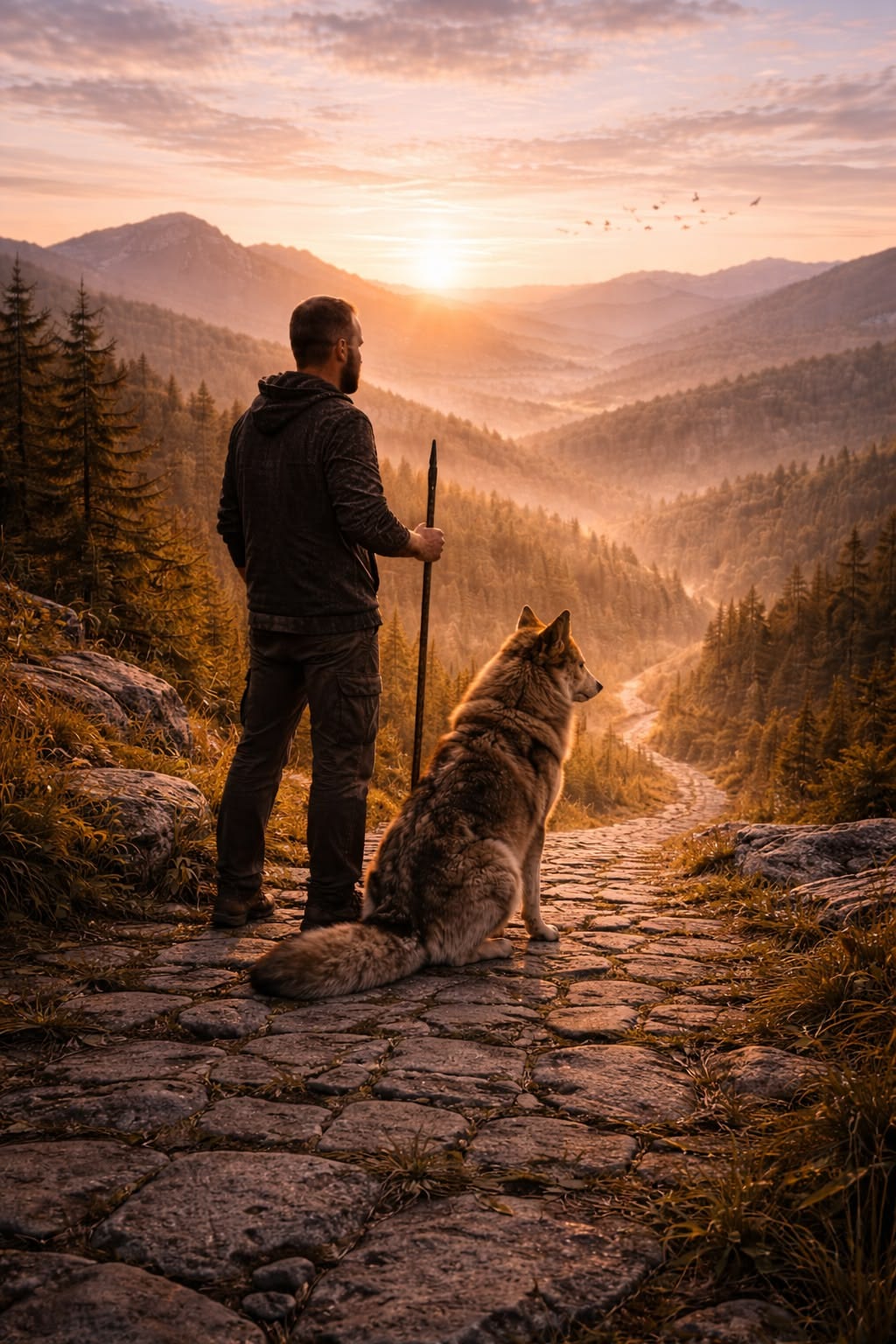
He hadn’t planned to stop here.
Marcus had been walking since before sunrise, the way he’d been walking every morning for the past three weeks — not toward anything, exactly, but with the particular determination of a man who has discovered that forward motion is the only thing keeping him from falling completely apart. The trail had been his therapist’s idea, delivered in the careful, neutral tone she used when she was suggesting something she suspected he’d resist. Some people find that extended time in nature helps reset the nervous system. He had nodded the way you nod at things you have no intention of doing, and then two weeks later he had put his apartment on a month-to-month lease, packed a bag, and driven to the trailhead with no plan beyond the next footfall.
Ghost had come with him, obviously.
The dog — a husky mix he’d found three years ago behind a dumpster in Asheville, skinny and suspicious and so obviously named Ghost that Marcus hadn’t even tried to think of anything else — went where Marcus went. That was the arrangement. Ghost had not been consulted on this arrangement and would not have objected even if he had been. He was that kind of dog. The kind that makes you believe, on the hard days, that loyalty is not a human invention but a natural force, like gravity, like weather, like the way water always finds the lowest point and stays.
The sun had broken over the ridge twenty minutes ago and Marcus had simply — stopped.
He didn’t plan it. His legs stopped and he stood and Ghost sat down beside him, close enough that Marcus could feel the warmth coming off his fur, and together they looked out at a valley that didn’t know or care about anything that had happened to either of them in the past two years.
Two years.
That was how long it had been since the company folded. Since the eighteen-hour days and the investor calls and the pitch decks and the product launches and the burning, consuming certainty that he was building something real — since all of that had collapsed in the course of about six weeks into lawsuits and severance negotiations and a silence so complete it was almost physical, like a room with no windows. His co-founder had moved to Singapore. Three of his closest friends had slowly, without announcement, stopped returning his calls. His girlfriend of four years had sat across from him at a kitchen table that he’d chosen and assembled and loved and said, gently but without hesitation, that she didn’t recognize the person he’d become in the aftermath, and she wasn’t sure he recognized himself either, and she needed to go.
She wasn’t wrong.
He stood on the ridge and breathed the kind of air that cities only approximate — cold and pine-sharp and carrying the faint sweetness of something blooming far down the valley — and tried to remember the last time he had breathed without the shallow tightness in his chest that he’d come to think of as his default state, the way some people’s default is anxious or restless. His default had become braced. Waiting for the next thing to go wrong.
Ghost pressed against his leg.
“I know,” Marcus said.
He didn’t know what he meant by that. Neither did Ghost, in all likelihood. But the exchange felt necessary anyway, the small confirmation that the two of them were here, together, on a ridge above a valley in the early morning gold, which was a true and complete sentence even if it didn’t resolve into anything larger.
He had called his father last night, from the tent, lying in the dark with Ghost a warm weight across his feet. His father was a retired electrician from Cincinnati who had never understood what Marcus did for a living — not the technology, not the venture capital, not the particular culture of a startup, with its foosball tables and its impossible valuations and its insistence that everything was either changing the world or not worth doing. His father had worked for thirty-one years for a company that made electrical components and had taken exactly three vacations in that time and had built, through that unremarkable consistency, a life that was still standing.
“You doing okay out there?” his father had asked.
“Getting there,” Marcus had said, which was the most honest answer he’d given anyone in months.
His father had been quiet for a moment. Then: “You know what your grandfather used to say? He said the only way out of a bad stretch is through it. You can’t go around. You can’t wait it out. You go through it.”
Marcus had heard this before. It hadn’t meant much before. On a dark mountainside with his dog across his feet and two years of wreckage in the rearview, it meant something different.
He looked out at the valley now, at the river catching the first light at the bottom like a thread of hammered gold, at the forest covering the slopes in that dense, indifferent abundance that forests have — the trees growing because trees grow, not because anyone is watching or measuring or assigning a valuation — and felt something shift in him. Not dramatically. Not the way it happens in movies, with swelling music and sudden clarity. Just a small, quiet movement, like a door that has been stuck for a long time finally giving an inch.
Ghost stood up, shook himself, and looked at Marcus.
“Yeah,” Marcus said. “I know.”
The valley was down there. The road — the old cobbled path, worn smooth by however many years of boots and rain — wound down through the trees toward it. He didn’t know what was at the bottom. He hadn’t planned that far. He had learned, these three weeks, that planning too far was its own kind of avoidance, the future as a place to hide from the present.
He was present, here, on this ridge, with his dog and his walking stick and the sun coming up over the mountains.
He had lost almost everything he thought he was.
He was still here.
Ghost started down the path without waiting.
Marcus followed.
