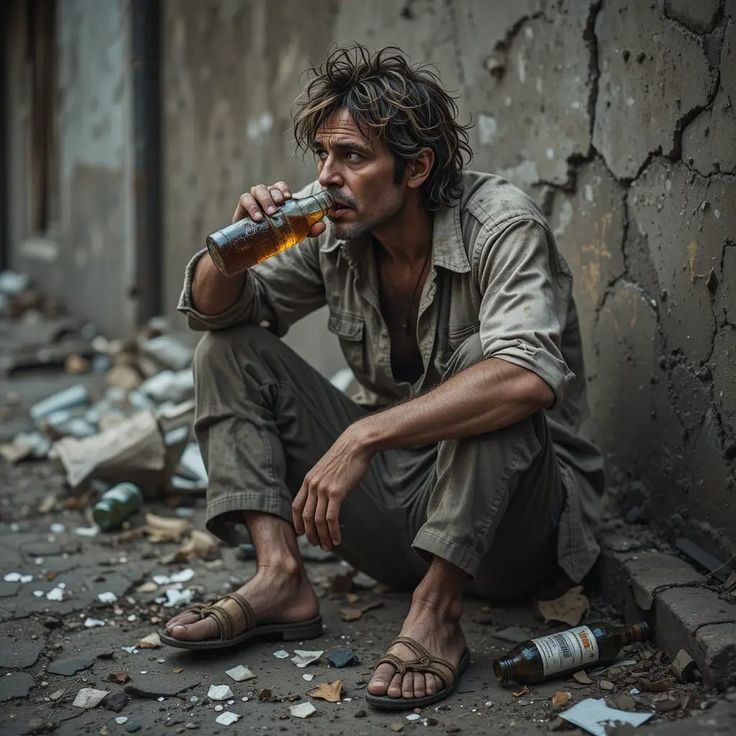
He used to know what day it was.
That sounds like a small thing until it isn’t. Until the days stop having edges — stop being Tuesday or Thursday or the fourteenth — and become instead a single continuous grey texture that you move through without landmarks, without the ordinary architecture of a life that tells you where you are in time. Ryan Calloway was forty-one years old and he was sitting in the shell of a building that nobody had finished demolishing, in a city that had stopped seeing him the way cities stop seeing certain people — not with cruelty, exactly, but with the practiced unseeing of a place that has decided some things are too complicated to look at directly.
He was drinking.
He was always drinking now, or working toward drinking, or recovering from drinking in the way that wasn’t really recovery but just the lowest point of a cycle before it turned back up. He had been a high school history teacher in Columbus, Ohio. He had been a husband. He had been a father — was still a father, technically, biologically, in every way except the ways that counted, which was to say the ways that required him to be present and sober and capable of being trusted with the weight of someone else’s need.
His daughter’s name was Abby. She was nine years old. He had not seen her in fourteen months.
The bottle in his hand was the cheap kind — the kind you didn’t choose because you preferred it but because it was the arithmetic of what was left after everything else had been subtracted. He held it without drinking, for once, just held it and looked at the wall across from him, at the cracked plaster and the water stains and the exposed lath behind where a section had broken away, at the remnants of someone’s wallpaper still clinging in strips — a pattern of small blue flowers, faded almost to nothing, that had once been someone’s choice, someone’s house, someone’s idea of what a home should look like.
He thought about homes a lot, for a man who didn’t have one.
The path from that life — the house in the Columbus suburb, the graded papers on the kitchen table, Abby’s drawings on the refrigerator, his wife Claire’s voice from the next room — to this building, this wall, this bottle, was not the dramatic cliff-edge fall that people imagined when they imagined this kind of story. It was a slope. Gentle enough, for long enough, that he had not recognized the angle until the speed was already too great to arrest by ordinary means.
It had started with his back. A herniated disc in the spring of the year Abby turned six — a routine injury, the kind that happened to men in their late thirties who carried things without thinking about how they were carrying them. The prescription had been appropriate. The dosage had been appropriate. Everything had been appropriate, right up to the point where appropriate stopped being a concept that applied to the quantity he needed to feel like himself, and by then the prescription had ended and the need hadn’t, and he had found other solutions to the problem of need in the way that people found solutions when they were desperate and the legitimate options had closed.
The alcohol had come later, as a substitute that became its own emergency.
He had hidden it from Claire for eight months. Eight months of mouthwash and careful timing and the exhausting performance of normalcy, the way you performed a character who had once been yourself and was now a costume you wore with decreasing skill. She had found out in the way that people who loved you always found out — not through discovery but through accumulation, the small daily evidence of a person disappearing inside themselves while the body continued to show up.
She had tried. He needed to say that out loud sometimes, to the wall, to the blue-flower wallpaper, because the story was easier to make her the villain of and the truth was she had tried for two years with the fierce and exhausted love of a woman who had not wanted this to be what happened and had not given up until giving up became the only thing left that protected Abby from watching her father dissolve in real time.
The custody agreement gave him supervised visitation contingent on sobriety he had not achieved.
Fourteen months.
He took a drink and then set the bottle down because the drinking didn’t actually help with the thinking about Abby, it only helped with the not thinking about Abby, and right now he was thinking about her, which meant the bottle was doing the wrong job and he knew it and couldn’t stop and also couldn’t fully stop trying.
He could hear the street from here. The ordinary sounds of a city moving through its afternoon — traffic, voices, the distant percussion of construction somewhere down the block, someone building something in a city where he was sitting in something being unmade. He watched a pigeon land in the rubble six feet from him, consider him with one orange eye, and depart without urgency.
He thought about a thing his father used to say, before his father became someone he didn’t visit: the difference between a man who falls and a man who stays fallen is the next thing he does.
He had been fallen for fourteen months.
He was thinking about the next thing.
Not grandly. Not with the swelling music of a resolution — he had made resolutions before, had felt the temporary architecture of them, had watched them come down. This was smaller than a resolution. This was just a man sitting in rubble looking at a pigeon’s departure point and thinking, in the tired but genuine way of someone who has not entirely stopped: there has to be a next thing.
His phone had eleven percent battery. He had not charged it in two days because charging it meant hearing the messages he hadn’t returned.
He turned it on anyway.
There was one text. From a number he didn’t recognize. Sent this morning at seven forty-two.
It said: Dad, it’s Abby. Mom doesn’t know I’m texting. I just wanted to know if you’re still there. I love you. Please be there.
Ryan Calloway sat in the rubble with his eleven percent battery and his nine-year-old daughter’s text and did something he had not done in fourteen months.
He made a decision.
