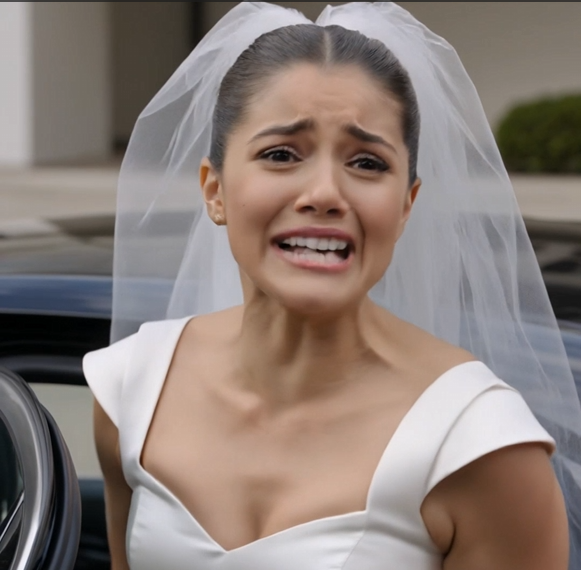
The music was still playing when the bride started running. Her white dress tore slightly at the bottom as she rushed past stunned guests, her veil slipping off and disappearing somewhere behind her. People thought it was part of the ceremony at first — some kind of dramatic tradition — until they saw the groom’s face. “Where are you going?!” he shouted, his voice cracking as he pushed through the crowd. She didn’t stop. At the edge of the venue, a black car was already waiting. A man stepped out — not a stranger. Someone the groom recognized. Someone who shouldn’t be there. The bride turned for just a second, tears in her eyes, torn between two worlds. “I’m sorry,” she whispered. Then she got in the car. The engine roared. The groom stood frozen — until his phone buzzed. A message from an unknown number. You were never supposed to find out like this. He opened the attached photo… and everything he thought he knew about her — about their entire relationship — collapsed in an instant. The photo was of Elena. Younger, maybe five or six years ago, judging by the length of her hair and the particular lightness in her face that Marcus hadn’t seen in the three years they’d been together. She was sitting at a restaurant table across from a man — the same man who had just helped her into that black car — and between them, propped against a water glass like it was the most ordinary thing in the world, was a framed photograph. A wedding portrait. Not theirs. Elena’s, with someone else. A white dress, a veil, a man whose face Marcus could not make out because the image was slightly blurred, taken at an angle. But the date stamp in the corner was clear: September 14th, 2018. Marcus stared at it until the numbers stopped meaning anything. He became aware, gradually, of the people around him. The caterers frozen with trays. His mother’s hand on his arm. The string quartet, which had finally, mercifully, stopped. His best man Daniel was saying something close to his ear, but the words arrived disassembled, in the wrong order. “Marcus. Hey. Marcus.” He looked up. “Come inside,” Daniel said carefully, the way you speak to someone standing too close to the edge of something. They sat in the bridal suite, which smelled overwhelmingly of her perfume. Her overnight bag was still open on the chair, a tube of lipstick uncapped on the vanity. Marcus sat on the edge of the bed in his rented tuxedo and stared at the photograph on his phone until Daniel gently took it from him and looked for himself. “You know who that is,” Marcus said. “The man.” “That’s —” Daniel stopped. “That’s Richard Voss.” Daniel said nothing, which was its own kind of confirmation. Richard Voss. Elena’s employer. The man who had offered her the position at his architecture firm eighteen months ago, the man she mentioned with a professional casualness that Marcus had never thought to question. Richard thinks the proposal needs more glass. Richard wants us in Copenhagen next month. Always Richard, always said the same way you might say the weather or the landlord — some neutral feature of the landscape of her working life. “She was married before,” Marcus said. It came out flat, almost like a question, almost not. “You didn’t know.” “She never —” He pressed his hands together, stared at the floor. “We talked about everything. We talked about her first apartment, her mother’s illness, her college boyfriend who played in a band. She told me she’d never come close to getting married. Those were her exact words. Never even close.” Daniel put the phone down on the vanity beside the lipstick. “What do you want to do?” Marcus almost laughed. It was such an impossible question, perfectly shaped to the impossibility of the moment. What did he want? He wanted to rewind approximately forty minutes, to when he had been standing at the altar watching the doors for her face. He had felt something in that moment — before the music had changed to something wrong, before she had appeared already moving, already leaving — he had felt what he could only describe as total certainty. The particular peace of a man who had made exactly the right decision. He wanted that back. He wanted not to know. “I want to understand,” he said instead. He called her number six times on the drive home. The first four went to voicemail. The fifth rang twice before cutting off — deliberately, he was almost certain. The sixth rang through to a mailbox that was full. He sat in his apartment — their apartment, as of today it was supposed to have become theirs — and he thought about what he actually knew, as opposed to what he had assumed. He knew she was from Lisbon originally, had moved to London at twenty-two for graduate school. He knew her parents were both dead, her father when she was a child, her mother three years ago from a slow illness that Elena described once, carefully, and never again. He knew she made excellent coffee and read architecture journals in bed and was constitutionally incapable of watching a film without pausing it to observe something about the production design. He knew the small scar on her collarbone, the way she always left cabinet doors slightly open, her habit of writing to-do lists and then losing them. He had thought he knew the shape of her history. He had not realized he was only reading the parts she had chosen to illuminate. His phone rang at half past midnight. Unknown number — the same one, he assumed, without checking. He answered. “Marcus.” It was Richard Voss. The voice was calm and measured, the voice of a man who managed large projects, who was accustomed to problems requiring careful navigation. “I owe you an explanation.” “Where is she?” “She’s safe. She’s —” A pause, and in it Marcus heard something he hadn’t expected: exhaustion. Real exhaustion, the kind that lives in the body. “She’s been trying to leave me for three years, Marcus. I want you to understand that. What you saw today — she wasn’t running to me. She was running because she panicked. Because I told her that if she went through with the wedding, I would tell you everything myself, and I would tell it badly.” Marcus sat very still. “You were blackmailing her.” “I was making a mistake,” Richard said. “One of several.” Another pause. “She’s not in the car with me anymore. She got out twenty minutes ago. I don’t know where she went. I’m calling because she wouldn’t call herself, and because you deserved — you deserve better than silence.” “You said you’d tell me everything.” “Yes.” “Then tell me.” They had been married for two years: 2017 to 2019. Elena had been twenty-six. Richard was fifteen years older, established, attentive, and gradually — incrementally, in the way these things go — suffocating. Not violent, not obviously cruel. Simply a man who had very specific ideas about the life they would lead together, and who treated any deviation as a personal wound requiring extended renegotiation. By the end Elena had stopped traveling alone, stopped seeing certain friends, stopped mentioning her own professional ambitions because the conversation that followed exhausted her more than the ambition itself. The divorce had been clean on paper and disastrous in practice. Richard had struggled, then recovered, then convinced himself — genuinely convinced himself, Marcus understood from the careful way Richard described it — that he had changed. When Elena reappeared in his professional world two years later, it felt like an answer to something. She had taken the job at his firm because she needed it. She had told herself she could manage the boundary. She had been wrong about that, and she had known she was wrong about it, and she had met Marcus six months later and told herself — this time — that she could simply not mention any of it. Build new walls. Start clean. “She loves you,” Richard said, and it was the most painful sentence Marcus had ever heard, because it arrived with the weight of someone who had forfeited the right to say it. “What she did today was wrong. But it came from fear, not from —” “Don’t,” Marcus said. “Don’t explain her to me.” Silence. “Is there anything else I need to know?” “No.” And then: “I’m sorry. For what it’s worth.” Marcus ended the call. She knocked on the door at two in the morning. Still in the dress, the hem ragged now with street-level damage, her feet bare and slightly dirty, her heels held in one hand like they were evidence. She had walked, he would later learn, almost four miles through the city. He opened the door and looked at her for a long time. “I know,” she said. Her voice was wrecked. “I know there is nothing I can say right now that is enough.” “Probably not.” “I’m not asking you to forgive me tonight.” “Good.” She looked at him with something that was not quite hope and not quite its absence — some complicated middle state that he recognized from architecture, from the moment between demolition and building when you are standing in a cleared space, able finally to see the true dimensions of what you are working with. “Can I come in?” she asked. He stood in the doorway for another moment. He thought about certainty and how quickly it could become rubble. He thought about the photograph, and Richard’s voice on the phone, and her saying I’m sorry in a register that had sounded like it cost her everything. He thought about the cabinet doors she always left slightly open. How he had started doing it too, without noticing. He stepped back from the door. She came in. The dress whispered against the floor behind her. Neither of them spoke. Outside, the city continued its indifferent roar, and somewhere across town the caterers were wrapping up untouched food, and the string quartet had long since packed their instruments and gone home. They sat in the kitchen under the ordinary yellow light, two people with the ruins of a day between them, beginning the long work of deciding what might still be built.2000 words. A heavy storm crashes over a dark forest. Rain pours down so hard it blurs everything. A young woman is running, slipping in the mud, her breath breaking into panicked gasps. Behind her — a man. Not shouting. Not rushing. Just walking… but always getting closer. She finally trips and falls hard, crawling backward, crying, shaking. “Please… just tell me what you want!” she screams. The man stops a few steps away. Calm. Too calm. “You don’t remember me, do you?” he says. She freezes. Lightning flashes — and for a second, she sees his face clearly… and something clicks. A memory. A night. A secret she buried. “No… that’s not possible…” she whispers. He takes one step closer. “You left me there.” She starts crying harder, shaking her head. “I thought you were dead…” The man tilts his head slightly. “I was.” Thunder crashes. And then he smiles.Show more22:44What the Storm Remembers A heavy storm crashes over a dark forest. Rain pours down so hard it blurs everything. A young woman is running, slipping in the mud, her breath breaking into panicked gasps. Behind her — a man. Not shouting. Not rushing. Just walking… but always getting closer. She finally trips and falls hard, crawling backward, crying, shaking. “Please… just tell me what you want!” she screams. The man stops a few steps away. Calm. Too calm. “You don’t remember me, do you?” he says. She freezes. Lightning flashes — and for a second, she sees his face clearly… and something clicks. A memory. A night. A secret she buried. “No… that’s not possible…” she whispers. He takes one step closer. “You left me there.” She starts crying harder, shaking her head. “I thought you were dead…” The man tilts his head slightly. “I was.” Thunder crashes. And then he smiles. His name had been Daniel Marsh. Had been. That was the phrase her mind kept snagging on, because the grammar of it was suddenly, catastrophically wrong. Had been implied conclusion. Past tense implied finality. She had built eleven years of her life on the foundation of that past tense, and now it was standing in front of her in a waterlogged jacket, smiling with his mouth but not his eyes, and the foundation was opening up beneath her feet. “Daniel.” His name came out of her like something she was being sick of. “There it is,” he said quietly. Cara pressed herself further into the mud, her back finding the rough bark of an oak. The rain came down in curtains. She could barely hear herself think over the percussion of it through the canopy, over the distant roll of thunder retreating eastward like something that had delivered its message and left. She had been walking the forest trail because she walked it every evening, had walked it for the three years since she’d moved to Ashford. It was familiar. Safe. Forty minutes out and forty minutes back, the same roots to step over, the same bend in the path where the blackbirds congregated. She had chosen this town precisely because it was the kind of place where nothing happened, where a woman could put distance between herself and a particular chapter of her life and simply — breathe. Exist. Become someone whose hands didn’t shake when the phone rang from an unknown number. She should have known that the past was not a thing you put distance between yourself and. It was a thing you carried. It found its own way home. “How,” she said. Not a question exactly. More like the beginning of one she couldn’t finish. Daniel took a few steps sideways and lowered himself onto a fallen log with the unhurried ease of someone settling in for a conversation, not a confrontation. That ease was what frightened her most. She had expected rage. She had braced for rage, had imagined it so many times in the quiet of sleepless nights — him bursting through a door somewhere, screaming, demanding. What she had not imagined was this: the preternatural stillness of a man who had already passed through the worst thing and come out the other side of it carrying nothing but patience. “You want the medical version or the real one?” he said. She said nothing. “Hypothermia. That’s the medical version. My core temperature dropped low enough that my heart stopped. Paramedics got there —” he paused, seemingly calculating “— nineteen minutes after you drove away. They brought me back. Three minutes of clinical death, apparently. Which is interesting, because I don’t remember any white light.” He looked up at the tree canopy, rain running down his face. “Just dark. And then not dark.” Cara’s throat was closing. “I called the ambulance.” “I know.” “I called before I left. I waited until I heard the sirens, I —” “I know that too.” “Then why —” The word broke apart. She pressed her fists against her eyes, tried to find something solid inside herself to stand on. “Why are you doing this? Why are you here? Why didn’t you just —” “Contact you through normal channels?” The almost-smile again. “I tried. Once. About eight years ago. Your number was disconnected. You’d moved. I thought about hiring someone to find you and then I thought —” He paused, turned a small stone over in his hand. “I thought, if she’s gone to that much trouble, maybe she deserves to be left alone.” “Then why now?” He was quiet for long enough that she looked up at him. “Because I’m dying,” he said. “Actually, this time. Properly. Inoperable, six to eight months, nothing poetic about it.” He said it the way you say it’s raining or the train is late. Factual. Pre-processed. “And I realized there was a version of me that was going to die without ever asking you, directly, to your face — why.” She had been twenty-three. He had been twenty-five. They had been together for eight months, which had felt like a long time then and felt like almost nothing now. It had been February, and they had been at the lake house belonging to his family — a grey, graceless building on the edge of a reservoir in the hills above the town where they’d met. His idea. A weekend away. She had felt it even then, the particular restlessness of a relationship beginning to understand its own shape, recognizing with quiet alarm that the shape was wrong. She had not loved him. She had thought she might, at the beginning, which was why she’d stayed past the point of certainty. That was the thing nobody told you about not-love: it looked so much like the early stages of love that you could confuse them for months, and by the time you understood the difference, you had already generated obligations, histories, a shared set of memories that complicated the exit. He had been drinking. Not dramatically, not violently — he was not that kind of man, had never been — but consistently, all evening, in a way that made him slow and then sleepy and then, around midnight, insistent on going down to the water. She had said no. She had said it was too cold, it was dark, the path to the dock was icy. He had gone anyway. She had heard the splash from the kitchen window where she was making tea. Had run. Had found the dock empty and the water black and moving, and for thirty seconds — she had counted, later, because she needed to know exactly what she was guilty of — she had stood completely still, unable to make her legs work. She had called the ambulance. She had pulled off her shoes and lowered herself to the dock’s edge and reached into the water and found nothing, nothing, nothing — and then she had seen him, face down and drifting, and she had screamed his name until he was close enough to grab. She had pulled him out. She had done that part. She had turned him over and pressed on his chest the way she’d seen it done and breathed into his mouth and felt with absolute terrible certainty that it was not working, and somewhere in the distance the sirens had started. And then she had left. She had driven home in wet clothes with her hands shaking on the wheel and she had told herself she was going to call the hospital. She was going to check. She was going to explain. Instead she had showered and changed and sat on her kitchen floor until morning and when she finally called, she had given a false name, and they had told her a man matching that description had been brought in and was in critical care, status unknown. And she had hung up and waited and then, two days later, called again, and a different voice had told her that no patient by that name was currently in the system. She had decided — chosen to decide — that this meant he had not survived. That the hospital had been in error, or he had been moved, or she had somehow given the wrong description. She had chosen the interpretation that closed the door, because the alternative was a door that stayed open forever. “I told myself you were dead,” she said now. “I needed to.” “I know.” “I was twenty-three. I was terrified. I didn’t —” “I’m not here for an apology,” Daniel said. He set down the stone. “I want you to understand that. I’m not here because I want you to spend the rest of your life carrying this. I’m here because I have six months left, give or take, and I spent eleven years wondering what was in your head that night, and I would like to know. That’s all.” He looked at her directly for the first time. “What happened inside you, in that moment? When you heard the sirens and got in the car?” The rain was easing. She could hear the difference — the forest beginning to settle, the sound changing from a roar to a murmur. Water dripped from every surface. Somewhere overhead, something moved in the branches. Cara pressed her back against the oak and looked at the man she had once left for dead and tried to find words for something she had never once tried to put into words, because putting it into words would have meant looking at it directly. “I thought,” she said slowly, “that if I stayed, everything I’d done wrong would become real. The relationship, the months of pretending, that night and what I’d done and not done. All of it. If I stayed, I had to be the person who had let it happen.” She stopped. Started again. “If I left, I could be someone else. Someone it hadn’t happened to.” Daniel was quiet for a long time. “Did it work?” he asked. She laughed, and it came out wretched. “What do you think?” He nodded slowly. He did not look satisfied, exactly, or relieved. He looked like a man who had received an answer and was finding it roughly the shape he’d expected, if not the weight. “For what it’s worth,” she said, “I am sorry. I know you said you didn’t come for that, but it’s —” Her voice held. “It’s the truest thing I have.” “I know,” he said. And then, after a moment: “I believe you.” He stood, and she realized with a shock that this was almost over — that he had not come to destroy her, had not come to extract anything, had come only to ask one question in person and then go. “Daniel.” He stopped. “Are you —” She searched for the right ending. “Is there anything you need? Anything I can —” “No.” Not unkindly. “I have people. I have a life. It turned out alright, mostly.” A pause. “I just needed to see your face when you remembered.” He walked away through the dripping forest, unhurried, the same way he’d arrived, growing smaller between the trees until the darkness and the rain took him back. Cara sat in the mud for a long time after. When she finally stood, the storm had passed completely. The sky to the west had cracked open into a narrow corridor of deep blue, and through it came the particular light that follows bad weather — clean and specific and extraordinarily gentle, illuminating everything it touched without judgment, without condition. She was still shaking. She began the walk home anyway.
