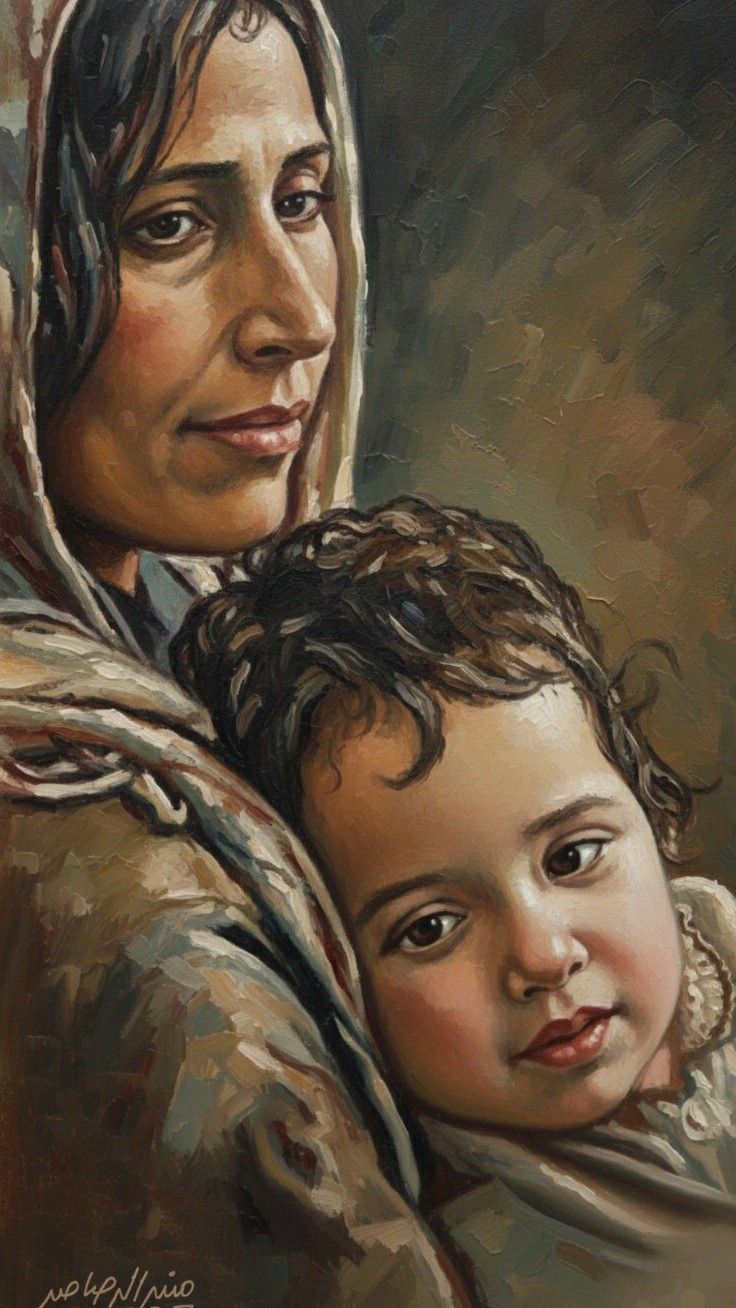
The painting had hung in Dr. Sarah Mitchell’s office for eleven years before she finally asked where it came from.
It arrived the morning after her worst shift — the night three patients died before sunrise, the night she sat in the hospital parking garage for forty minutes, unable to make herself drive home. Her colleague James had found it leaning against her office door, no note, no explanation. Just a woman and a child, rendered in oils, their eyes carrying something Sarah couldn’t name but immediately recognized.
She assumed it was a gift from the hospital foundation. She never questioned it. Some things arrive at exactly the right moment, and you learn not to interrogate miracles.
Eleven years later, a patient named Nadia Karimi changed everything.
Nadia was sixty-three, a refugee from Iran who had arrived in Columbus, Ohio seventeen years prior with nothing but a suitcase and a daughter named Leila. She came to Sarah’s office for a routine cardiology follow-up, and the moment she stepped through the door, she stopped breathing.
Not medically. Spiritually.
Her hand flew to her mouth. Her eyes filled instantly, completely, the way eyes do when something long buried suddenly surfaces without warning.
“Where,” Nadia whispered, pointing at the painting, “did you get this?”
Sarah felt the hair rise on her arms. “I was hoping you could tell me.”
Nadia sat down slowly, as if her legs had forgotten their purpose. She stared at the painting for a long time before she spoke. When she did, her English — careful and precise after nearly two decades in America — became something softer, more fragile.
“I painted that,” she said. “In Tehran. In 1986.”
Sarah pulled her chair close. Outside her window, Columbus carried on — traffic signals, food trucks, the ordinary machinery of an American afternoon. Inside the office, time had stopped.
Nadia had been a painter before she was a refugee, before she was a mother, before she was a patient with a mitral valve that concerned cardiologists. In Tehran she had studied at the university, and her professors said she had a gift that came along perhaps once in a generation. She painted people the way other artists painted light — as if the soul were the subject and the face merely its evidence.
In 1986, during the Iran-Iraq War, she painted her neighbor Maryam and Maryam’s two-year-old daughter Soraya. Maryam’s husband had been killed four months earlier. Maryam had nowhere to go and no reason to smile, but she smiled anyway — not for herself, but because Soraya was watching, and mothers do not let their children see the full weight of what they carry.
Nadia painted that smile. She captured the exact grammar of it — the love underneath the exhaustion, the determination underneath the grief.
She gave the painting to Maryam when it was finished. Maryam wept, then laughed, then said it was the most honest portrait she had ever seen of herself.
Six months later, Maryam and Soraya disappeared. The neighborhood said they had fled — west, maybe Turkey, maybe further. Nobody knew. In those years, people vanished like smoke, and you learned not to ask too many questions because questions had a way of making you vanish too.
Nadia never saw the painting again.
She carried Maryam and Soraya with her the way you carry the people you couldn’t save — quietly, constantly, in the part of your chest that never fully relaxes.
Sarah sat with the silence for a moment. Then she asked the question that had been building since Nadia first walked through the door.
“How did it get here?”
Nadia shook her head slowly. “I don’t know.”
But Sarah was already thinking. She was already pulling at the thread.
She had a friend named David Chen who worked for an international refugee resettlement organization based in Washington. She had another friend, Ama Owusu, who catalogued donated artwork for a network of nonprofits across the Midwest. Sarah herself had spent three weeks volunteering in a Turkish clinic in 2008, the year before she came back to Columbus and found the painting waiting outside her door.
Turkey. 2008.
She called David that evening. She described the painting, the Arabic or Farsi signature in the corner, the subject — a mother and child, circa mid-1980s Iranian oil painting, remarkable quality.
David called her back in four hours.
He had found the thread.
In 2007, a woman named Soraya — thirty-one years old, living in Ankara — had donated a painting to a refugee aid organization before emigrating to Canada. She told the intake volunteer that the painting had traveled with her and her mother from Iran to Turkey in 1986, that her mother Maryam had carried it rolled inside a blanket for three hundred miles, that her mother said it was proof — proof that someone had seen them, really seen them, at the moment they needed it most.
Maryam died in Ankara in 2003. Soraya, about to begin a new life in Toronto, decided the painting should keep moving. She wanted it to do for someone else what it had done for her mother — remind them that bearing weight with grace is not weakness. It is the most radical thing a human being can do.
The aid organization passed it to a partner in Istanbul. Istanbul passed it to a clinic. The clinic passed it to a visiting American doctor who was flying home to Columbus, Ohio, and who had mentioned, over dinner one night, that she had a colleague who was burning out and needed something to hold onto.
Sarah sat in her kitchen and cried for a long time.
Then she picked up the phone and called Nadia Karimi.
“I know where it’s been,” she said. “And I think there’s someone you need to call.”
