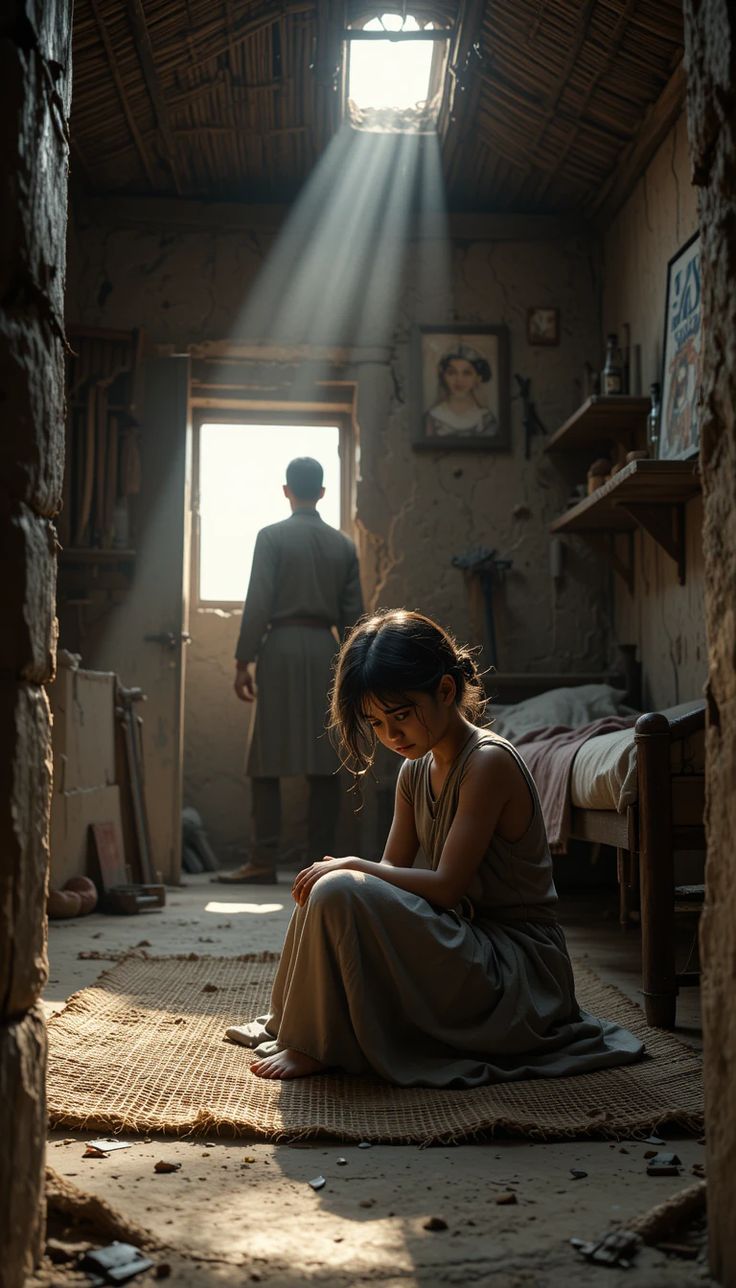
The morning her father left for the last time, Lena counted the rays of sunlight coming through the broken roof.
Seven. There were always seven, depending on where the clouds sat. She had learned to find comfort in that number — the way the beams cut through the dust like something holy, like the world was trying to remind her that beauty still existed in broken places, if you were willing to sit still long enough to see it.
Her father stood in the doorway. He did not turn around.
He had been standing there for three minutes. Lena knew because she had counted those too. She had become very good at counting things she couldn’t control — sunbeams, minutes, the number of times a door opened versus the number of times it stayed open long enough to mean something.
“Papa,” she said.
He didn’t answer. His shoulders moved slightly, the way shoulders move when someone is deciding between two versions of themselves. The version that turns around. The version that walks forward into the light and keeps going.
He chose the light.
The door stayed open after he left, and for a long while Lena just sat on the burlap mat and let the sun fall across her hands and thought about the portrait on the wall.
The portrait had been there longer than Lena could remember. A girl with dark hair and pale skin, painted in a style that belonged to another century, hung slightly crooked above the shelf where her father kept things he claimed to need but never used. She had asked about it once, when she was small enough to believe that fathers answered questions honestly.
“She’s someone who was here before us,” he said.
“Who?”
“Someone who waited,” he said, and then he went outside and didn’t come back until dinner.
Lena had grown up beside that portrait. She had studied the painted girl’s expression the way other children studied textbooks — searching for something instructive, some lesson about how to hold your face when the world was doing its worst. The girl in the portrait had mastered it. There was sadness in her eyes but not defeat. There was patience in the set of her mouth that had nothing passive about it. It was the patience of someone who had made a decision: I will still be here when this is over.
Lena wanted to learn that.
She was seventeen the summer her father left and did not come back. They lived forty miles outside a small city that Americans would not recognize by name, in a house that had been in her family for four generations. The walls were cracked. The roof had a hole that her father had promised to fix for six years. The floor was dirt covered by a rug that was more memory than fabric.
But there was a bed. There was a shelf. There was a portrait of a girl who had waited.
And there was Lena.
For the first week she ate what was left in the cupboards and tried not to think too far ahead. She was good at that — the short view, the immediate moment, the seven sunbeams and the dust they carried. Thinking too far ahead was how you frightened yourself into paralysis. Her mother had taught her that before her mother disappeared into the particular silence that grief sometimes becomes.
On the eighth day, a woman named Mrs. Haddad came from the village. She was sixty, small, and carried food in a cloth bag the way people carry something sacred. She sat beside Lena on the mat and did not immediately speak, which Lena appreciated more than she could say. Most people, when confronted with another person’s pain, fill the silence with words that are really just noise dressed up as comfort. Mrs. Haddad understood that sometimes presence is the whole gift.
“You can’t stay here alone,” Mrs. Haddad finally said.
“I know,” said Lena.
“My son is in America. Minnesota.” She said the word carefully, as if it were fragile. “He has been trying to bring me for two years. The paperwork—” she made a gesture that communicated everything about paperwork that needed to be said. “But he has a colleague. A woman who helps people like us. Like you.”
Lena looked at the portrait on the wall.
“I don’t want to leave her,” she said, and she wasn’t sure if she meant the painted girl or some version of herself she was afraid of losing.
“You won’t,” said Mrs. Haddad. “The things that are truly yours travel with you.”
The process took fourteen months. Lena learned this about paperwork: it is designed to make you prove, over and over again, that your need is real. That your fear is legitimate. That you are worth the bureaucratic effort of being saved. She proved it fourteen times in fourteen different ways and each time something inside her hardened slightly, which she understood was not entirely bad. You needed a certain hardness to survive softness later.
She brought three things when she left: a photograph of her mother, a dress that had belonged to her grandmother, and the portrait.
She wrapped the portrait in the dress and packed the photograph against her heart.
On the plane, somewhere over the Atlantic, she unwrapped a corner of the portrait and looked at the painted girl’s face in the thin airplane light. Still patient. Still waiting. Still holding something in her expression that said: I knew you would make it. I was here so you would know it was possible.
Lena pressed her fingers against the canvas and felt the ridges of paint that someone had laid down with care, with intention, with the belief that a face honestly rendered could outlast everything that surrounded it.
She closed her eyes over the Atlantic and, for the first time in fourteen months, slept without counting anything.
