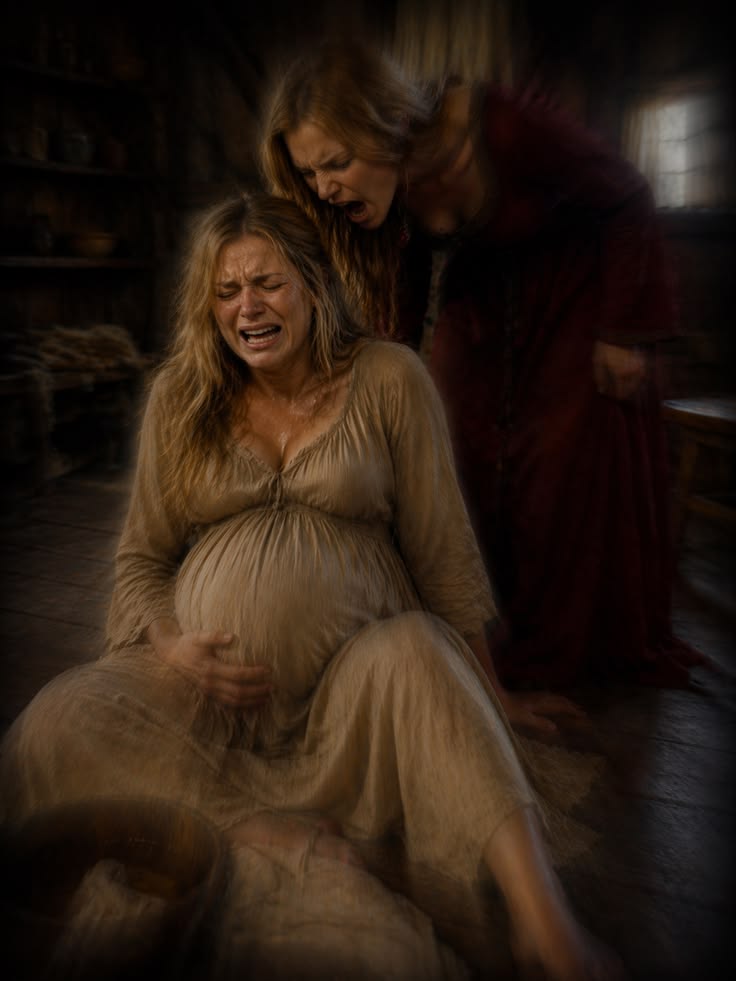
The storm had been building since noon, and by the time Clara’s water broke, the roads were already gone.
Not flooded. Gone. In the hill country of western Tennessee, when the sky decided to settle a score, it did so completely. The creek that ran behind the Aldridge property had crossed the lower field by three o’clock, swallowed the gravel road by four, and by the time Clara’s contractions were four minutes apart, the only thing between their farmhouse and the rest of the world was six inches of moving water and a truck that wouldn’t start in weather like this even when it was new, which it hadn’t been for eleven years.
Clara’s mother-in-law, Ruth, had delivered babies before.
This was the fact they were both holding onto.
“Look at me,” Ruth said, her voice coming out harder than she intended, which was not cruelty but necessity. She had learned long ago that softness had its season and this was not it. “Clara. Look at my face.”
Clara looked. Her eyes were glassy with pain, the particular unfocused terror of a body doing something enormous against a person’s will, and Ruth grabbed her shoulders and said it again, louder this time, because loud was sometimes the only frequency that reached through pain.
“I have done this before. You hear me? I have done this before and I am right here.”
Ruth Aldridge was sixty-one years old and had spent forty of those years on this same property, in this same county, in a life that outsiders sometimes called simple and insiders understood as anything but. She had buried a husband, raised three sons, survived a drought that lasted four years and a flood that took the barn, and she had delivered two babies — her nephew’s twins, born premature on a January night in 1987 when the midwife couldn’t get through and the hospital was forty miles away and the decision had been made by circumstances rather than preparation.
Both boys lived. They were thirty-eight now. One was a plumber in Nashville. The other taught high school biology in Knoxville and had two daughters of his own.
Ruth had never told anyone how frightened she had been that night. She had simply done what needed doing and then gone outside afterward and shook for twenty minutes in the cold before coming back in to hold the babies.
You do the thing first. You feel it later. This was the Aldridge family philosophy, passed down not through words but through demonstration, generation after generation.
She was demonstrating it now.
Clara was twenty-six, a Kentucky girl who had married Ruth’s youngest son, Daniel, three years ago in a ceremony that Ruth had initially approached with the measured skepticism she applied to all change and then abandoned completely when she saw how Daniel looked at this woman. Some things you cannot argue with. The way her son looked at Clara was one of them.
Daniel was in Atlanta. A job — roofing work that had stretched from three days to two weeks, the way work did when the money was real and the family needed it. He had called that morning, before the storm got its teeth in. He had said he’d be home Friday. He had no idea that Friday was going to be three days too late.
Clara had tried to call him when the contractions started. The call dropped after eleven seconds. She tried again. Straight to voicemail.
She was thirty-eight weeks. Early but not dangerously so. The baby had been healthy at every appointment. Dr. Reyes in town had said everything looked perfect and that first babies were usually slow to arrive and that Clara had good hips and nothing to worry about.
Dr. Reyes was also forty miles away on the other side of a creek that had eaten the road.
Ruth had done what she could to prepare the room. Towels, boiled water — she didn’t entirely know why the old instructions always said boiled water, but she wasn’t going to be the one to break with tradition tonight. Clean sheets from the closet. The lamp pulled close because the overhead light had flickered twice already and she didn’t trust the power to hold through the storm.
She had called 911 at 4:47 PM. The dispatcher, a calm woman named Deb who sounded like she had handled worse, told Ruth that emergency services were responding to multiple situations across the county and that help was coming but she could not give a time. She walked Ruth through what to do. Ruth listened carefully, asked two questions, and thanked her.
Then she set the phone face-up on the table where she could see it and got to work.
Clara screamed and Ruth held her, held her the way she had held her own sons through nightmares and fevers and the particular grief of being young in a world that doesn’t warn you about its sharpest edges. She was a grandmother to a child she hadn’t met yet and she was going to be there when that child arrived, no storm, no washed-out road, no absence of anyone or anything was going to change that.
“You’re doing it,” Ruth said, low and fierce. “You’re already doing it.”
“I can’t—”
“You are. Right now. You can’t stop now even if you wanted to.”
Clara made a sound that was beyond language, beyond anything words are built to carry, the sound of a body at the absolute edge of what a body can survive and surviving it anyway.
And then, at 6:22 PM, while the storm threw everything it had against the windows and the lamp flickered once and held, Ruth Aldridge caught her granddaughter with both hands.
The baby cried immediately. Loud and furious and certain.
Ruth laughed. She hadn’t planned to. It came out of her like something that had been stored under pressure for a very long time.
Outside, the rain began, almost gently, to slow.
