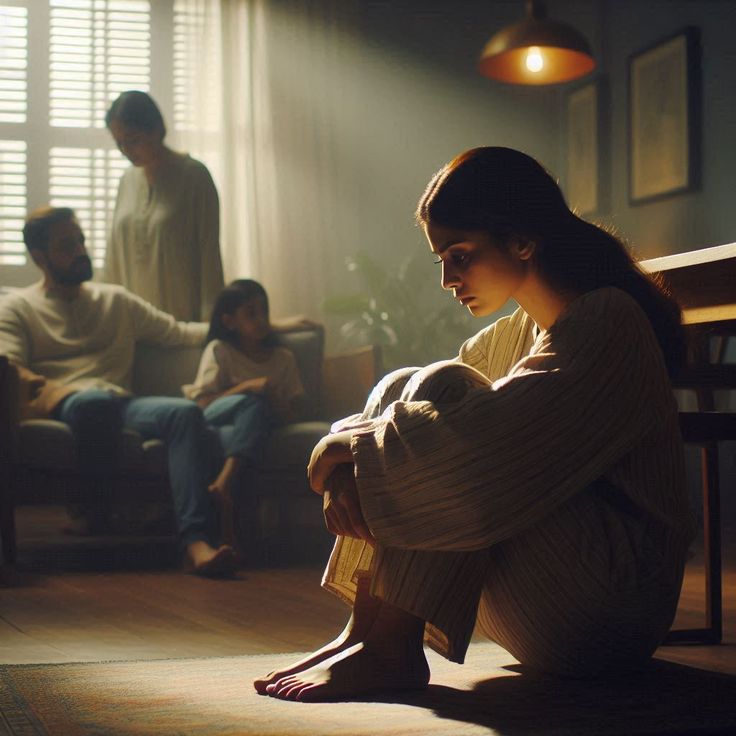
She had been sitting on the floor for forty minutes before anyone noticed.
That was the part that stayed with Maya longest — not the argument, not the words that had been said in the kitchen with the particular precision that people who love each other use when they want to cause maximum damage, but the forty minutes. Her father on the couch, talking to her little sister Priya about something that made Priya laugh. Her mother standing at the window with her arms crossed, doing the thing she did when she was still angry but had decided to perform composure instead. The lamp throwing its warm circle of light across all of them, this picture of a family in a living room on a Tuesday evening in suburban New Jersey.
And Maya on the floor in the corner, knees pulled to her chest, invisible.
Not literally. They could see her if they chose to look. That was the specific cruelty of this particular loneliness — it wasn’t the loneliness of absence. It was the loneliness of presence. Of being in the room, completely in the room, and somehow still entirely alone in it.
She was twenty-four years old and she had moved back home seven months ago and she was beginning to understand that some distances are measured in feet.
The plan had made sense when her therapist in Boston suggested it.
Maya had been working at a marketing firm for two years, grinding through sixty-hour weeks in a city where her rent consumed sixty percent of her salary, eating dinner at her desk, sleeping five hours on good nights, until the morning she sat in the bathroom of her office building for thirty-five minutes because she could not make her legs carry her to her desk. Not wouldn’t. Couldn’t. Her body had simply filed a formal objection and refused to participate further.
Her therapist, Dr. Okonkwo, was a patient woman who had spent eighteen months teaching Maya the difference between pushing through difficulty and ignoring damage. “Going home isn’t failure,” she said. “Rebuilding requires a foundation. Go find yours.”
Maya had taken this advice with the earnest, overachieving sincerity she applied to everything, including breaking down. She had given notice, broken her lease, driven her packed Civic eleven hours south to Cherry Hill, and arrived at her parents’ house on a Sunday in October with a plan that was detailed and reasonable and accounted for almost everything except the actual experience of being twenty-four and sleeping in the room where she had slept at fourteen.
The Sharma house was not an unhappy house. This was important to say because the story of a family that is not unhappy but still manages to make its members feel alone is a harder story to tell, and Maya had spent considerable energy trying to explain it to people who kept waiting for the villain.
There wasn’t one.
Her father, Raj, was a software engineer who expressed love through problem-solving. When Maya told him she had burned out, he researched burnout for three days and presented her with a document of evidence-based recovery strategies. It was thorough. It was thoughtful. It was exactly the kind of help that arrives in the wrong shape.
Her mother, Anita, was a high school English teacher who expressed love through standards, because she believed, genuinely and without malice, that the greatest gift you could give someone was your honest belief in their potential. She did not understand how to turn this off. She did not understand that there are seasons when potential needs to be left alone in the dark, like a seed, and not constantly excavated to check on its progress.
Her sister Priya was eleven and largely innocent of all of it, moving through the house like a small warm current of uncomplicated life, sitting next to their father, making him laugh, needing nothing from Maya except occasional presence, which Maya found she could sometimes provide and sometimes absolutely could not.
The thing about depression — and Maya was being more honest with herself about that word lately, saying it plainly in her head without the qualifications she used to stack around it like sandbags — the thing about it was that it made you a poor narrator of your own experience.
You felt invisible and you could not see that your invisibility was partly constructed. You felt unheard and you could not hear yourself speaking. You sat on the floor forty minutes and told yourself no one cared and could not account for the fact that you had not asked for anything, had given no one the information they would need to reach you, had built your distance so carefully and completely that breaching it required tools no one in this room had been given.
She knew this intellectually. Dr. Okonkwo had explained the architecture of it in terms Maya could understand and even admire from a distance, the way you can admire the engineering of a trap you’re caught in.
Knowing the architecture didn’t give you the exit.
It was Priya who finally crossed the room.
Not her parents. Priya. Eleven years old, still in her school socks, carrying the complete and uncalculating instinct of someone who had not yet learned to be afraid of other people’s pain.
She sat down next to Maya on the floor. She didn’t say anything. She put her head on Maya’s shoulder the way small animals seek warmth — simply, without ceremony, without making it mean too much or too little.
Maya felt something shift. Not break. Not heal. Just move slightly, the way a door moves when someone tests it from the other side.
“You’re cold,” Priya said.
“Yeah,” said Maya.
“I’ll get a blanket.”
She got up and came back with the blanket from the couch and wrapped it around both of them and Maya thought: this. This is the foundation. Not the house. Not the plan. This eleven-year-old in her school socks who just decided that her sister needed a blanket and got one.
It wasn’t everything. But it was the first true thing that had happened in seven months.
