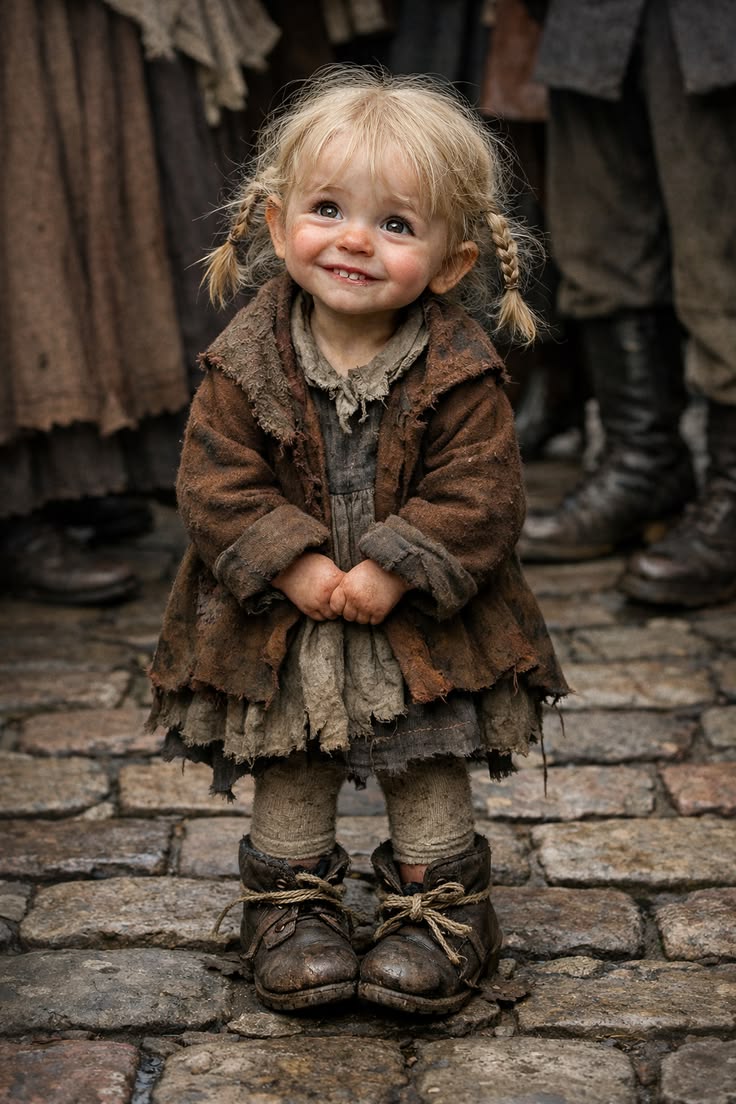
Nobody knew whose child she was.
That was the first problem. The second problem was that nobody could stop looking at her, because she was standing in the middle of the processing yard at Ellis Island on a Tuesday morning in October of 1903, wearing shoes four sizes too large tied on with rope, a coat that had belonged to someone twice her size, and a smile that had absolutely no business existing on a face that had clearly seen what she had seen to get here.
She was perhaps two years old. Perhaps three. Small enough that the shoes swallowed her feet completely, large enough to stand without assistance, which she was doing with a kind of cheerful authority that suggested she had been standing on her own for longer than most children her age were required to.
Her hair was blonde, braided in two small plaits that someone had done carefully, with love, recently enough that they hadn’t fully unraveled. Someone had braided this child’s hair this morning. Someone had tied those shoes with rope so they wouldn’t fall off. Someone had put her in this coat because the October wind off the harbor was cold and the coat, however oversized, was wool.
And then that someone was gone.
Inspector Thomas Carey had worked Ellis Island for nine years. He had seen every variety of human arrival, every texture of hope and desperation that the word immigration could contain. He had processed the fearful and the furious, the sick and the stunned, the ones who wept at the sight of the skyline and the ones who looked at it with the flat eyes of people who had stopped expecting the world to keep its promises.
He had never seen a child standing alone in the yard, smiling like she knew something the adults around her had forgotten.
He crouched down to her level.
“Hello there,” he said.
She looked at him with grey eyes that were startlingly clear, the eyes of someone who had not yet learned to be suspicious of strangers, or who had learned it and decided against it.
“Boots,” she said, and looked down at her feet with evident satisfaction.
Thomas spent the next four hours trying to find where she had come from.
The manifest from the SS Pretoria, arrived that morning from Hamburg, listed no unaccompanied minors. He cross-referenced every family with children, spoke through translators to forty-three adults who had been aboard, described the girl — blonde, grey eyes, two braids, the large shoes, the brown wool coat — to every one of them.
Thirty-nine had never seen her. Three thought perhaps they had glimpsed her on deck, in the company of a woman, but the descriptions of the woman were inconsistent and vague in the way that descriptions become when people are exhausted and frightened and processing their own enormous circumstances.
The fortieth person Thomas spoke to was an older Polish woman named Berta Wozniak who had traveled with her adult son and his wife. Berta looked at Thomas’s description for a long moment, then looked away, then looked back.
“There was a woman,” she said through the interpreter, carefully. “In the lower berth beside mine. Young. Sick, I think, for the whole crossing. She had this child.”
“What happened to the woman?”
Berta was quiet.
“The sea was rough,” she said finally. “The third night.”
Thomas understood. He had heard this kind of sentence before.
He brought the girl to the registry room and found her a corner with a bench and a view of the yard. He gave her a piece of bread from his own lunch, which she accepted with the focused seriousness of a small person who understood the value of food without having been taught to perform gratitude for it. She ate it carefully, holding the shoes out in front of her occasionally to admire them, apparently considering the bread and the boots the twin highlights of an otherwise reasonable morning.
Her name, as best anyone could establish, was Anya. She had said it herself when Thomas asked, pointing at her own chest with one small finger. Anya. Said with the confidence of someone who owned the name completely.
Anya what, nobody knew.
From where, nobody knew.
To whom, nobody knew.
The rules were clear. Unaccompanied minors with no established contacts in the country were to be held in the registry until next of kin could be identified or, failing that, transferred to the care of the Children’s Aid Society. Thomas had followed this protocol before. It was the right protocol. It existed for good reasons.
He filled out the paperwork. He did it slowly, which was unlike him.
At four in the afternoon, a woman named Agnes Carey arrived at Ellis Island — his wife, who came on Tuesdays to bring him dinner and who had, over nine years, developed the habit of walking through the registry with him because she said it reminded her of what mattered.
Agnes found the child before Thomas could explain anything.
She simply walked through the door of the side room where Anya had been placed with two other children awaiting processing, and stopped. Anya looked up at her from the floor where she was attempting, with great seriousness, to retie the rope on her left shoe.
Agnes sat down on the floor in her good Tuesday dress and helped tie the shoe.
When she looked up at Thomas, her expression told him everything, the way married people communicate entire arguments and decisions and lifetimes in a single look.
He had three more forms to file before the end of his shift.
He filed them slowly, wondering, as his pen moved across the paper, whether the law was always the same thing as the answer, and whether a woman who braided her daughter’s hair on the last morning of her life had done so in the hope that someone on the other side of the ocean would see the care in those braids and understand what they were being asked to do.
