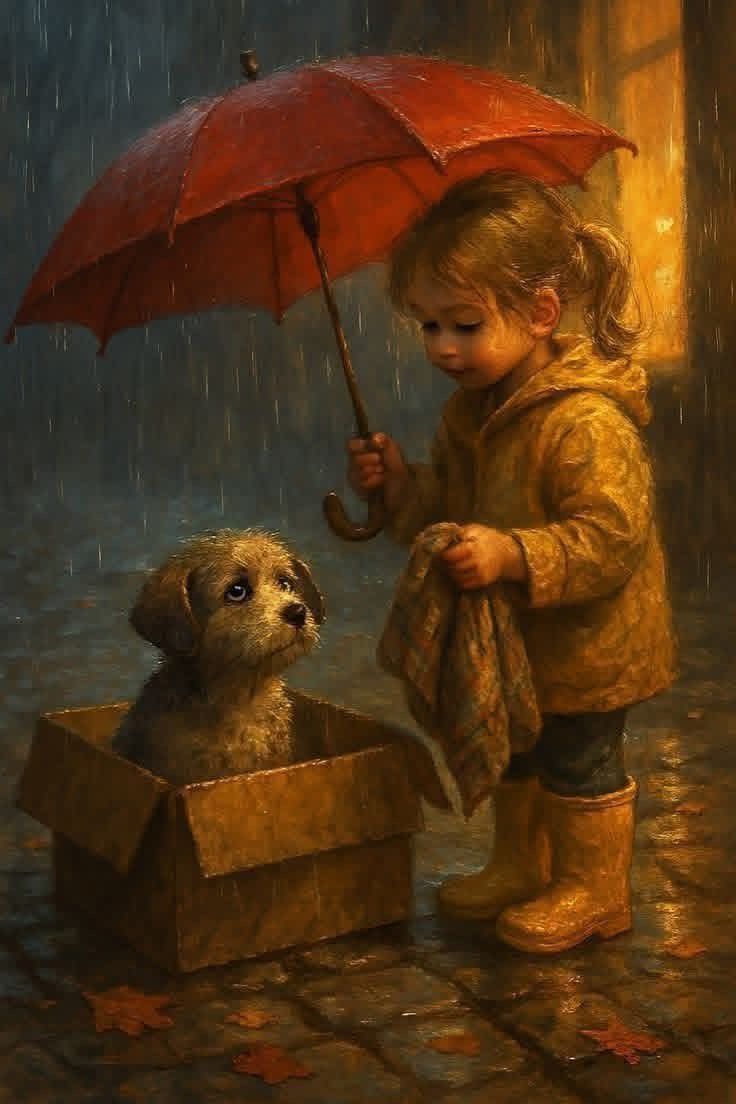
Ellie was four years old and she understood three important things about rain.
First, rain was cold. Second, rain made puddles that were excellent for jumping. Third, and most importantly, rain was something that happened to you whether you wanted it to or not, which meant the only real question was what you did while it was happening.
She was considering this third point very seriously on the Tuesday afternoon her mother sent her to wait on the front stoop while she locked up the apartment, when Ellie looked down at the sidewalk and found the box.
It was a cardboard box, the kind that things important enough to be shipped in boxes came in, sitting directly in the path of the rain with the particular helplessness of something that had not chosen to be where it was. The box was getting wet. Ellie could see this clearly. She could also see, after she took three careful steps down the stoop and leaned forward to investigate, that the box was not empty.
The dog inside it was approximately the size of a shoebox himself, which made the situation feel cosmically appropriate to Ellie in a way she could not have articulated but felt completely. He was the color of wet sand. His ears were the color of slightly darker wet sand. He had one blue eye and one brown eye and both of them were looking up at her with an expression that Ellie recognized immediately because she had made it herself on numerous occasions.
It was the face of someone who needed help and was not entirely sure help was coming.
Ellie looked at the dog. She looked at her red umbrella. She performed the calculation that four-year-olds perform when they encounter a problem — not the complicated adult calculation full of variables and consequences and what-will-people-think, but the clean, simple, four-year-old calculation that runs: here is a problem, here is what I have, these two things should meet each other.
She extended the red umbrella over the box.
Her mother, Karen, came through the front door forty seconds later, digging in her purse for her keys, already composing the mental list of errands that stood between this moment and dinner. She was a second-grade teacher and a single mother and she operated on a schedule that had approximately zero room in it for deviation, which was a thing she had accepted about her life with the pragmatic grace of someone who had learned that acceptance was more efficient than resistance.
She looked up and found her daughter standing in the rain, arm fully extended, holding a red umbrella over a cardboard box, already soaked from the shoulder down because the umbrella was covering the box and not Ellie.
“Eleanor Marie,” Karen said.
Ellie looked up. The expression on her face was one Karen knew well — the particular combination of certainty and preemptive apology that meant her daughter had already made a decision and was now simply waiting to find out what it was going to cost her.
“There’s a dog,” Ellie said.
Karen looked in the box. The dog looked back at Karen with his mismatched eyes and made a sound that fell somewhere between a whimper and a greeting, as if he understood that she was the relevant decision-maker and wanted to make a good first impression.
Karen was a practical woman. She was also a woman who had grown up with dogs, who had wanted a dog for three years but told herself the apartment was too small, the schedule too full, the timing too impractical. She had a list of responsible reasons why a dog was not currently possible.
She looked at her daughter, standing in the rain, arm aching, umbrella held perfectly steady over a box that contained one wet and hopeful animal.
The list became suddenly difficult to locate.
They named him Boots, because of Ellie’s rain boots, and because Ellie declared on the walk home — the dog wrapped in Karen’s cardigan, Ellie restored to the protection of the red umbrella — that he needed a name that understood rain.
Karen spent that evening doing the things responsible adults do when they have accidentally acquired a dog: she called the vet, she posted on the neighborhood Facebook group asking if anyone had lost him, she researched whether her lease technically permitted pets. She found a vet who could see them Thursday. She got seventeen responses to the Facebook post, none of which were from anyone claiming ownership. Her lease had a clause that was ambiguous enough to be optimistic about.
She also spent a portion of that evening sitting on the kitchen floor watching her daughter and this dog look at each other with the mutual recognition of two creatures who had been waiting, without knowing it, for exactly this specific other creature.
Boots had stopped shaking. He was curled against Ellie’s yellow raincoat, which she had refused to take off because Boots seemed to find it comforting, and Ellie was telling him, in a low and serious voice, about the important things. The puddles. The umbrella. The way rain was something that happened whether you wanted it to or not.
The dog listened with his mismatched eyes half-closed and the specific attentiveness of an animal who has found his person and intends to pay close attention to everything she says for the rest of his life.
Karen watched them and thought about the forty seconds between sending Ellie to the stoop and walking through the door herself. Forty seconds in which her four-year-old had surveyed a problem, assessed her resources, and made a decision so purely and correctly generous that it had rerouted both their lives without a moment’s hesitation.
She thought about how children do this — move toward need without calculation, extend what they have without first asking whether they can afford it.
She thought she might try to do that more often.
She took a picture of Ellie and Boots on the kitchen floor. In the photo, Ellie still had the red umbrella in her hand, as if she wasn’t quite ready to put it down yet.
Karen made it her phone wallpaper and kept it there for eleven years.
