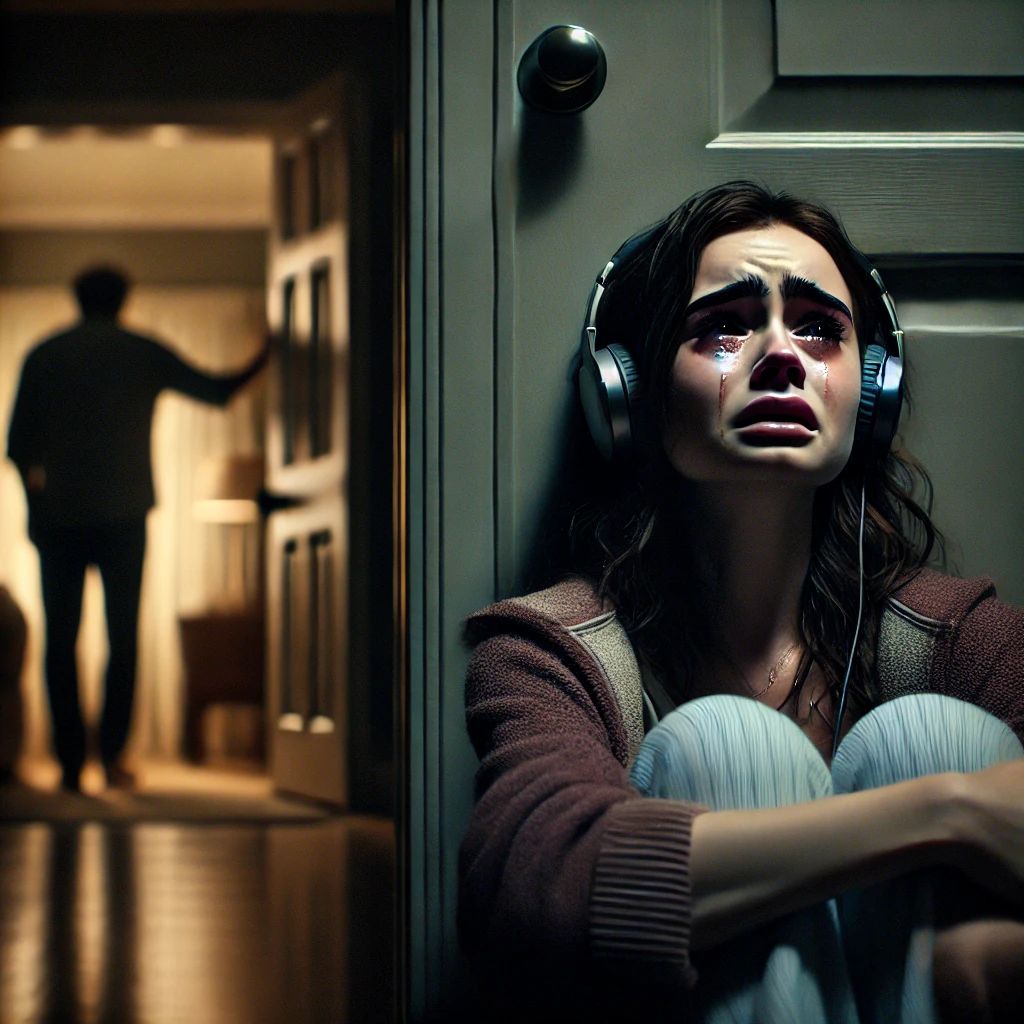
She had learned to turn the music up before the fighting started.
It wasn’t a conscious strategy at first. It began the way most survival mechanisms begin — accidentally, through repetition, until the body memorizes what the mind hasn’t fully processed yet. The first time, she was thirteen, doing homework with headphones on when her parents’ voices in the kitchen climbed past the threshold she didn’t yet have a name for. The music covered it. She turned it louder. The music covered it more. Something in her nervous system filed this information under solutions and never let go.
Now she was nineteen and she was sitting with her back against her bedroom door, headphones on, music at a volume that her audiologist would have opinions about, and she was crying the way she had learned to cry — quietly, efficiently, without the kind of sound that carried through walls and required other people to respond to it.
Through the door, through the headphones, through the music, she could still feel it. Not hear it exactly. Feel it. The way you feel bass through a floor. The way argument has a frequency that bypasses the ears entirely and goes straight to somewhere older and deeper, some prehistoric part of the brain that existed before language and recognizes danger in vibration alone.
Her name was Simone. The man walking away down the hallway was her father. And she was running out of music loud enough.
The apartment was in Columbus, Ohio, third floor, the kind of building that had been nice once and was now merely adequate in the way that things maintained on a tight budget are adequate — functional, clean enough, carrying the faint weariness of a place that has absorbed too many lives without ever being properly renewed.
Her parents had moved here four years ago from Detroit, following her father’s job, which had followed the particular logic of jobs that require people to uproot themselves and call it opportunity. Her mother, Diana, had left her sister, her book club, her garden, and twenty-two years of accumulated neighborhood knowledge to come to a city where she knew no one. Her father, Marcus, had left a promotion he didn’t get, a best friend who had stopped speaking to him over a debt, and a version of himself he’d been trying to outrun for a decade.
They had brought all of it with them. This was the thing about moving — you pack the boxes and load the truck and drive eight hours and unload everything into new rooms, and then you stand in the kitchen of the new place and realize that you have arranged all the same furniture in a different configuration and the problems you were escaping are sitting on the couch looking at you.
Simone had understood this at fifteen. She was not sure her parents understood it yet.
The music she chose on nights like this was always the same. Not sad music — sad music was for grief you could name and process and eventually set down. What she needed on these nights was music that was larger than the room, larger than the apartment, larger than the situation. Music that said: there is a world outside this door that is so much bigger than what is happening right now, and you are going to live in that world eventually, and this is not the whole of what your life will be.
She had a playlist. She had built it over six years with the care that other people built other things — careers, relationships, savings accounts. Song by song, chosen for their specific gravity, their ability to expand the ceiling of whatever space she was sitting in.
Tonight she was on the fourth song. Usually she was okay by the third.
She pressed the back of her head against the door and looked up at the ceiling and breathed the way her school counselor, Mrs. Alvarez, had taught her — four counts in, hold for four, out for four. A square of breath. A small geometry of calm.
Mrs. Alvarez had said: you cannot fix what is happening between your parents. You can only manage how it lands on you.
Simone had appreciated the honesty of this. She was tired of adults who told her things would get better without telling her what to do while they were still bad.
The hallway went quiet.
This was sometimes worse than the noise — the silence that followed, which had its own texture, its own weight, the silence of two people who have said the damaging things and are now separately carrying the damage to separate rooms.
She heard the front door. Open. Close.
Her father’s footsteps down the hall had that particular quality she had memorized — the deliberate heaviness of a man who wants to be heard leaving. It was a different sound from the sound of a man who simply leaves. She had learned to tell them apart.
She took the headphones off.
The apartment was quiet now in the way apartments are quiet when one person has left and another is somewhere inside it, not moving. Simone sat with the silence for a moment, and then she did the thing she always did after — she got up, straightened her clothes, walked to the kitchen, and put the kettle on.
Her mother was in the living room. Diana was fifty-one and had the face of someone who had been beautiful in a way that worry had not erased but simply translated into something more complicated. She was sitting in the armchair by the window, not looking at anything, doing the particular stillness of someone who has just finished something exhausting and hasn’t yet decided what comes next.
Simone brought her tea. She sat on the couch. She didn’t say anything, because there was nothing to say that either of them didn’t already know.
Diana looked at the tea. Then at her daughter.
“I’m sorry,” she said.
“I know,” said Simone.
They sat together in the quiet apartment and drank their tea and outside Columbus carried on its ordinary evening, indifferent and vast and full of other people’s ordinary problems, which was somehow, in this moment, exactly the right thing for it to be doing.
