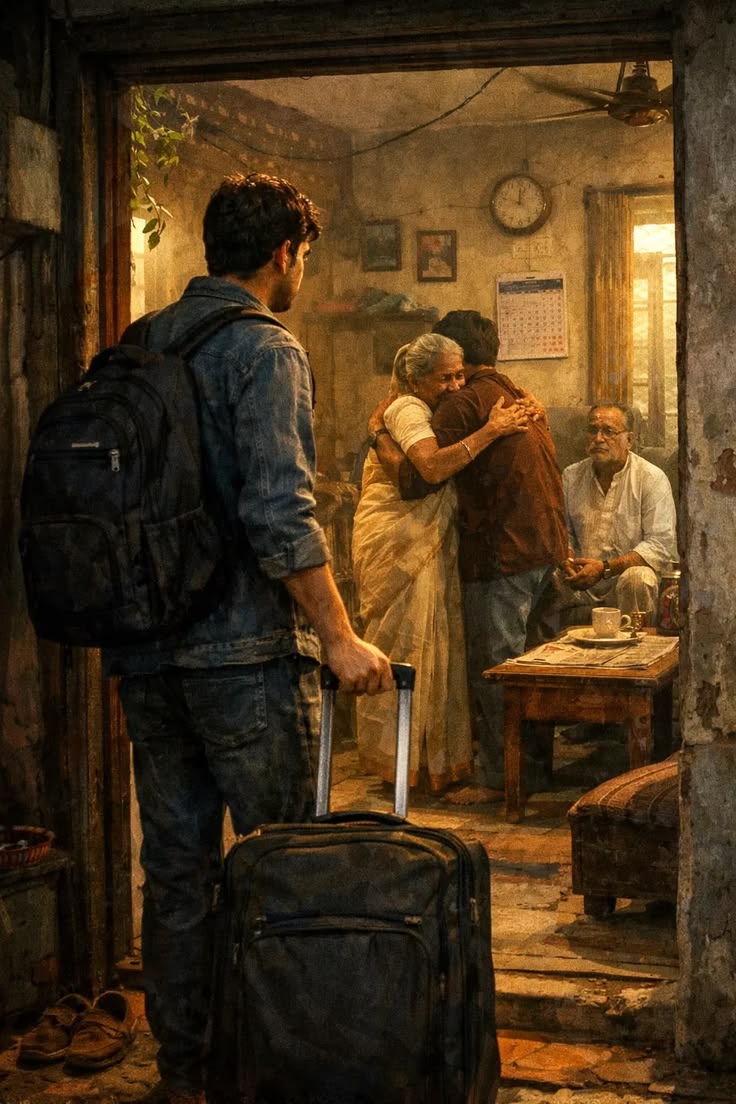
He had rehearsed this moment for eight years.
Not obsessively. Not every day. But in the quiet pockets of his American life — on the subway in Chicago, waiting for coffee to brew in his apartment on Damen Avenue, in the particular loneliness of Sunday mornings when the city was still sleeping and the distance between where he was and where he came from felt most measurable — Arjun had played this scene in his mind and tried to prepare himself for what it would feel like to stand in this doorway again.
He had not prepared himself correctly.
The room was exactly the same. This was the first thing that broke him, quietly, in a way that didn’t show on his face. The clock on the wall, the one with the crack in the plastic casing that his father had been meaning to replace since 2009. The calendar from the local bank, always two months behind because nobody in this house tracked time by calendars. The ceiling fan that wobbled on its axis every third rotation, a rhythm he had slept to for eighteen years without ever consciously noting it until the first night in Chicago when the silence of an unmoving ceiling felt wrong in a way he couldn’t explain to his roommate.
The room was exactly the same and he had changed entirely and somehow he had not accounted for how those two facts would exist simultaneously in his chest.
His mother hadn’t seen him yet.
She was embracing his brother Vikram, who had arrived twenty minutes earlier and who had apparently said something that made her laugh and cry at the same time, which was a thing their mother did that neither of them had inherited and both of them had spent their entire lives moved by. Her arms were around Vikram’s back, her face pressed to his shoulder, and she was holding him with the specific intensity of a woman who has released people into the world and lives every ordinary day with the knowledge that the world does not always return them.
His father sat at the small table with his tea, watching this reunion with the expression he always wore at moments of emotion — not cold, never cold, but contained, the face of a man who felt things at a depth that made surface expression seem insufficient and had therefore mostly abandoned it. He was thinner than the last video call. Arjun noticed this with the particular attention of a son who has learned to inventory his parents’ aging across the pixelated inadequacy of a phone screen.
His father saw him first.
He didn’t call out. He simply looked, and in the looking was everything — the eight years, the distance, the phone calls that ended with silences too full to be comfortable, the things said and unsaid and said wrong and never corrected. His father looked at him from across the small room that smelled of chai and incense and the particular dust of a city that never fully slept, and his expression did something that Arjun had never seen it do before.
It let go of something.
Arjun had left for Chicago with a scholarship, a single suitcase, and the absolute certainty that he was doing the right thing. He was twenty-two. He had worked for this scholarship with the focused intensity that children of sacrifice develop early — the understanding, absorbed without being spoken, that the opportunities laid before you are not really for you alone, that they carry the weight of everything your parents didn’t get to do, and that you are therefore obligated to be worth that weight.
He had been worth it by every measurable standard. The degree from Northwestern. The job at the consulting firm downtown. The apartment he now shared with no one, because he could afford not to share it, which his twenty-two-year-old self had imagined as a form of freedom and his thirty-year-old self understood as a form of silence.
He sent money home every month. He called every Sunday. He made the video calls longer at Diwali and his parents’ birthdays and the anniversary of his grandmother’s death, which his mother observed with a quiet ritual that he participated in from six thousand miles away via a phone propped against a coffee mug.
He had been a good son by long distance. He had spent eight years being as present as absence allows.
But standing in this doorway with his suitcase in his hand, watching his mother hold his brother, watching his father’s face release something it had been holding for eight years, Arjun understood the difference between being present by long distance and being present.
The difference was not philosophical. It was physical. It was this room, this smell, this wobbling ceiling fan.
It was the fact that his mother’s hair was fully grey now and he had watched it happen in increments on a phone screen and had told himself that was the same as witnessing it.
It was not.
His mother turned.
He would not be able to describe afterward exactly what happened in her face when she saw him. Language was not built for it. It was the expression of a woman who has been quietly afraid for eight years and has just been given permission to stop, which is not the same as happiness, not entirely — it is something bigger and more complicated than happiness, something that has grief folded inside it because you cannot feel the full relief of someone’s return without also feeling the full weight of their absence.
She crossed the room in four steps and Arjun dropped the suitcase handle and she held him the way she had held him at seven years old during the blackouts when the whole neighborhood went dark and she sat with him until the lights came back, not saying everything will be fine, just holding him until it was.
He stood in the doorway of his childhood and let himself be held.
Behind him, Chicago. Ahead of him, everything he had been homesick for without knowing the full word for what he was missing.
His father picked up his tea. His brother caught his eye over their mother’s shoulder and nodded once — the nod that meant: I know. Me too. Welcome back.
The ceiling fan wobbled on its third rotation.
Arjun was home.
