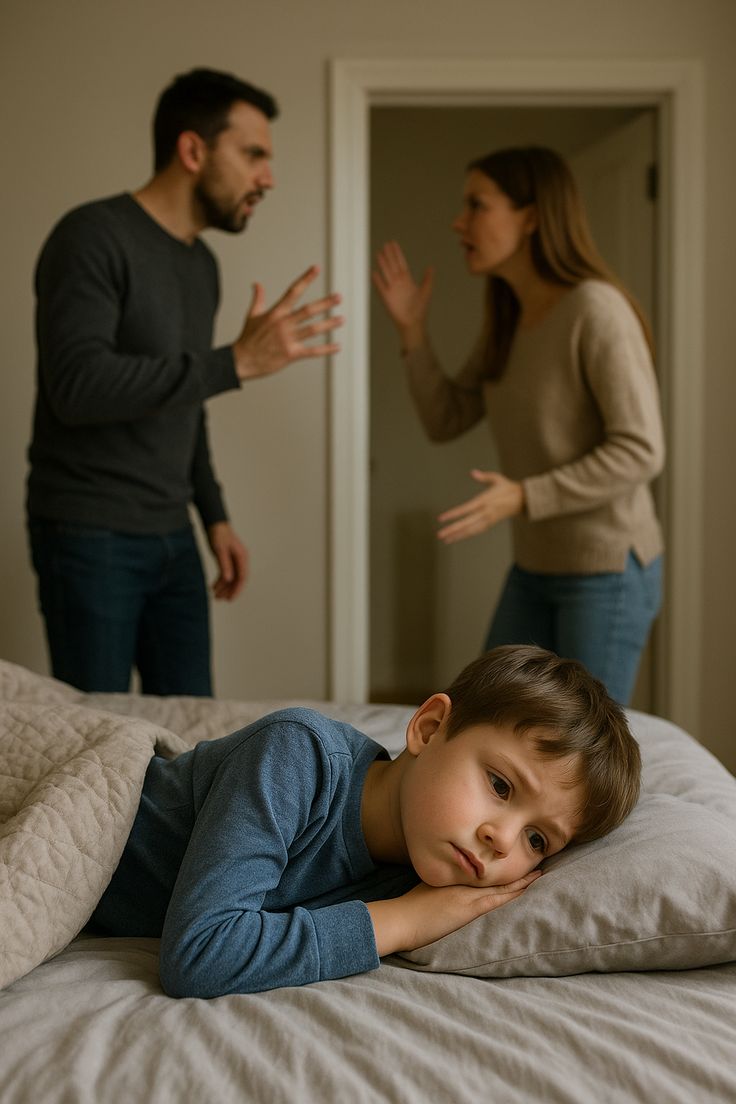
Noah had learned to count the arguments by the pauses between them. There was always a pause before his dad’s voice dropped low and sharp, the way it did right before the really bad words came. And there was always a pause after, like both of them needed a moment to decide if they were finished or just reloading.
He lay on his bed with his cheek pressed against the pillow and stared at the wall. If he focused on the small crack running from the window frame toward the ceiling, the kind of crack that had been there so long it felt like part of the house, he could almost make the voices blur into something that sounded less like his parents and more like weather. Just noise. Just something happening outside of him.
It didn’t really work. It never really worked. But he kept trying.
He was eight years old. He had been trying for about two of those years.
“You never listen to me, Daniel. You never have.” His mother’s voice carried through the wall the way it always did, clear and strained, like a wire pulled too tight.
“I listen. I just don’t agree. Those are two different things, Renee.”
“Don’t do that. Don’t use that voice like I’m being unreasonable.”
“I’m not using a voice.”
“You’re using the voice right now.”
Noah pulled the pillow over his head. Under there it was dark and warm and it smelled like the fabric softener his mom used, the lavender kind. He breathed it in slowly. His teacher, Mrs. Carmichael, had taught them a breathing exercise at the beginning of the year, something about breathing in for four counts and out for four counts when you felt nervous. He used it a lot at home now. More than he ever used it at school.
Four in. Four out.
He thought about his friend Tyler’s house. He had slept over there last month for Tyler’s birthday, and the thing that struck him most wasn’t the big television in the basement or the fact that Tyler’s dad made homemade pizza from scratch. It was the quiet. Not silence, because there was plenty of noise, laughing and the game on TV and Tyler’s little sister singing something to herself in the other room. But it was a different kind of noise. It was noise that didn’t make your body go stiff. Noise that didn’t make you wait for what came next.
Noah had lain in the sleeping bag on Tyler’s floor that night and thought, so this is what a house feels like when it isn’t angry. He hadn’t known how to hold that thought without it hurting, so he had let it go and gone to sleep.
Downstairs, something shifted. The voices got louder for a moment and then, suddenly, went quiet. The quiet was almost worse than the arguing. With the arguing, at least he knew where everyone was and what was happening. The quiet meant he didn’t know anything.
He heard footsteps on the stairs. He recognized them as his mother’s before she even reached the top. She had a way of climbing stairs that was different when she was upset, slower, heavier. He pulled the pillow off his head and sat up, arranging his face into the expression he had practiced, the one that looked like he hadn’t heard anything, the one designed to protect her from knowing that he had.
She pushed the door open and leaned against the frame. She had been crying, he could see that, but she had also tried to fix it, the way she always did, pressing under her eyes with her fingertips and taking a few deep breaths before she came to find him. She thought he didn’t notice this either. He noticed everything.
“Hey, buddy,” she said. Her voice was soft and careful.
“Hey, Mom.”
She came and sat on the edge of his bed. She looked at him for a moment in that way she had, like she was searching for something and hoping not to find it. “You doing okay?”
“Yeah,” he said. “I was just resting.”
She put her hand on his back and rubbed a slow circle between his shoulder blades. He let himself lean into it slightly, just slightly, the way you lean toward warmth without wanting to admit you were cold.
“I’m sorry if we were loud,” she said.
He shrugged. “It’s okay.”
It was the thing they did. She apologized without explaining, and he forgave without asking, and neither of them said the real thing, which was that this had been happening for two years and that Noah had stopped believing it was a phase and started believing it was just what his family was. A thing that argued. A thing that hurt. A thing that stayed together in a way that sometimes felt less like love and more like habit.
He didn’t blame them. That was the part that confused him most when he thought about it late at night. He had tried blaming them and it hadn’t felt right. They were his parents. They had taught him to ride a bike and stayed up with him when he had the flu and read to him so many nights that certain books felt like their voices lived inside the pages. They were good people. He knew that. But good people could do things that broke the air in a house, and broken air was something a kid had to breathe regardless.
His dad appeared in the doorway a few minutes later. He looked tired. He always looked tired now. He leaned against the frame the same way his mom had, and the three of them sat together in Noah’s small room while the evening light went gray against the curtains.
Nobody said anything for a while. But they were together. And sometimes, Noah had decided, together was the only word that mattered. Even when together was complicated. Even when together was bruised.
He just wished it didn’t have to be.
