The argument started over a credit card bill.
That’s the thing nobody tells you about the end of a marriage — it rarely begins with the real thing. It begins with a number on a statement, a tone of voice, a dish left in the sink one too many times. The real thing, the actual wound underneath, is too large and too old to approach directly. So people circle it. They argue about money and schedules and who forgot to call the insurance company, and what they’re really saying, underneath all of it, is: I am not seen. I am not enough. I am so tired of pretending this is fine.
Kyle Mercer had been pretending for two years.
So had Amanda.
They had gotten very good at it — the kind of good that fools neighbors and in-laws and the couples they had dinner with twice a month who always said, on the drive home, “They seem so solid.” They had built a life that looked, from the outside, exactly like what a life was supposed to look like: the four-bedroom house in suburban Columbus, Ohio, the two cars, the carefully curated family photos on the wall going back eight years, smiles so consistent you could set a clock by them.
What the photos didn’t show was the silence that had moved in like a slow fog. The separate phones, the separate evenings, the way two people can share a bed and still be completely, utterly alone.
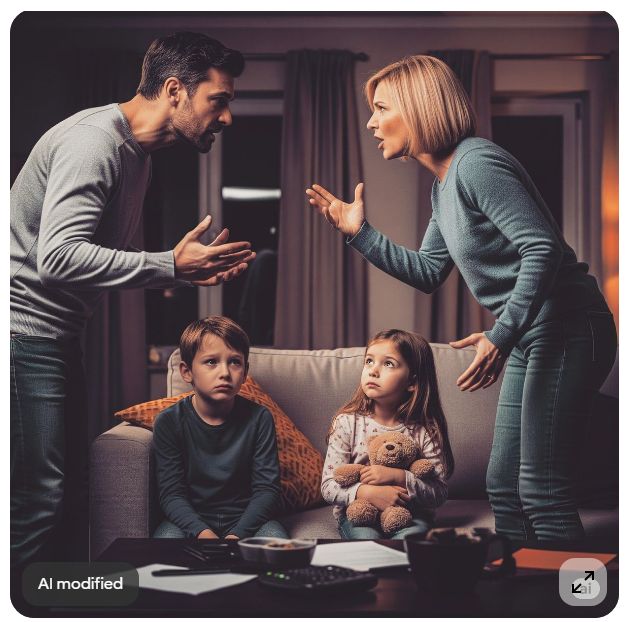
Caleb was nine. He sat on the left side of the couch, the side nearest the door, which he had chosen without knowing why — though if you asked a child psychologist, they would tell you that children in volatile homes often unconsciously position themselves near exits. He had his father’s dark hair and his mother’s eyes and an expression on his face that was working very hard to show nothing at all.
He had learned to show nothing at all at around age seven. It was a kind of armor. If you don’t react, sometimes they stop. Or at least they stop looking at you.
Lily was six. She sat on the right side of the couch with her teddy bear — the brown one with the worn left ear that she had slept with every night of her life — pressed hard against her chest. She was looking up at her parents the way children look at thunderstorms: frightened, fascinated, helpless, desperate to understand what she had done to cause the weather.
She had not done anything. Children never do. But they always, always believe they have.
“You spent four hundred dollars on what, Amanda? Tell me. I want to hear you say it.”
“It was for the kids’ activities, Kyle. The same activities you agreed to in August, or did you forget that conversation too?”
“I didn’t forget anything. What I remember is agreeing to one activity each, not —”
“One activity each? Caleb’s in soccer and coding club, Lily’s in dance, those aren’t optional, those are —”
“Everything is optional when we have twelve thousand dollars on a card that was supposed to be paid off by March —”
“And whose fault is that? Whose bonus didn’t come through? Who told me we were fine in January when we were clearly —”
The words came faster now, overlapping, each one a lit match thrown into a room already full of smoke. Kyle’s hands moved when he argued — sharp, chopping gestures, the body language of a man making points in a meeting. Amanda’s voice climbed in pitch but never volume, which was somehow worse, a cold precision to it, surgical.
Between them, on the coffee table: a calculator, bank statements, a pizza box from dinner that no one had finished, and a permission slip for Lily’s spring recital that needed a signature and twelve dollars.
The small, ordinary wreckage of a life in the process of breaking.
Caleb looked at his sister.
This was something he did automatically now — checked on Lily the way a soldier checks on the person next to them. She was squeezing the bear so tightly that the worn left ear had folded completely over. Her lower lip was doing the thing it did before she cried, that small almost invisible trembling.
He slid across the couch cushion until he was beside her. He didn’t say anything. He put his arm around her the way their dad used to put his arm around their mom, on the good evenings, the ones that felt like a different family entirely.
Lily leaned into him. She didn’t cry. Not yet.
Above them, the argument continued. The words were starting to change now — moving away from the credit card, toward older injuries, the ones that had been waiting in the dark for exactly this kind of door to open.
Caleb pulled Lily slightly closer.
He looked up at his parents once — just once, with the eyes of a boy who is nine years old and already learning, too early, that the people you love most can also be the source of your deepest fear — and then he looked away. He stared at the fireplace across the room. It wasn’t lit. It hadn’t been lit all winter.
He tried to remember the last time it had been lit. The last time they had all sat in front of it with hot chocolate, the four of them, easy and warm and unhurried.
He couldn’t place it. It felt like a very long time ago.
He held his sister and counted the bricks in the fireplace and waited for the storm to pass.
It was Lily who ended it.
Not with words. She was six. What she did was simpler and more devastating than any word either of her parents had thrown across the room that evening.
She began, very quietly, to sing.
