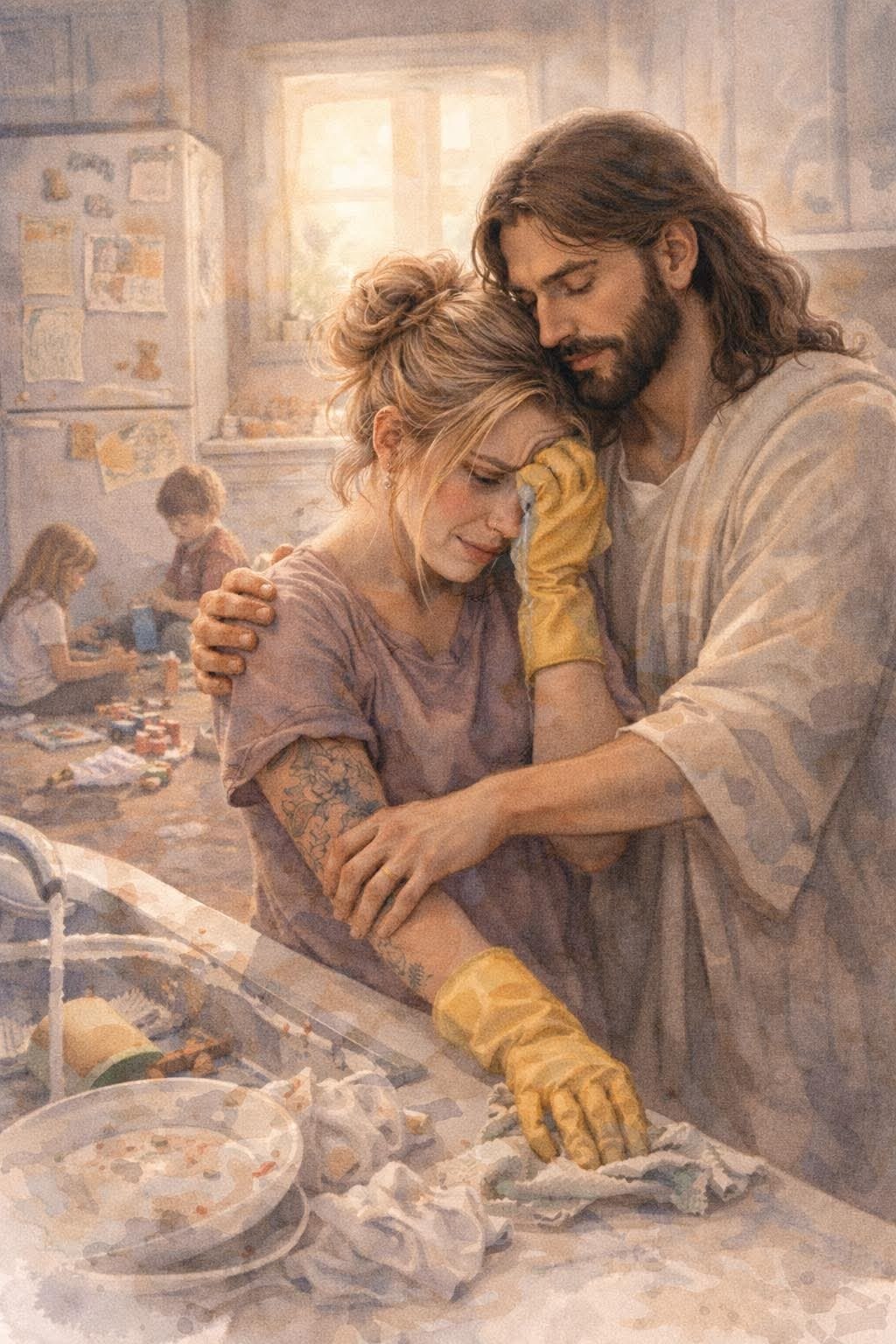
The dishes had been in the sink since morning.
That was the thing that broke her — not the big things, not the overdue electric bill on the counter or the voicemail from her mother she hadn’t returned in eleven days or the way her daughter had cried at school drop-off again and clung to her leg in a way that made leaving feel like a small violence every single morning. It wasn’t any of those things individually. It was the dishes.
Haley Brennan, thirty-four years old, standing at the kitchen sink in rubber gloves that had turned yellow from use, looked at the stack of cereal bowls and dinner plates and two mugs with dried coffee rings inside them and felt the full weight of her life press down on her shoulders like something physical. Like weather. Like a hand.
She had been holding it together for so long that she had forgotten what it felt like not to hold it.
Three years ago, her life had a different shape.
Marcus had been in it then — not a perfect man, not a storybook man, but hers, specifically and particularly hers, in the way that matters most. He had made bad coffee and excellent pancakes. He had sung off-key in the shower every single morning without embarrassment. He had known, without being told, when she needed the lights low and the television off and just someone sitting near her in the quiet.
The accident had been on a Tuesday in February, which seemed wrong somehow — February was supposed to be reserved for loss, but Tuesday felt too ordinary, too much like a day that should have contained nothing more dramatic than a work meeting and a grocery run.
It had contained something else entirely.
Now it was just Haley. Haley and Emma, who was five and had her father’s eyes and her father’s habit of tilting her head when she was thinking hard about something, a gesture so precise and so Marcus that it sometimes stopped Haley’s breath mid-sentence.
The water was running. She hadn’t turned it on with any intention — her hands had done it automatically, the body going through motions the mind had stopped supervising. The warm water ran over the yellow gloves and she picked up the first bowl and began to scrub and somewhere between the first bowl and the second something in her chest gave way like a seam that had been holding under too much pressure for too long.
She didn’t sob. It wasn’t that kind of crying. It was the quiet kind, the kind that happens in the middle of ordinary tasks — at sinks, in shower stalls, in parked cars in grocery store parking lots — the kind that doesn’t announce itself because it has nowhere dramatic to go. Tears ran down her face and dropped into the dishwater and she kept scrubbing because the children don’t stop needing things just because you are breaking, and the world does not pause its requirements just because you have run out of the resources to meet them.
Behind her, Emma sat on the kitchen floor building something with colored blocks, narrating the construction quietly to herself in the way five-year-olds do — a running commentary on a world entirely of her own making, safe and coherent and hers.
Haley listened to it and cried silently and scrubbed a plate that was already clean.
She felt it before she understood it.
A warmth. Not the water — different from the water, coming from behind her, an encircling warmth that moved around her shoulders the way an embrace moves, deliberate and specific and directed entirely at her. She felt it settle around her like something she had been cold without and hadn’t known until the cold was gone.
She stopped scrubbing.
The kitchen was the same kitchen. The dishes were the same dishes. Emma was still building her tower behind her, still narrating. The electric bill was still on the counter. The voicemail was still unreturned.
Nothing had changed. Everything felt different.
There are moments — rare, unscheduled, arriving without announcement — when the membrane between the seen and the unseen becomes briefly thin. When something beyond the ordinary logic of cause and effect makes itself quietly, undeniably known. Not in thunder. Not in spectacle. In warmth, at a kitchen sink, on a Tuesday afternoon, while a woman in yellow rubber gloves washes dishes and tries not to fall apart.
Haley had grown up in the church. She had drifted from it in her twenties — not in anger, just in the way young people drift from things, carried by current. She had prayed at Marcus’s funeral with a desperation that felt more like drowning than faith. She had stopped praying after, because the silence on the other side had felt, at the time, like confirmation of everything she feared.
But this was not silence.
This was — she had no better word for it — presence. The specific, unhurried presence of someone who had been there all along, who had watched her hold it together and hold it together and hold it together, and who was here now, precisely here, in the most unglamorous possible moment, to say without words what words always fail to fully carry:
I see you. Not the version you show. You — the real one, the tired one, the one standing at the sink at 4 p.m. in yellow gloves, holding more than any person should have to hold alone. I see her. And I have not looked away. Not once. Not for a single ordinary Tuesday of your life.
She stood at the sink and let herself be held by something she couldn’t explain and didn’t try to.
After a while, Emma padded over in her socks and wrapped both arms around Haley’s leg and pressed her face against her mother’s hip and said nothing — just held on.
Haley put one yellow-gloved hand on her daughter’s head.
The dishes could wait.
Outside the kitchen window, the afternoon light was doing something extraordinary — coming through at an angle that turned everything it touched briefly, quietly golden.
She breathed.
For the first time in a very long time, the breath went all the way down.
