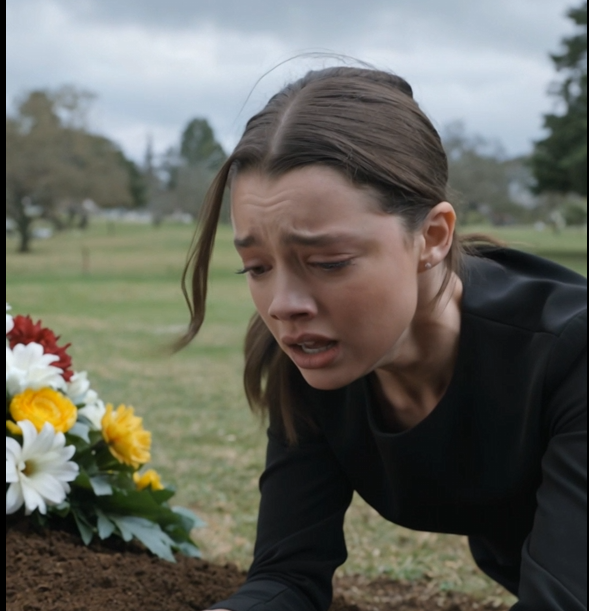
The funeral was supposed to be quiet… until she started screaming.
A woman in black ran toward the coffin, her voice shaking with rage and pain.
“You ruined my life! You promised me!” she cried, pointing at the man who could no longer answer.
People froze. No one moved. No one stopped her.
“I waited ten years for you!” she shouted.
Then suddenly — she tore her dress and collapsed near the grave, crying, hitting the ground like she was trying to wake him up.
The family stood in shock. His wife said nothing. The priest didn’t know what to do.
And then… something unexpected happened.
A small boy slowly walked to the coffin.
No one noticed him at first.
He touched the wood gently, stood on his toes, and whispered:
“Why is everyone angry if you’re gone?”
Silence.
The woman stopped crying. The whispers disappeared. Even the wind felt quieter.
Because in that moment, everyone understood something they didn’t want to admit—
The man in the coffin was gone…
but the truth, the lies, and the pain he left behind… were still alive.
And no one there was ready to face them.
The boy’s name was Daniel. He was seven years old, and he did not understand why adults always lied at funerals. They said words like good man, loving father, honest friend. But he had watched their faces, and their faces did not look like those words.
They looked angry.
They looked scared.
They looked relieved.
Daniel stepped back from the coffin and looked at the woman who had been screaming. She was sitting on the ground, her torn dress covered in dirt and wet grass, her hands shaking. She looked at the boy as if she had never seen a child before.
“What did you say?” she asked quietly.
The boy shrugged. “I asked why everyone is angry. My teacher said when someone dies, we should be sad, not angry.”
No one answered him.
The dead man’s wife, Margaret, finally moved. She had been standing beside the priest the whole time, pale and silent, holding a white handkerchief in both hands like it was the only thing keeping her standing.
She walked slowly toward the grave, her heels sinking slightly into the soft ground. She looked at the woman on the ground, then at the coffin, then at the people around her.
“You should leave,” someone whispered to the screaming woman.
But Margaret raised her hand slightly. “No,” she said quietly. “She should stay.”
Everyone looked at her in surprise.
Margaret’s voice was calm, but her eyes were tired in a way that made her look much older than she was. “If we are going to bury him today,” she said, “we might as well bury the truth with him. Or we can finally say it out loud.”
The wind moved through the cemetery again, carrying the smell of wet earth and flowers.
The screaming woman slowly stood up. She looked embarrassed now, but also relieved, like someone who had been holding their breath for years and had finally exhaled.
“He told me he loved me,” the woman said quietly. “He told me he would leave you. He told me we would start a new life. I believed him. I waited ten years.”
No one interrupted her.
“I missed chances to marry someone else. I didn’t have children because he said we would have our own. I lived in a small apartment because he said we would move together soon.” She laughed bitterly. “Ten years. Every birthday he said, ‘Next year.’ Every Christmas he said, ‘Soon.’”
She looked at the coffin.
“And now he’s dead. And I was never anything. Just a secret that died with him.”
People shifted uncomfortably. Some pretended to look at their phones. Others stared at the ground.
Margaret listened without interrupting. When the woman finished, Margaret nodded slowly.
“I know,” she said.
The woman looked up, confused. “You know?”
Margaret nodded again. “I knew about you for nine years.”
The cemetery became very quiet again.
“I found the messages on his phone,” Margaret said. “I saw the photos. I even saw the ring he bought but never gave you.”
The woman’s face went white.
“You knew… and you stayed?” she asked.
Margaret looked at the coffin for a long time before answering.
“Yes,” she said finally. “I stayed.”
“Why?” the woman asked.
Margaret’s voice did not shake when she answered. “Because he was sick.”
The words seemed to fall into the cemetery like stones.
“He found out eleven years ago,” Margaret continued. “Cancer. Very aggressive. The doctors said maybe five years, maybe less. He didn’t want anyone to know. He said he didn’t want people to look at him like he was already dead.”
The screaming woman slowly sat down again, but this time she didn’t cry.
“He met you around that time,” Margaret said. “And for a while… he was happy again. I hadn’t seen him smile like that in years. I should have left him. Maybe I would have, if I thought he had a future. But he didn’t. He was dying the whole time.”
The woman covered her mouth with her hand.
“He told me he would end it with you many times,” Margaret continued. “But every time he tried, he came home and said he couldn’t do it. He said you looked at him like he still had time.”
Margaret finally looked at the woman directly.
“He didn’t leave me because I was his wife,” she said. “He didn’t leave you because you were his hope. And in the end, he lost both of us anyway.”
The woman started crying again, but this time it was quiet.
“I didn’t know,” she whispered. “I swear I didn’t know.”
“I know,” Margaret said.
They stood there in silence, two women connected by the same man, the same lies, and the same years that none of them would get back.
Then the small boy spoke again.
“So… he wasn’t a good man?” Daniel asked.
The adults looked at each other, uncomfortable.
Margaret thought for a long time before answering.
“He was a weak man,” she said finally. “But he was also a scared man. And sometimes scared people make very bad decisions.”
The boy nodded slowly, like he understood more than they expected.
“Is that why everyone is angry?” he asked.
Margaret looked around at the faces — the angry mistress, the silent relatives, the uncomfortable friends, the priest who wished he was somewhere else.
“Yes,” she said quietly. “We are angry because he is gone and we can’t ask him why.”
The boy thought about this.
Then he walked back to the coffin, put his small hand on it again, and said quietly:
“You should have told the truth before you died. It would have been easier.”
No one knew what to say to that.
The priest finally cleared his throat and continued the prayer, but now the words sounded different. They were no longer about a perfect man, a loving husband, a loyal friend.
They were about a complicated man who made mistakes.
A man who lied.
A man who loved two women and hurt both of them.
A man who was afraid to die and afraid to tell the truth.
When the coffin was slowly lowered into the ground, Margaret and the other woman stood on opposite sides of the grave, but they were no longer enemies. They were just two people who had loved the same man and lost the same years.
The boy Daniel held his mother’s hand and watched the coffin disappear into the earth.
“Mom,” he said quietly, “when you die, will people be angry?”
His mother squeezed his hand. “I hope not,” she said.
“Then you should always tell the truth,” the boy said seriously.
His mother looked at him and realized that sometimes the wisest person at a funeral is the one who doesn’t understand why adults lie so much.
The wind blew across the cemetery again, moving the flowers and the black umbrellas.
And for the first time that day, no one was shouting.
But many people were thinking about the same thing:
The dead are buried in the ground,
but the truth they leave behind
is buried in the people who are still alive.
