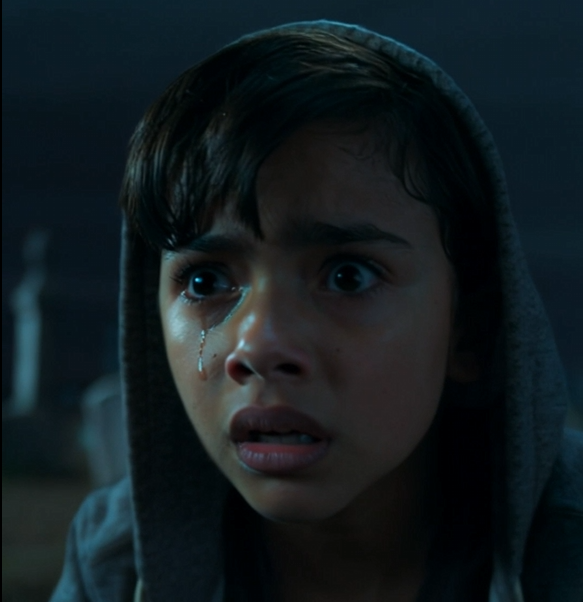
Nora had been walking the long way around Ellsworth Cemetery for eleven years, ever since she’d started working at the records office on Pullman Street, because the long way added seven minutes to her commute and she had decided, at thirty-one, that seven minutes of trees and silence was worth the cost. She knew the cemetery the way you know a place you pass through regularly without ever quite entering: the names on the older stones near the east fence, the groundskeeper who sometimes nodded from his cart, the quality of light in the late afternoon when it came through the oak canopy at a low angle and made everything briefly golden. She knew, also, what fresh graves looked like. She had seen a few in her eleven years of passing. A dark rectangle of turned earth, still mounded, not yet settled to the level of the surrounding grass. Flowers or no flowers. Sometimes a temporary marker, plastic or wire, while the permanent stone was cut. She did not know what a child digging at a fresh grave looked like, because she had never seen it before. So when she came around the bend in the path and saw the boy — seven, maybe eight, small for whatever age he was, kneeling in the dirt, hands working at the mounded earth like he was looking for something — she stopped, and stared, and then went toward him, because what else do you do. The boy He didn’t hear her coming. Or if he did, he didn’t look up. He was crying, but quietly — the kind of crying that has been going on for long enough that it has become ambient, just a condition of the face rather than an event, tears tracking without much accompanying sound. His hands were dark with soil up to the wrists. He wasn’t digging efficiently — no tool, no technique, just fingers raking at the mound, pulling earth away in small increments, not achieving depth so much as texture, disturbing the surface over and over in the same few spots. “Hey,” Nora said. She crouched down a few feet away. “Hey. Are you okay?” He looked at her. His face was the kind of face that seven-year-olds have when they are past caring about strangers — open and devastated and slightly impatient, the way people get when a private emergency is interrupted by someone who doesn’t understand the emergency. “They buried him wrong,” he said. Nora looked at the grave. The temporary marker said Hector Alves Brum, Beloved, and a date she didn’t do the math on but which suggested an old man. “What do you mean, wrong?” “He doesn’t like the dark,” the boy said. He went back to his hands in the dirt. “He’s scared of the dark. I told them and they didn’t listen.” Nora sat with this for a moment. The pragmatic response organized itself in her mind — he’s gone, sweetheart, he can’t feel anything, the dark isn’t dark the way you think — and she heard how all of it would land, which was badly, and she kept it to herself. “Who is he?” she asked instead. “My grandpa,” the boy said. What she tried She tried, gently, to explain. Not the death part — the boy clearly had that information — but the sleep part, the peace part, the way that a body when it is finished is finished, not frightened, not cold, not alone in the dark in the way that a living person left in the dark is alone. She had said versions of this before, at the bedsides of elderly relatives, to younger cousins who asked the hard questions at funerals. She was not unskilled at it. The boy listened. He didn’t stop his hands while he listened, which meant she was being heard but not persuaded, which was its own kind of respect. When she finished, he said: “He would call me when the power went out. Even when I was asleep. He’d call my mom’s phone and say is the boy okay, does he have a light.” He paused. “He was still doing that. A few months ago.” Nora had nothing to put next to this. She let it stand. “He’d want a light,” the boy said. “Even if he can’t feel it. He’d want one there.” She reached into her bag. She had, as she often did, a small LED keychain torch — the kind you forget you carry until you need it. She looked at it in her palm for a moment, considering the logistics and the groundskeeper and what a reasonable adult did in this situation. Then she held it out to the boy. “You could leave that,” she said. “On top.” The boy looked at it. He took it from her hand and turned it over, clicked it on, held the small beam against the earth. Then he set it at the top of the mound, carefully, with a deliberateness that reminded her of the way people place candles. He sat back. His hands were still in the dirt, but loosely now. Not digging. Just resting. Nora reached out to take his wrist gently — to guide him up, she thought, to find his family, to do the reasonable next thing — and that was when the ground moved. The movement Not a tremor. Not an earthquake. Not the slow settling of soil that graves do over time, which is gradual and imperceptible. This was a distinct, concentrated motion directly beneath the boy’s hands — a pushing upward, a single pulse of pressure from underneath, as if something beneath the surface had shifted its weight, or turned over, or reached. The boy snatched his hands back. Nora was on her feet in less than a second, the animal part of her brain running faster than the rest, her heart doing something loud and wrong against her ribs. They stared at the mound. The ground moved again. The same spot. A definite, unmistakable, localized upward pressure, the soil above it doming slightly and then settling. “What,” Nora said. This was the whole sentence. It was the only sentence available. The boy was not afraid. This was the thing she would not be able to adequately explain later — he was startled, yes, he had pulled his hands back, yes, but he was not afraid. He was watching the mound with the wide, calm intensity of a child seeing something confirmed rather than something terrifying. “He knows we’re here,” the boy said. What Nora knew She was forty-two years old and had a degree in urban planning and had spent eleven years processing property transfer documents in a municipal records office and did not believe in things that could not be explained. This was not a firm philosophical position so much as a practical one — the world ran better, in her experience, when you kept your explanations within the range of the demonstrable. So she stood in the cold of the late afternoon in Ellsworth Cemetery and she ran the explanations. Gas, from decomposition, moving soil. Animals — a mole, something underground, something that had been there already and been startled by the boy’s hands. Subsidence, seismic micro-activity, the soil itself shifting as temperature dropped in the early evening. These were all real things. They happened. She ran through every explanation she had. She believed all of them, and none of them moved the sensation from her chest — the sensation of having witnessed something that belonged in a different category entirely. The ground did not move again. The boy reached out and patted the mound, twice, with his palm flat. The gesture was so familiar, so unconscious — the way you pat a shoulder, the way you say it’s okay, I’m here without saying it — that Nora felt something happen in her throat that she was not prepared for. “Okay, Vô,” the boy said, which she would later learn was the Portuguese word for grandfather. “Okay. We’re here.” The family They came around the bend in the path five minutes later — a woman in her late thirties, dark-haired, her eyes swollen, and beside her a man with his hand on the small of her back and his own face doing the careful work of holding itself together. They stopped when they saw the boy, and the woman let out a breath that was mostly relief. “Daniel,” she said. “I told you to wait by the car.” “I know,” Daniel said. He stood up. His hands were filthy. He looked at the mound one more time and then back at his mother. “He knows we were here,” he said. “I think he’s okay now.” The woman looked at Nora, standing a few feet away, still not entirely back inside herself. “I’m sorry — did he — was he bothering you?” “No,” Nora said. “No, not at all.” She wanted to say something else. She wasn’t sure what. She looked at the small LED light still sitting on top of the mound, its beam barely visible in the fading afternoon, more suggestion than illumination. She looked at the boy, who was letting his mother wipe the dirt from his hands with a tissue from her coat pocket, submitting to this with patient resignation. “He’s a good kid,” Nora said. Which was true, and not enough, and the best she could do. The woman smiled the way people smile when they are too tired to be fully present for kindness. “He loved his grandfather very much.” “I could tell,” Nora said. The walk home She did not take her usual path. She went out the main gate instead of the side one, which added time, but she needed the open street, the noise, the ordinary friction of people and cars and the smell of a food cart on the corner. She needed the world to assert itself in its familiar ways. She thought about the movement in the earth for most of the walk. She thought about it in the way you think about something you saw but can’t place — turning it over, testing different frames, setting it down and picking it back up. Gas. A mole. Subsidence. Grief hallucination, some kind of perceptual artifact produced by stress and cold and the particular quality of attention you bring to a stranger’s pain. All of these were possible. She was almost certain one of them was true. She thought about the boy’s face when it happened. Not frightened. Confirmed. The face of a child who had known something that the adults around him had gently, kindly, systematically tried to talk him out of, and who had been proven right, or who believed he had been, which in that moment and in that place amounted to the same thing. She thought about an old man who still called to ask if his grandson had a light when the power went out. Even after he was too sick to drive. Even when it was the middle of the night. Is the boy okay. Does he have a light. She thought about the keychain torch, still on the mound, its small beam going out into the dark. At the corner of her street she stopped walking and stood for a moment, and she did something she had not done in a long time, which was to hold a question open without resolving it. Not to decide. Not to file it under explicable or inexplicable. Just to let it stay a question, unfinished, the way certain things insist on remaining. Then she went home. She made dinner. She called her own mother, which she had been meaning to do for two weeks and kept not doing, and she talked to her for forty minutes about nothing in particular, which was everything in particular, which is usually how it works. She did not tell her mother what had happened in the cemetery. She wasn’t sure she could explain it. She wasn’t sure it needed explaining.
