Nobody at Walter Reed talked about what was really wrong with them.
This was not a criticism. It was simply the culture — the particular emotional topography of a place where young men and women arrived after having experienced things that the English language, for all its flexibility, handles poorly. They talked about their injuries with clinical precision. They talked about physical therapy benchmarks and prosthetic fittings and pain medication schedules. They talked, sometimes, about practical next steps — what came after discharge, what jobs might look like, what life might look like, which was a question so large most of them approached it sideways, never directly.
What they did not talk about — not in the group sessions, not with the counselors, not in the long nights in the ward when the hospital quieted and the things you’d been keeping busy enough to avoid caught up with you — was the inside damage. The part that didn’t show on an X-ray. The weight of what they’d seen and done and lost that sat behind the eyes of a twenty-four-year-old who had learned things about the world that twenty-four-year-olds are not supposed to know yet.
Sergeant First Class Marcus Webb, thirty-one years old, one prosthetic leg below the right knee, had been at Walter Reed for six weeks and had successfully not talked about any of it to anyone.
He was, by all clinical measures, progressing well.
He was not, by any honest measure, okay.
Sunny arrived on a Tuesday.
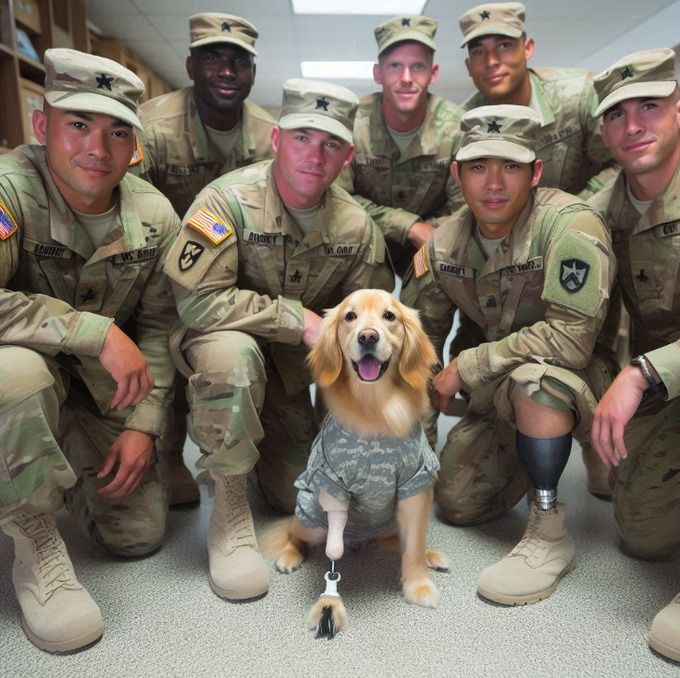
She came in through the main entrance of the rehabilitation ward in a small camouflage vest that someone had fitted to her Golden Retriever frame with the kind of loving absurdity that immediately disarms people who have spent too long in environments that take everything seriously. One front leg ended in a small prosthetic — a neat, functional device that she used with the complete lack of self-consciousness of an animal that had simply incorporated this new fact about herself and moved on.
She was escorted by a volunteer named Patricia, sixty-two years old, who had been bringing therapy dogs to Walter Reed for nine years with the reliable conviction of someone who has seen enough evidence to no longer require convincing.
Sunny moved down the corridor with Patricia the way she always moved — with a quality that Marcus, watching from the doorway of the common room, could only describe as brightness. Not the performed, effortful brightness of someone trying to cheer up a room. The real kind. The kind that doesn’t know it’s doing anything, that simply is what it is and lets that be sufficient.
She stopped at doorways. She looked in. When she found a person who was alone and quiet — the specific kind of quiet that isn’t peaceful — she went in.
Marcus watched this for twenty minutes before she reached him.
He was sitting in the chair by the window that he had claimed as his in the way patients claim territory — not aggressively, just through consistent occupation until it becomes understood. He had his phone in his hand and wasn’t looking at it, which was the modern equivalent of staring at the middle distance.
Sunny came in without announcement. She crossed to him in four steps — three regular, one slightly adapted — and sat in front of his chair and looked up at him with the frank, patient attention of a dog that has decided you are worth her time.
Marcus looked at her.
He looked at her front leg. The prosthetic. Small, functional, bearing her weight without drama or complaint.
Something shifted in his chest — a physical sensation, an actual movement of something he’d had locked down for six weeks.
“Hey,” he said. His voice came out rougher than expected, the way voices do when they haven’t been used for anything real in a long time.
Sunny put her chin on his knee.
The gesture was so simple and so complete that Marcus sat very still for a moment, afraid that moving would end it. He put his hand on her head, slowly, the way you touch something you’re not sure you’re allowed to touch. She leaned into it.
They stayed like that for a while.
Patricia appeared in the doorway, assessed the situation with nine years of practiced reading, and quietly went elsewhere.
Marcus had lost his leg on a Wednesday in Helmand Province. He had lost two members of his unit the same day — Diaz and Kowalski, who had been to his right and whose absence occupied a specific geography in his chest that the grief counselors had not yet found the access point to.
He had not cried since it happened. Not at the hospital in Germany. Not when his mother flew in and sat beside his bed for four days holding his hand with both of hers. Not during any of the six weeks at Walter Reed.
He did not cry now.
But something loosened. Something that had been set at a specific tension since Helmand adjusted — slightly, incrementally, the way a joint releases after long compression. His shoulders, he realized, had come down from somewhere near his ears. His breathing, which he had not noticed was shallow, deepened without his deciding to deepen it.
Sunny looked up at him. Her tail moved.
“You’ve got one too,” he said quietly. As if she might be in a position to discuss it.
She put her paw on his foot — the real one, the left, the boot. Placed it there deliberately and left it.
Marcus looked at the paw on his boot for a long time.
The photograph was taken by Patricia three visits later — Sunny in the center of the common room in her little camouflage vest, seven soldiers arranged around her in various positions of kneeling and crouching, all of them in various stages of recovery, all of them touching her in some way — a hand on her back, fingers in her fur, one soldier with his forehead actually resting against the top of her head with his eyes closed.
Every one of them was smiling.
Not the performance of smiling. The real kind — unguarded, surprised out of them by a dog in a little uniform who had simply shown up and been completely, wholeheartedly present.
Marcus was on the left side of the photograph. His prosthetic leg was visible. He was not looking at the camera. He was looking at Sunny with an expression that Patricia, when she saw the photograph later, could only describe as recognition — the specific face of someone who has encountered something that understands them without needing them to explain.
She framed it and hung it in the entryway of the ward.
Nobody asked her to. Nobody asked her to take it down.
It was Marcus who started the group.
Not a formal group. Not a scheduled, clinically supervised therapeutic intervention with intake forms and outcome measurements. Just a Tuesday afternoon thing — common room, whoever showed up, Sunny in the center because Sunny was always in the center, her presence being the thing that made the whole arrangement work.
They talked. Not about benchmarks and prosthetic fittings. About the real things. About Helmand and Baghdad and Kandahar and the faces they carried. About what they were afraid of when they got home. About who they were going to be now, which was the question most of them had been approaching sideways for weeks and which somehow, in that room, with that dog, became possible to approach directly.
Sunny moved between them as they talked — a slow circuit of the room, stopping at whoever needed stopping at, with the accuracy of something that doesn’t require words to read a person.
Nobody could explain how she knew.
Nobody tried very hard to explain it. Some things function better when you leave them in the category of gift.
