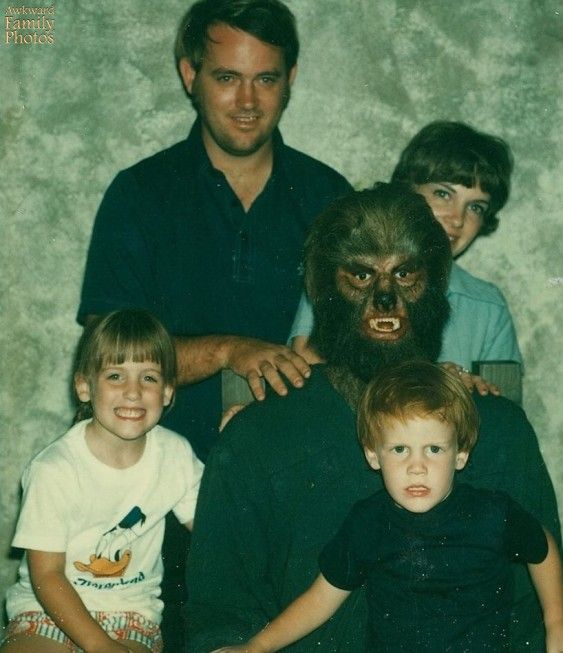
The Henderson family portrait of 1987 was supposed to be simple. Dad had even ironed his navy polo shirt twice.
It was the summer Disneyland came to them — or at least, that’s how Dad explained it to Grandma when she asked why the photo on the mantle had a werewolf in it. A traveling photo studio had set up shop in the Sears parking lot off Route 9 in Bakersfield, California. For $14.99, you got a professional backdrop, a photographer named Gerald, and your choice of costume character: Mickey Mouse, a pirate, or — and this was the wildcard — “The Beast,” a full-body werewolf suit that smelled faintly of mothballs and somebody else’s fear.
Dad, whose name was Dennis and who had never once in forty-two years made a spontaneous decision, chose The Beast.
“It’ll be funny,” he told the kids. “Something to remember.”
Cassie, who was nine and had a Donald Duck shirt on because she’d worn it to Disneyland two summers prior and hadn’t stopped talking about it since, thought it was the greatest idea her father had ever had. She smiled so wide in that photo that her back teeth showed.
Marcus, who was twelve and at the precise age where nothing parents do is acceptable, stood behind the creature with the expression of a boy already composing the therapy monologue he would deliver twenty years later.
And then there was little Tommy. Five years old, red-haired, and deeply, profoundly uncertain about all of it. He sat in front of The Beast like a man awaiting sentencing, his small hands folded in his lap, his eyes broadcasting a single clear message to the camera: I did not consent to this.
Gerald the photographer kept saying “Big smiles!” which, for Tommy, produced nothing. Not even a twitch.
The Beast itself — operated by a twenty-year-old named Kevin from Fresno who needed the money for community college — had its hairy paw draped over Marcus’s shoulder with a casual familiarity that Marcus would describe, decades later, as “weirdly paternal.” Kevin had done forty-seven of these shoots that weekend. He was a professional. He knew how to lean in just right, how to tilt the snarling latex head so it caught the light.
Dennis paid Gerald, collected the Polaroid, and drove the family to Denny’s for dinner.
He put the photo in a frame that same night. Oak wood. Glass front. Hung it right between Cassie’s school portrait and the needlepoint rooster that had belonged to his mother.
His wife, Linda, stood in the hallway for a long moment looking at it.
“Dennis,” she said.
“It’s a conversation piece,” he said.
It was that. Neighbors who came over for the first time always stopped in the hall. Always tilted their heads. Always said something like, “Is that a…” and Dennis would say, “Yep,” with the quiet satisfaction of a man who had done one wild thing in his life and framed it.
The kids grew up. Cassie became a dental hygienist in Tucson. Marcus moved to Portland and got really into sourdough and saying things like “I just need space to process.” Tommy — little uncertain Tommy — became, improbably, a wedding photographer in Nashville. He took joyful pictures for a living. He was very good at getting people to smile naturally.
He never once used a werewolf.
The photo stayed on the wall. Through Linda’s book club phases and Dennis’s brief flirtation with woodworking and the years when the kids came home for Christmas and the years when they didn’t. Through grandchildren who pointed at The Beast and shrieked with delight. Through the funeral arrangements nobody wanted to make and the house that eventually went quiet.
When they cleaned out the house, all three of them stood in the hallway and looked at the photo.
Marcus said he didn’t want it. Then said he did. Then put it in his car without another word.
He hung it in his Portland kitchen, between a hand-lettered sign that said GATHER and a succulent shelf his partner had installed. Guests always stopped. Always tilted their heads.
“That’s my family,” Marcus would say. “Summer of ’87. That’s my dad. That’s my sister. That’s me.”
A pause.
“And the werewolf?”
Marcus would smile — finally, genuinely, the smile that had refused to come in that Sears parking lot thirty-something years ago.
“That’s Uncle Roy,” he’d say. “We don’t talk about Uncle Roy.”
