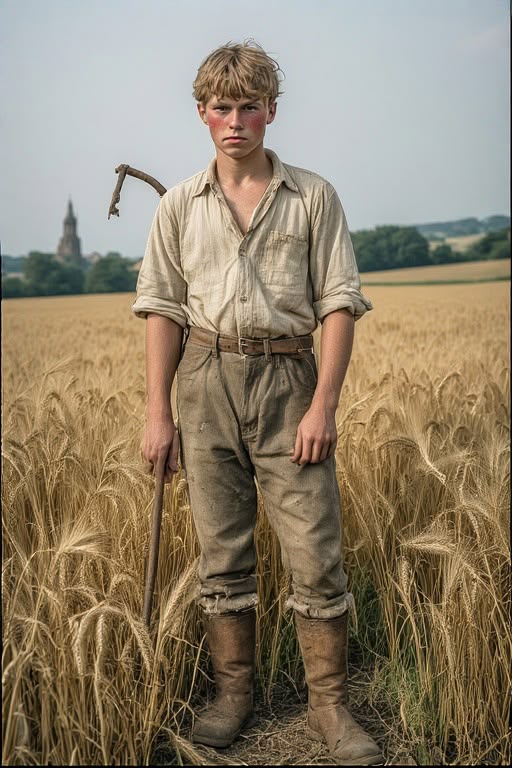
Everybody left Millhaven eventually.
That was the understood truth of the place — a small farming town in central Kansas so flat and so still that on a clear day you could watch a storm coming for forty minutes before it arrived, which was about how long it took to realize your life was doing the same thing. Kids grew up, graduated from the consolidated high school twelve miles east, and pointed themselves at Wichita or Kansas City or somewhere with a skyline, and they did not look back. Not because Millhaven was bad. Just because it was small, and small places have a way of making you feel the edges of yourself pressing against the edges of the town, and eventually something has to give.
Eli Marsh was seventeen years old and had not left.
Not for lack of offers. His grades were good — better than good, quietly remarkable in the way of people who read everything they can get their hands on without advertising it. His history teacher, Mr. Delacroix, had written him a college recommendation letter the previous spring without being asked, just placed it on his desk one morning and said “In case you decide you want it.” It was still in the drawer of Eli’s nightstand, folded in thirds, unopened after the initial read.
His father needed him on the farm. That was the simple version.
The complicated version was that Eli Marsh was the kind of person who believed, with a stubbornness that looked like loyalty from the outside and felt like drowning from the inside, that leaving people who needed you was a moral failure. His father, Raymond, was not sick and not cruel and not helpless — he was simply alone. Had been alone since Eli’s mother drove to Hutchinson for groceries seven years ago and made a different choice somewhere along the highway, a choice that involved a man named Gary from Pratt County and a second life that apparently had room for her but not for the family she’d been building.
Raymond had never recovered, not really. He functioned. Got up, worked the wheat, ate dinner, slept. But something behind his eyes had gone quiet and stayed that way, and Eli had spent seven years treating that quiet like a wound that needed tending.
So he stayed.
He worked the wheat harvest in the summer heat with a scythe his grandfather had used and a hat that was two sizes too big and boots that had worn to the exact shape of his feet over four seasons of this same field. He knew this land the way you know something you have touched ten thousand times — the low spot in the northeast corner that pooled after hard rain, the stretch along the fence line where the soil went sandy and the yield was always thin, the exact moment in the early morning when the field stopped being brown and gold and became pure light.
He did not talk about this to anyone because there was no one left his age to tell.
The Pryor boys had gone to Kansas State. Jenny Callahan, who Eli had loved quietly and with great discipline since seventh grade, had gone to Denver and sent back Instagram photos of mountains and coffee shops that made his chest ache in a way he chose not to examine too closely. Even Dusty Hamm, who had seemed like the least likely person in Millhaven to have ambitions of any kind, had taken a welding certificate program in Salina and was now making more money than either of their fathers.
Eli was the last one.
On this particular Tuesday in August, he stood in the middle of the east field at four in the afternoon and felt the heat pressing down like a hand on the top of his head and looked at the church steeple in the distance — the Lutheran church that had been there since 1887 and would probably outlast everyone currently living — and thought, for the first time with real clarity, that he was angry.
Not at his father. Not at his mother, or Gary, or any of the specific people who had arranged the circumstances of his life. Just — angry. A general, structural anger at the fact of it all. That he was seventeen and sun-burned and exhausted and brilliant, and the recommendation letter in his drawer was written in Mr. Delacroix’s careful hand and was probably the nicest thing anyone had ever said about him, and it was folded in thirds in the dark.
He drove the scythe into the earth. Not violently. Just deliberately, the way you plant a flag.
Stood there looking at it for a moment.
Then he heard tires on the dirt road at the field’s edge and turned to see a truck he didn’t recognize — an older model Ford, out-of-state plates, a crack running diagonal across the windshield — pulling up and stopping.
The door opened.
A woman got out. Late thirties, maybe forty. Dark hair pulled back. A camera around her neck, serious equipment, not tourist stuff. She looked at the field, then at Eli, then at the scythe standing upright in the wheat.
“Mind if I photograph you?” she said. “I’m doing a project. American rural youth. I’ve been driving for three weeks.”
Eli looked at her for a long moment.
“Who’s going to see it?” he asked.
“Galleries,” she said. “New York, maybe. Chicago. Depends.”
Eli looked back at the steeple. Then at the scythe. Then at the Kansas sky, which was doing that thing it did in August — turning a color with no good name for it, blue-white and immense and completely indifferent to the people living underneath it.
“Okay,” he said.
He didn’t move. Didn’t pose. Just stood there in the field looking directly at her camera the way he looked at everything — straight on, serious, giving nothing away.
She clicked the shutter.
Neither of them knew yet that the photograph would win a national prize. That it would appear in a magazine with a million readers. That the boy in the wheat field with the ancient scythe and the old boots and the eyes that looked like they contained seventeen years of staying would make people across America stop on the page and feel something they couldn’t immediately name.
Neither of them knew that one of those people would be Jenny Callahan, in her Denver apartment, holding the magazine with both hands.
That she would read the caption — Eli Marsh, 17, Millhaven, Kansas — and sit down on her kitchen floor.
