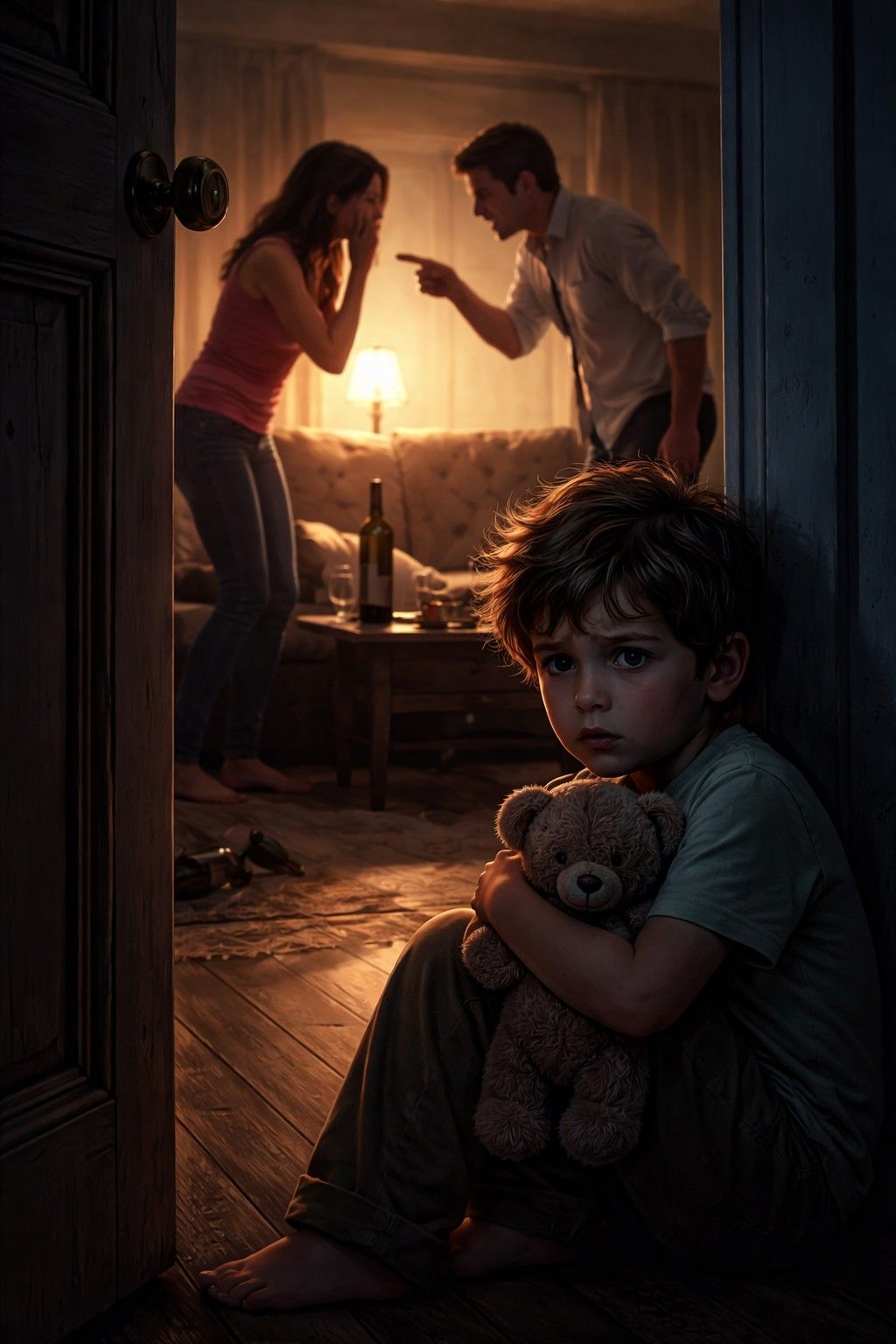
His name was the bear’s name too.
That was the thing nobody knew except Owen himself — that the bear, whose fur had gone thin at the left ear from years of being held exactly this way, was also named Owen. He had named it when he was three, before he understood that names were supposed to be unique, before he understood most things. Now he was seven and he understood quite a lot, much more than anyone in this house seemed to realize, and he pressed his face against the bear’s worn head and listened to his parents through the open door and counted.
Counting helped. His teacher, Mrs. Patton, had taught him to count when things got loud inside himself — count the ceiling tiles, count your breaths, count backward from twenty. She had meant it for math anxiety. Owen had repurposed it.
One. His dad’s voice, that particular pitch it reached after the bottle on the coffee table got low.
Two. His mom’s voice, the one that was trying to stay calm and not quite managing. She was good at calm during the day. Night was harder.
Three. The word his dad used that Owen was not allowed to use, deployed now for the fourth time tonight.
Four. Something moved — a hand, a gesture — and his mom stepped back and hit the arm of the couch and his whole body clenched like a fist.
Nothing broke. Nothing landed. It didn’t always break or land. Sometimes it was just the sound of almost, which was its own kind of damage, less visible and just as real.
Owen pressed his back harder against the wall beside the door. He had learned this spot over the past year and a half — close enough to hear, positioned so that the light from the living room lamp fell in a warm stripe across the hallway floor that didn’t quite reach him. He was in the dark but could see the light. This felt important, though he couldn’t have said why.
He was good at the not-saying-why. He was good at a lot of things that didn’t have names yet because he was seven and the vocabulary for his specific interior life was still being assembled.
He knew: when to be invisible. When the house was safe and when it was a held breath. The exact sound of his dad’s truck in the driveway and what speed of parking meant which version of the evening was coming. The way his mom laughed differently depending on whether she meant it. The precise moment in an argument when the temperature shifted from bad to worse, which was a skill he had developed with the unconscious dedication of someone whose survival had quietly come to depend on it.
He did not know — could not have known — that these skills had names. That a woman named Dr. Sandra Reeves, who worked thirty miles away in a beige office with a sand tray and a feelings chart on the wall, had words for what Owen had built inside himself. That words like hypervigilance and emotional parentification and adverse childhood experiences existed and applied to him specifically. That the counting, and the spot by the wall, and the way he sometimes felt his heart before he heard the truck — that none of this was normal, in the sense of typical, even though it was entirely normal to Owen because it was all he had ever known.
The bear knew, though. That was the arrangement. Owen told the bear everything — in whispers, in his room, after, with the covers pulled to his chin — and the bear held it without judgment and without fear and without needing to fix anything, which was more than most people managed.
Tonight Owen told the bear: They’re fighting again.
The bear already knew.
The voices shifted. His mom was crying now — not loud, the quiet kind that was somehow worse — and his dad’s voice had dropped from sharp to low, which didn’t always mean better, sometimes meant more deliberate. Owen counted the stripe of light on the floor. Counted his own heartbeats, which were fast. Counted the flowers on the hallway wallpaper that he had memorized months ago without meaning to: seven visible from this angle, three fully open, four partial, the one nearest the baseboard that had a water stain through its center that made it look like it was splitting apart.
He was so tired.
Not sleepy-tired. The other kind. The kind that lived in his chest and didn’t go away with rest, that was there on good days and bad days and the medium days that were actually the hardest because on medium days he couldn’t tell which way things were going to go and the not-knowing was its own weight.
He wanted to go to school. School was rules and schedules and Mrs. Patton who said good morning, Owen every single day in the same voice, the same warmth, the same way — like he was expected and welcome and none of that was ever in question. School was the only place where Owen did not monitor the temperature of the room.
Tomorrow was school.
He focused on tomorrow like a fixed point.
The voices in the living room went quieter. Then quieter still. Then the specific silence that meant the argument had exhausted itself, which was the best outcome available. Not fixed. Not resolved. Just stopped, the way a storm stops, leaving everything wet and rearranged but still standing.
Owen waited a full minute. Then he stood up, carefully, holding the bear, and moved in bare feet back down the dark hallway to his room.
He got into bed. Pulled the covers up. Pressed his face against the bear’s thin left ear.
We’re okay, he whispered. Tomorrow is school.
He closed his eyes and counted backward from twenty, the way Mrs. Patton had taught him, and somewhere around eleven he fell asleep, still holding on.
