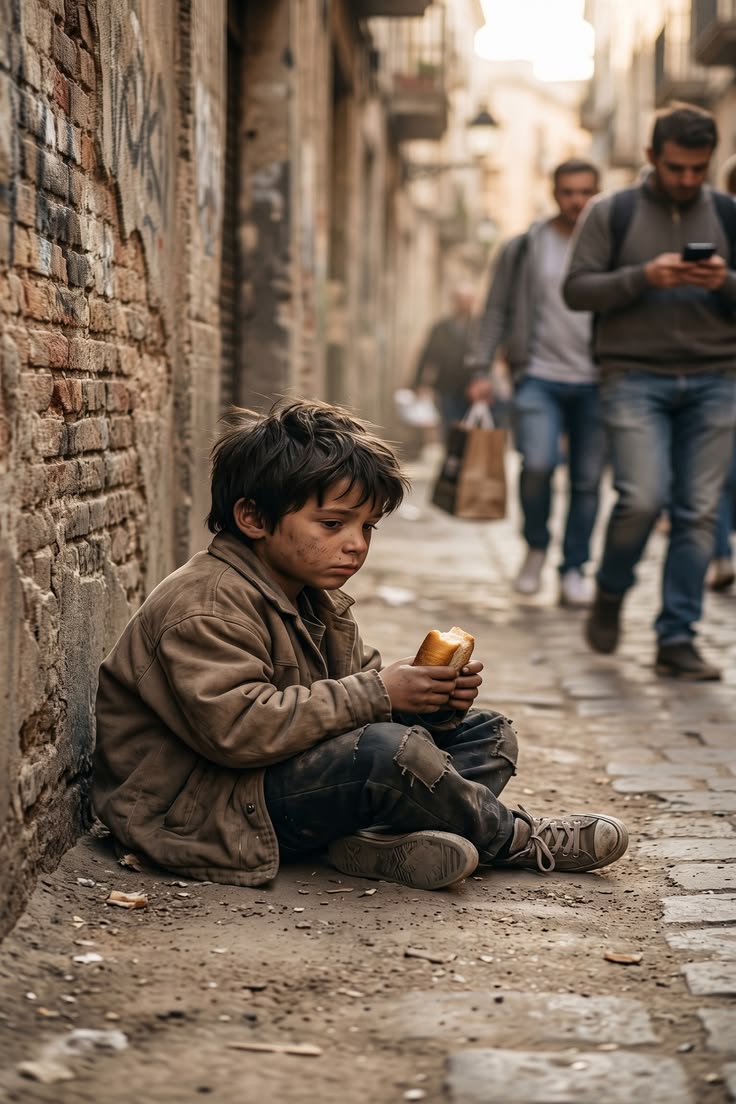
Nobody stopped.
That was the thing Mateo had learned first, before he learned how to find water, before he learned which doorways stayed dry in the rain, before he learned the precise science of making himself small enough that the city’s impatience flowed around him like a river around a stone. He had learned that people in motion do not stop. They have somewhere to be. They have phones that require looking at, bags that require carrying, lives that require full-time attention. A boy sitting against a wall with dirty shoes is scenery. Scenery does not require a response.
He was nine years old and he had been scenery for six weeks.
The bread in his hands was the end of what a woman had given him that morning outside the bakery on Calle Mercado — not looking at him when she gave it, which was its own kind of message, but giving it anyway, which was a different and more important one. He was making it last. This was another early lesson: make everything last. Food, warmth, the battery on the cracked phone he no longer had. Goodwill, when it appeared, which was infrequent and therefore precious.
He ate a small piece and watched the alley.
The city moved past its mouth in both directions — feet, mostly, the anonymous lower halves of adults going about the serious business of being adults. Occasionally he could hear the street sounds: a car horn, someone laughing, the particular squeal of bus brakes on the corner of the main boulevard two blocks west. He had mapped this neighborhood in the way that necessity teaches you to map things — not with a phone or an app but with his feet and his memory, walking until he knew which streets had cameras and which didn’t, which restaurants put out usable food after closing, which corner store owner looked away when he reached for something small near the door and which one called out and which one called the police.
The police were not the worst thing that could happen. But they were not the best.
He thought about his sister. He thought about Valentina roughly seventeen times per hour, which he knew because he had counted once during a long afternoon with nothing else to do, just to know the number, just to make the missing her into something with a shape. Seventeen times per hour, every hour, the specific ache of her — her voice, her laugh, the way she used to call him Teo because she couldn’t manage the full syllable until she was three. She was eleven now. Or she had been eleven the last time he’d seen her. That was eight weeks ago.
Eight weeks and two cities ago, when everything that had been their life — fragile and imperfect and insufficient but theirs — had come apart in a single evening that he did not let himself think about in detail because thinking about it in detail meant he stopped functioning, and he needed to function, so he kept it behind a door in himself and kept the door closed.
Valentina was with their aunt in Riverside. He believed this. He had to believe it because the alternative was not something he could afford to think about and still eat bread and still stay warm and still plan the next move, which was the only thing that kept him going — the next move, always just the next move, the day after tomorrow reduced to the next hour.
He was going to get to California.
That was the plan. Distilled from six weeks of chaos and loss into its simplest form: get to California. Their aunt’s address was in his head, memorized the way you memorize something when you know the paper it’s written on might not survive. 14 Orchard Way, Riverside. Zip code 92501. He repeated it to himself the way other kids repeated multiplication tables. His anchor. His destination. The fixed point he navigated by.
The problem was the distance. The problem was money, which he didn’t have. The problem was that he was nine years old in a city he’d been in for six weeks and didn’t know well enough yet, surviving on bread from a woman who hadn’t looked at him and water from a gas station bathroom and the specific, exhausting vigilance of someone who has learned that sleeping too deeply is a risk.
He ate another piece of bread. Watched a man walk by looking at his phone — a nice phone, a bright screen, the man’s face lit blue-white and completely absorbed. The man was so close Mateo could have reached out and touched his jacket. The man did not look down.
Mateo did not reach out.
He was not a thief. This was important to him in a way he couldn’t fully articulate but felt precisely — a line he had not crossed and would not cross because on the other side of that line was a version of himself he didn’t want to meet. He had been hungry enough. He had been scared enough. He had been invisible enough. He had not yet been that.
He was still deciding what kind of person to be, and he was doing it under conditions that made the deciding very hard, and he was nine years old, and he was doing it anyway.
The bread was almost gone.
He looked at the last piece for a moment. Then he looked up, past the mouth of the alley, at the afternoon sky above the city — that particular western light, golden and dust-colored, the same light that had been over every city he’d moved through, the one thing that stayed consistent, the one thing nobody owned.
He thought: Valentina can see this same sky right now.
He ate the last piece of bread.
Then he stood up, brushed the dirt from his jeans in the automatic way of someone who still cared about being clean even when cleaning was mostly symbolic, and walked to the alley’s mouth.
Turned west.
Started walking.
