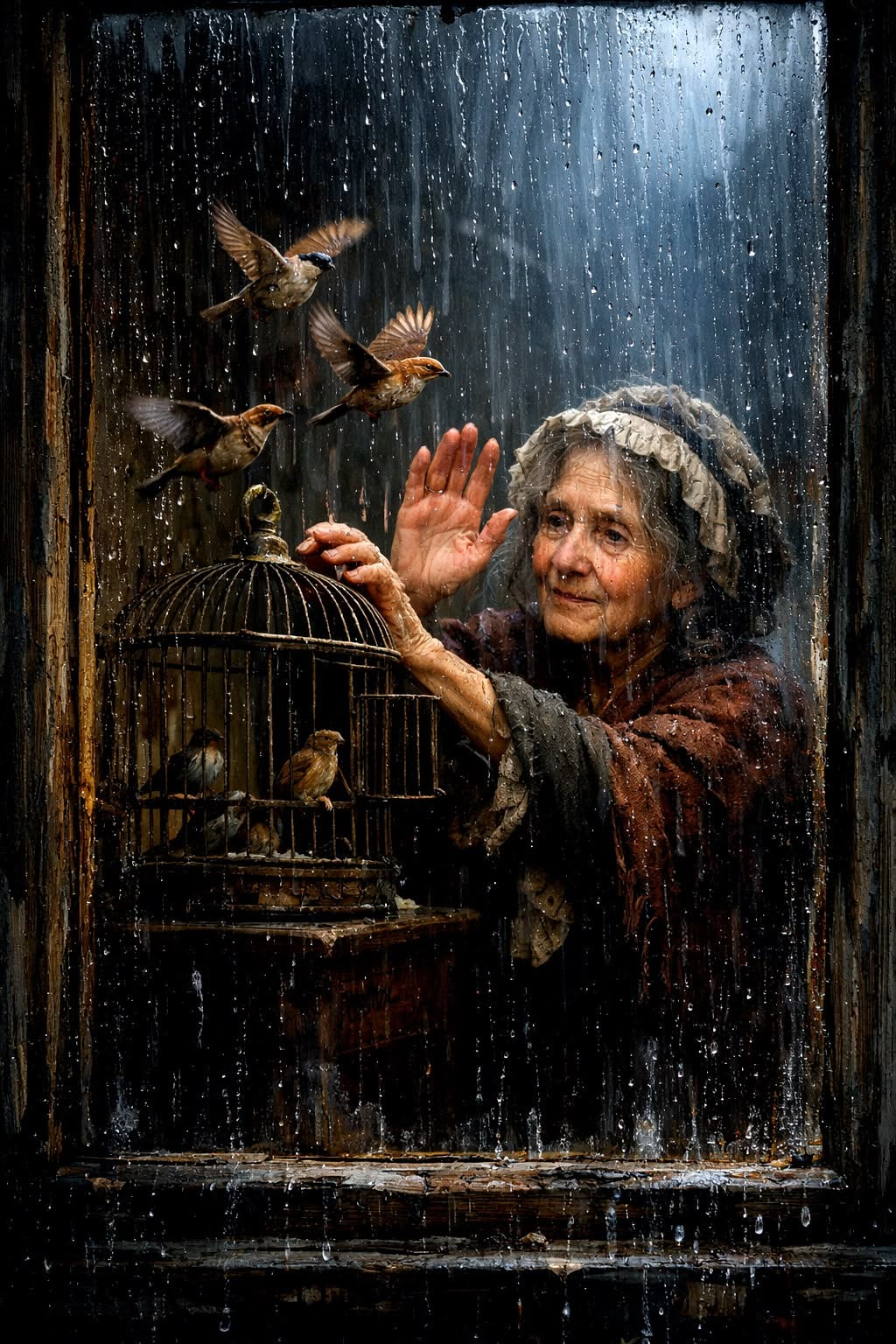
She had been opening that window every morning for forty-one years.
Rain or shine, summer heat or January frost, Miriam Hadley would shuffle to the window of her third-floor apartment on Deacon Street in Portland, Oregon, press her weathered hands against the old wooden frame, and lift. The neighbors had grown so used to the sound — that long, familiar groan of swollen wood giving way — that they barely noticed it anymore. It had become part of the building’s rhythm, like the radiator clicking on at six or the mail slot snapping shut at noon.
But this morning was different.
This morning, Miriam had the cage.
It had belonged to her husband, George, who had died eleven months ago in the blue recliner by the television, so quietly that she hadn’t realized it for nearly an hour. George had loved birds the way some men love baseball or woodworking — completely, without needing to explain it. He had kept finches and sparrows his whole life, rescued them from bad weather and broken wings and the cruel indifference of the city, nursed them back, and let them go. “You can’t keep a wild thing,” he used to say, opening whatever cage he had at the time. “You can only borrow it for a while.”
Miriam had never fully understood that until now.
The cage on the windowsill held five sparrows. She had found the first one on the fire escape in October, stunned from hitting the building’s glass — small as a walnut, shaking. She’d brought it inside the way George would have, warmed it in a kitchen towel, fed it seeds and water with an eyedropper. When it recovered, she didn’t let it go. She told herself it wasn’t ready. She told herself the weather was too cold.
She found the others over the months that followed. A second bird, then a third, each one a small emergency that gave her somewhere to put her hands, something to wake up for. By February she had five. She had George’s old cage cleaned and set up by the radiator, and every morning she sat beside it with her coffee and talked to them the way she used to talk to him — about the news, about the neighbors, about the dreams she kept having where he was still in the blue recliner and she brought him a cup of tea and everything was ordinary and fine.
The birds never talked back, of course. But they listened in that specific, tilted-head way that made her feel heard.
Her daughter, Carol, drove up from Sacramento in March and took one look at the cage and said, “Mom, you can’t have birds in this apartment. Your lease.” Miriam said she’d check. She did not check. Carol called twice a week and asked about the birds and Miriam said they were doing fine, just fine, and changed the subject to Carol’s kids.
But something had shifted in April.
She noticed it first in the smallest sparrow — the one she’d named George, quietly, without telling anyone. He had started flying in tight, agitated circles inside the cage. Then the others started doing it too, all five of them restless and bumping against the bars in a way they never had before. Miriam watched them and felt something move in her chest. Not grief, exactly. Something older and quieter than grief.
She thought about what her husband used to say.
She thought about it for three days.
Then on a Thursday morning in late April, with rain coming down the way it only comes down in Portland — heavy and steady and without apology — Miriam Hadley carried the cage to the window, opened the latch, and raised the glass.
She didn’t rush them. She put her hand near the open door and waited. The smallest one — George — went first. He shot out into the rain without hesitation, like he’d always known the door would eventually open. The others followed in quick succession, wings catching the wet air, scattering into the gray sky above Deacon Street.
The last two hesitated inside the cage. Miriam pressed her palm gently to the wire, not to stop them — just to feel them through the bars one last time. Then she lifted her hand, open, into the rain. A farewell. A blessing. Whatever it was that old women gave to wild things when they finally let go.
They flew.
She stood at the open window for a long time after, her hand still raised, rain running down her wrist and soaking through the sleeve of her robe. She was crying, though she hadn’t planned to. Not from sadness, she thought — or not only from sadness. It was the particular ache of doing the right thing when the right thing costs you something.
The apartment felt enormous when she closed the window.
She made coffee. She sat at the kitchen table. The empty cage sat on the windowsill, and she looked at it the way you look at something you’re not ready to put away.
Her phone buzzed. A text from Carol: Checking in. How are the birds?
Miriam looked at the cage. She looked at the rain-streaked window. She picked up the phone and typed back: I let them go this morning.
Three dots appeared. Then: Oh, Mom.
Then: Are you okay?
Miriam thought about it for a moment, the way you think about a question that deserves an honest answer. Outside, somewhere beyond the gray and the rain, five small sparrows were finding their way back to whatever sparrows return to when the cage door finally opens.
I think I’m going to be, she wrote back. I think that’s enough for today.
She set the phone down, wrapped both hands around her coffee cup, and sat with the quiet — which was different now, somehow. Not empty. Just open.
