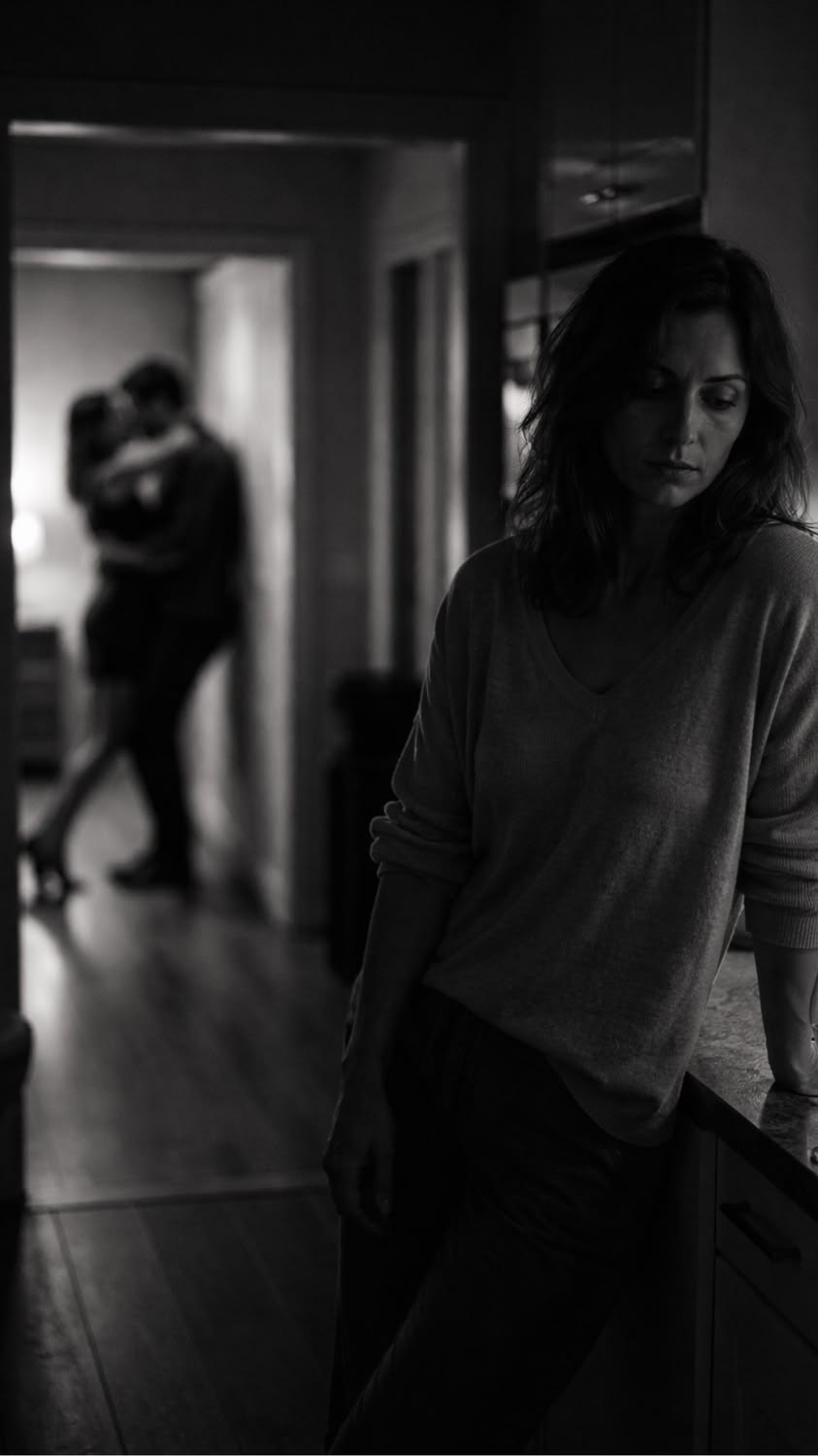
She had always been good at pretending not to see things.
It was a skill she’d developed young — the kind of quiet survival trick children learn in houses where the truth is too loud to live with comfortably. Look at the floor. Fix your eyes on the middle distance. Let the difficult thing blur at the edges until it becomes just a shape, just a shadow, just something happening in another room that has nothing to do with you.
Claire Merritt was thirty-eight years old and she was still doing it.
She stood at the kitchen counter with both hands pressed flat against the cold marble, looking down at nothing. Behind her, through the open hallway door, she could hear them. Not words — she had stopped processing words about ten minutes ago — just the low, unmistakable sound of her husband and her sister existing together in a way that had no innocent explanation. The small sounds. The silences between the sounds. The particular quality of a quiet that two people only make when they believe no one else is in the house.
She had come home early. The meeting had been canceled. Such a small, stupid thing.
The kitchen smelled like the dinner she hadn’t cooked, the wine she hadn’t opened, the ordinary Tuesday evening she had been planning in her head on the drive home. She had been thinking about what to make. She had been thinking about whether Ryan would want to watch something after dinner or read. She had been thinking, as she sometimes did on quiet drives, about whether they were happy — not desperately, not with alarm, just in the low-grade wondering way of someone taking inventory.
She had her answer now.
Claire didn’t move. She was aware of this about herself — the freezing, the going still, the body’s first response to catastrophe being a kind of terrible patience. She had done it at her father’s hospital bedside. She had done it the night her first engagement ended, standing in a parking lot in the rain. She went quiet the way the sky goes quiet before something large and irreversible happens.
Her sister’s name was Dana.
Dana, who was thirty-four and funny and always late and borrowed things without asking and called their mother every Sunday without fail. Dana, who had been the maid of honor at Claire and Ryan’s wedding six years ago, who had cried during the vows — genuinely, openly cried — and squeezed Claire’s hand at the reception and said, You deserve this. You really, really do.
Claire looked down at her hands on the marble. The wedding ring caught the kitchen light.
She became aware, slowly, that she was not crying. She noted this the way you note weather — not judging it, just observing. There was something in her chest, but it wasn’t grief yet. It was something that preceded grief. Something pre-verbal and enormous, like standing at the edge of a very high place and looking down before you’ve decided anything.
The sounds in the other room shifted. A voice — Ryan’s — low and urgent. Then Dana’s, softer.
Claire pushed off from the counter and walked to the refrigerator. She opened it. She stood looking into it for a long moment, not seeing anything inside, just needing somewhere to put her eyes. She took out a bottle of water. She closed the refrigerator door. She twisted the cap off the water and drank half of it standing there in the kitchen, mechanically, the way you drink when your body needs something your mind isn’t paying attention to.
Then she heard footsteps.
Ryan appeared in the kitchen doorway. He was still fully dressed — she registered this in some distant, cataloging part of her brain. He saw her and went absolutely white. The color left his face the way water leaves a bathtub, all at once, with a kind of helpless speed.
“Claire.” Her name in his mouth was not a greeting. It was the sound of something breaking.
She looked at him. She felt very calm. She was aware this was not normal calm — not the calm of someone who was okay — but the calm of someone who was not yet inside the full size of what was happening to them. She would get there. She knew she would get there. But right now she was standing just outside it, in the kitchen, holding a water bottle.
“How long,” she said. Her voice was even. She was almost surprised.
Ryan opened his mouth. Closed it. His hands went to his face briefly and then dropped. “Claire, I—”
“How long, Ryan.”
The pause that followed was its own kind of answer. Long enough that she understood it was not a recent thing, not a single terrible mistake, not the kind of thing a person could hand back and ask forgiveness for in a single conversation. Long enough that she understood there were other evenings, other ordinary days, other drives home where she’d been thinking about dinner.
Dana did not appear in the doorway. Claire had expected her to. The absence of her felt, somehow, like the worst part.
She set the water bottle on the counter. She picked up her keys from where she’d dropped them when she walked in. She looked at Ryan — really looked at him, the way you look at something you are memorizing because you understand, at some deep and wordless level, that you will never see it the same way again.
“Don’t,” she said quietly. Not angrily. Just clearly.
And she walked out the front door into the cool evening air, got into her car, and drove. She did not know where she was going. She drove the way you drive when the destination doesn’t matter yet — hands on the wheel, eyes on the road, the city sliding past the windows like a film she was watching from very far away.
At the first red light, the calm finally broke.
She sat there with the light turning green above her and let it come — all of it, the whole enormous weight of it — and she cried the way people cry when there’s no one left to be composed for.
The light turned green. She didn’t move. Someone behind her honked, once, gently.
She wiped her face with the back of her hand. She put the car in drive.
She had nowhere to go. She drove anyway.
