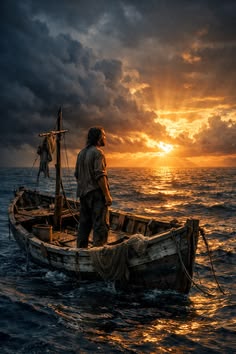
He had been on the water for eleven days.
Not by choice — or rather, by a choice that had seemed reasonable in the harbor at dawn and had revealed itself, by degrees, to be the kind of decision a man makes when he is running from something large enough that the open ocean seems, by comparison, like the safer option. Thomas Reyes was forty-four years old, a former commercial fisherman from Gloucester, Massachusetts, and a man who understood the sea the way some people understood music — not just the notes but the grammar of it, the way it changed its mind, the way it said one thing on the surface and kept its real intentions deeper down.
He stood at the bow of the Clara Mae — twenty-two feet of aging wooden hull named after his mother, who had died the previous spring and who would have had significant things to say about what her son was currently doing — and he watched the sun break through the storm clouds in long, golden columns that struck the water like something deliberate. Like a statement. Like the sky had something it needed to say and had finally found the right language for it.
Thomas had left Gloucester on a Tuesday.
The reason was simple in its facts and complicated in everything beneath them. He had lost the house — not dramatically, not all at once, but in the grinding, bureaucratic way that loss happened to ordinary people: a loan modified, a payment missed, a letter, another letter, a final letter. He had lost the commercial license two years before that, in a different kind of grinding, and had been working dock labor and odd jobs and telling himself it was temporary with the specific stubbornness of a man who had never asked for help and had confused that with strength. His daughter, Maya, was nineteen and in her first year at UMass and did not know the full shape of things because he had shielded her from it with the carefully constructed normalcy of a father who believed that protecting his child from his failures was the same thing as protecting her.
He knew, somewhere he hadn’t let himself look directly at, that it was not the same thing.
His ex-wife, Carol, had known the full shape of things for years. They had been divorced for seven, and she had watched the gradual erosion of Thomas from a distance that was partly geography and partly the particular remove of a woman who had loved a man completely and had accepted, finally, that loving him completely was not the same as being able to reach him. She still called on Maya’s birthdays. Sometimes she called on his. He always let it go to voicemail and called back within the hour, which was its own kind of language.
He had taken the Clara Mae out with three hundred dollars, enough diesel for a week, a week’s worth of canned goods, and no destination. He had told himself he needed to think. The water had always been where he thought best — the particular clarifying quality of being surrounded by something larger than your problems, something indifferent to them in the way that was actually useful, that stripped away the noise and left you with the signal.
What he had found, in eleven days, was not the clarity he expected.
He had found, instead, a kind of honesty.
Day three, he had gone over the facts the way you went over accounts — systematically, without sentiment. The house: gone or going, nothing left to prevent. The license: that was a grief he had not finished, a loss that had taken not just income but identity, the answer to the question what do you do having been I fish for twenty years and then suddenly nothing he knew how to say. Maya: doing well, better than well, carrying none of what he’d feared she’d carry, which meant the shielding had worked or meant she was smarter than his protections and had known and chosen not to say so, which was possible, because she was her mother’s daughter and her mother had always known things Thomas didn’t realize he was broadcasting.
Day six, he had cried.
He was not a man who cried often or easily — it had been trained out of him in the specific way it was trained out of men of his generation and geography, by fathers who were not cruel but who modeled a particular kind of sealed endurance that their sons absorbed like weather. He had cried at his mother’s funeral, briefly, in the car alone before going inside. He had cried the night Carol told him she was leaving, once, after she’d gone, with the lights off. Both times, alone, which was the only condition under which Thomas Reyes allowed himself that particular release.
Day six on the water, alone in the middle of the Atlantic, he cried for a long time and no one saw it except the water, which kept no record.
On the other side of it was something that was not clarity exactly but was adjacent to it. Not answers — the practical problems remained exactly as he’d left them, unresolved and patient. But a kind of inventory. A reckoning that didn’t require a verdict yet, just an honest accounting of what was there and what wasn’t and what might still be possible if he stopped pretending the accounting didn’t need to happen.
He thought about Maya.
He thought about her the way he always thought about her when things were most stripped down — not with guilt, not with pride exactly, but with the simple foundational fact of her, the reality of a person he had helped bring into the world and who existed now regardless of everything else, completely and permanently, in the way that children existed for parents even when geography or silence had put distance between them. She was the coordinate he navigated from. Even now. Especially now.
He had to go back.
Not because things were resolved — they weren’t. Not because he had a plan — he didn’t, not yet. But because the sea, which had always told him the truth if he stayed long enough to listen, was telling him now that the thing he was looking for was not out here on the horizon.
It was behind him.
He turned the Clara Mae around.
The sun was fully up now, breaking over the clouds in the particular gold of a morning that had decided to mean something. Thomas set the heading for Gloucester and felt, for the first time in eleven days, the specific gravity of direction — the way it grounded you, even when you were still on open water, to know which way was home.
He didn’t know what he would find when he got there. He knew it would be hard. He knew there were calls to make and truths to tell and help to ask for — that last one the hardest, the thing his father’s endurance had never taught him, the thing he was going to have to figure out in real time, without a model.
He put his hand on the tiller.
The Clara Mae moved forward through the gold morning water, a man and a wooden boat and the long Atlantic between them and the shore, heading back toward the life that was waiting for him to stop running from it.
It was enough of a plan to start.
