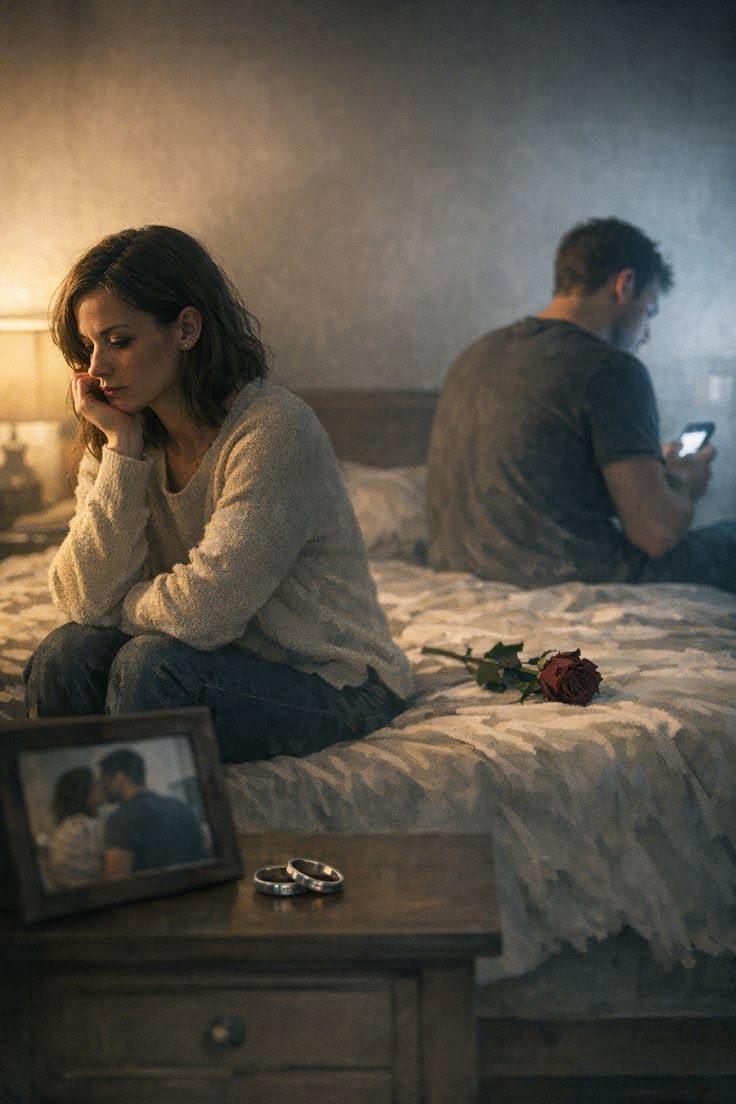
He had bought the rose that morning.
She had found it on the bed when she came upstairs — a single red rose, laid in the center of the white duvet with the careful deliberateness of a gesture that was trying to say something its giver hadn’t found the words for yet. She had stood in the doorway looking at it for a long moment, her hand still on the frame, and felt something move through her that was not happiness exactly and not sadness exactly but the specific ache of a thing that used to be simple becoming complicated — the way a song you loved could, after enough hard seasons, become almost too much to hear.
She had sat down on her side of the bed.
He had come up twenty minutes later, sat on his side, and picked up his phone.
The rose lay between them like a country neither one knew how to cross anymore.
Her name was Sarah. His was Ben. They had been married for nine years, which was long enough that most of their friends considered them settled — one of those couples you stopped worrying about, the dependable ones at the dinner table who balanced each other out and never made scenes and had the kind of low-key, functional partnership that looked, from the outside, like contentment. Sarah had heard the word solid applied to them more times than she could count. She had always taken it as a compliment. Lately she had been turning it over in her mind, examining its other faces. Solid as in stable. Solid as in reliable. Solid as in dense. Solid as in a thing with no give left in it.
She looked at the photograph on the nightstand.
It was from their second year together, before the wedding, taken at a friend’s backyard party in June. They were standing close, faces turned toward each other, laughing at something — she couldn’t remember what, and this bothered her more than it should have, the way a small gap in memory felt like evidence of something larger going wrong. But the thing she kept coming back to was the look on Ben’s face in that photo. Not the laugh — the moment just before the laugh, the open, unguarded look of a man who was completely present with the person beside him. Available. Turned fully toward her.
She tried to remember the last time he had looked at her that way.
She tried to remember the last time she had looked at him that way either, and this was the thought that sat heaviest.
Behind her she could hear the low sound of the phone in his hand — the small notifications, the scrolling. She didn’t know what he was looking at. She used to know. They used to leave their phones on the kitchen counter at night, a habit they’d established early in the marriage, a quiet agreement about protecting the bedroom from the rest of the world. She couldn’t remember when that had stopped. It had stopped the way most things stopped — gradually, without announcement, until one day you looked around and the thing was simply gone and you couldn’t identify the exact moment of its leaving.
“You found the rose,” he said. Not a question.
“Yes.”
A pause. The phone went quiet.
“I didn’t know what to do with it,” he said. “I just — I was at the store and I saw it and I thought…” He stopped. “I don’t know what I thought.”
Sarah looked at the rose. It was a good one — deep red, fully opened, the kind that still had its thorns. He had always bought the kind with thorns still on, which she had once found romantic and which she now found herself thinking about in a different register, the way familiarity could reframe the meaning of small things without changing the things themselves.
“It’s beautiful,” she said. Because it was, and because she still believed in saying true things even when they were complicated.
Another silence. The lamp on her side of the bed cast its warm, limited light. The room was the same room it had always been — the furniture they’d picked out together, the curtains she’d ordered three times before getting the right ones, the particular smell of a shared space that was intimate and invisible until you imagined losing it, at which point it became almost unbearably specific.
“Are we okay?” Ben asked.
She had been waiting for the question for months. She had rehearsed answers to it in the car, in the shower, in the spaces of her workday when she found herself somewhere other than the present moment. She had prepared careful, measured answers. She had prepared honest answers. She had prepared the answer that was true but survivable and the answer that was true and more than that.
She turned around on the bed to face him.
He had put the phone down. He was looking at her — really looking, with the full attention that had been rationed lately, that she had been telling herself she was imagining the absence of. And there it was again, in the directness of his eyes in the lamplight: the man from the photograph. Still there. Obscured by nine years of accumulation — the routines and the grievances and the slowly calcified habits of two people who had let the maintenance slide because maintenance was hard and the structure had seemed so solid — but there. Present. Turned toward her.
“I don’t know,” she said honestly. “But I think I want to be.”
He was quiet for a moment. Then: “Me too.”
It was not a resolution. It was not the end of anything or the beginning of anything in a dramatic sense. It was two people sitting on a bed with a rose between them and a photograph on the nightstand and nine years of shared life behind them, saying the small, frightening, necessary thing: I want to try. Not I’ve already figured out how. Just: I want to.
She reached out and touched the rose.
He reached out and touched her hand.
The lamp held its small circle of light around them both, and outside the window the night was quiet, and the rings on the nightstand caught the light and held it, the way held things did — waiting to be picked up again, waiting to be worn, waiting for the hands that had set them down to decide, in their own time and for their own reasons, to reach back.
