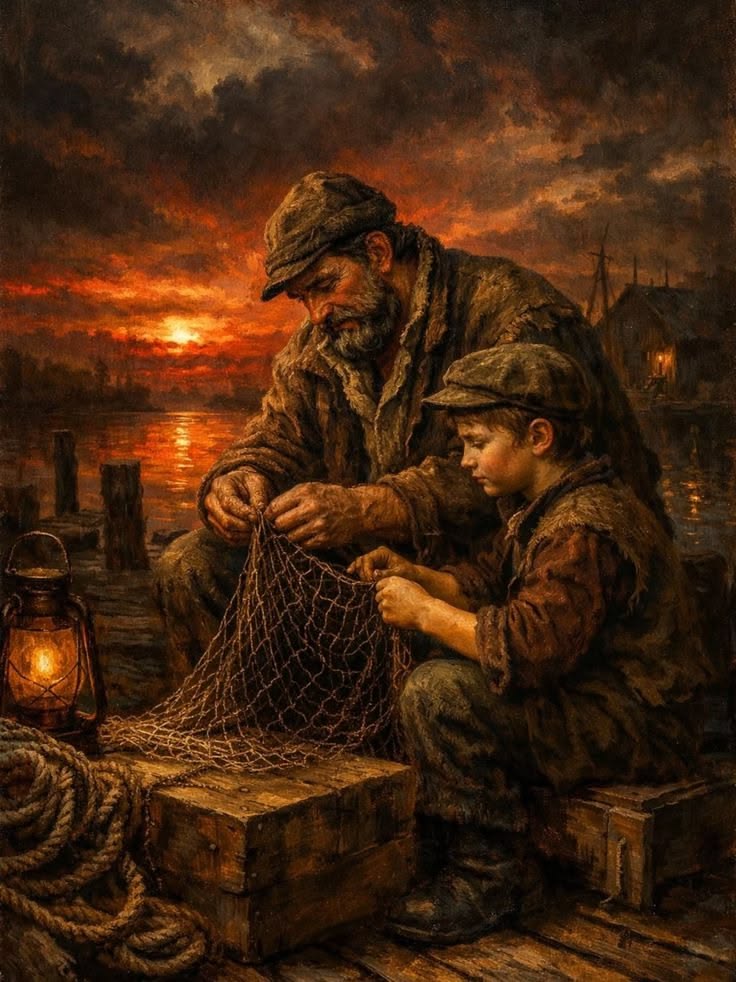
The old man always said that a broken net was just a conversation waiting to happen.
Henry Marsh had been saying things like that his whole life — the kind of compressed wisdom that sounded simple until you turned it over and found it had weight. His wife Margaret had called it his dock philosophy. His son James, who had left Harwick Bay for Boston at twenty-two and come back rarely and always briefly, called it old-fashioned. His grandson Owen, who was ten years old and sitting beside him on the dock crate in the last red light of a Tuesday evening, had not yet formed an opinion. He was still at the age where a man who knew things was worth sitting next to, and questions were better than conclusions.
They had been at the net for an hour.
It was a mending net, old and good, the kind Henry had been working his whole life — sixty-one years on the water, starting as a boy beside his own grandfather on a dock not unlike this one, in a town not unlike this one, under a sky that looked, most evenings, exactly like this. The tears weren’t bad. A rough haul two days ago had opened three sections, and Henry’s hands — large, scarred, moving with the unhurried authority of hands that had done this ten thousand times — worked the twine through the mesh with the steady rhythm of someone who had long since stopped thinking about the mechanics and let the body remember.
Owen watched.
He had come for the summer — an arrangement negotiated between his parents in the careful, diplomatic language of a divorce that was trying hard to be civilized. His father James was in Boston, working. His mother was in Portland, also working. Owen had been, as he heard adults put it when they thought he was out of earshot, between situations. He understood this to mean that the summer needed somewhere to put him, and Harwick Bay was where his grandfather was, and his grandfather had said yes before the question was fully asked.
He had been here three weeks. He had learned to bait a hook, to read the morning sky for weather, to drink black coffee without making a face — this last one a matter of pride that Henry had encouraged without comment, simply by handing him a cup every morning as if there were no other option. Owen had decided that black coffee tasted like something that expected more of you, and he was still deciding if that was good.
“Your turn,” Henry said.
He guided Owen’s hands to the break in the net — a clean tear about eight inches wide, the mesh parted in a way that looked, if you tilted your head, like a gap in a sentence. He showed him the entry point, the angle of the needle, the tension required — not too tight, not too loose, which was advice that applied to more things than nets, though Henry didn’t say that yet. He let the mechanics come first. The philosophy could follow.
Owen tried.
His first attempt was too tight — the mesh puckered around his knot like something flinching. Henry said nothing, just placed his thumb at the tension point and pressed gently, a correction without language. Owen tried again. Better. The third attempt was right, or close enough that Henry made the small sound in the back of his throat that Owen had come to recognize as approval — not praise exactly, just acknowledgment. Yes. Like that.
The sun continued its descent over Harwick Bay, painting the water in shades of copper and blood orange that no photograph ever quite captured, though people kept trying. The lantern on the dock box had been lit by Henry before they started, not because they needed it yet but because he always lit it at the beginning of an evening’s work — a habit from his grandfather, who had lit his from his own grandfather, a chain of small flames stretching back through the men of this dock like a kept promise.
“Grandpa,” Owen said, without looking up from the net.
“Mm.”
“Are Mom and Dad going to stay divorced?”
Henry’s hands continued their work. He did not pause, which was itself an answer of a kind — the question was not surprising, was not too large for the dock or the evening. It was simply a thing the boy needed to say somewhere, and here was as good as anywhere.
“I expect so,” Henry said.
Owen kept his eyes on his hands. “Does it get easier?”
Henry considered the question with the seriousness it deserved, the way he considered most things — not rushing to the answer, not deflecting toward comfort. He had found, in seventy-three years, that the questions children asked deserved the same honest engagement as the questions adults asked, and that children could tell the difference between an answer and a reassurance, and that they remembered which one they had gotten.
“The hard parts stay hard,” he said finally. “But you get stronger than them, if you let yourself.” He paused. “Key is letting yourself.”
Owen pulled a new length of twine through the mesh. His hands were steadier now than an hour ago. Muscle memory beginning its slow accumulation.
“Is that what you did? When Grandma died?”
“Still doing it,” Henry said simply.
The water held the last of the sunset on its surface, moving it in long, broken reflections that rearranged themselves constantly without ever settling. The harbor lights were coming on one by one in the distance — the cannery, the old inn, the buoy markers that had guided boats into Harwick Bay for longer than anyone still living could remember.
Henry looked at his grandson’s hands — young, clumsy, trying, learning — and felt something move in him that was not quite grief and not quite hope but lived in the country between them, where most of the important things lived.
“You’re doing well,” he said. “With the net.”
Owen looked up. In the lantern light his face was very young and very serious, carrying things that ten-year-olds had no business carrying but carried anyway, because weight didn’t check ages before it landed.
“Grandpa,” he said. “Can I come back next summer too?”
Henry kept his eyes on the net.
“You can come back every summer,” he said. “For as long as I’m sitting on this dock.”
He meant it as comfort. He did not know — could not know, in the ordinary human way of not knowing what is coming — that it would become something else entirely by the end of August. Something the boy would hold for the rest of his life, turning it over in dark moments the way his grandfather turned a net, looking for the place where things could be mended.
But that was August.
Tonight was tonight. The lantern burned. The nets grew whole under their hands. The sky over Harwick Bay went from red to deep blue to the first faint arrival of stars, and the old man and the boy sat together on the dock in the ancient, quiet companionship of a thing being fixed, one careful knot at a time.
