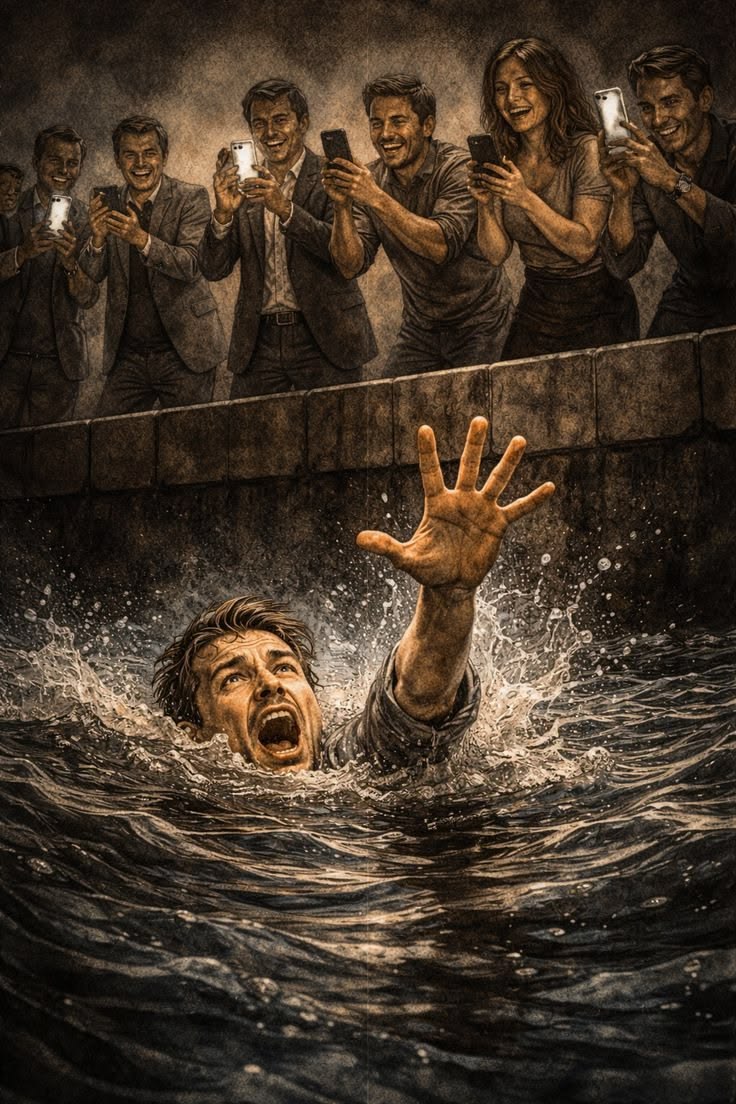
The video hit two million views before Daniel Marsh’s body was recovered.
That was the number his sister kept coming back to. Not the depth of the water. Not the temperature. Not the six minutes between his fall and the arrival of the paramedics. Two million people had watched her brother drown, and the most common comment underneath the video — posted four hundred and twelve times in various forms — was a single laughing emoji.
She’d counted. She’d had nothing but time to count.
Daniel had been the kind of man who held elevator doors for strangers. The kind who learned the names of every barista at every coffee shop he visited more than twice, who left twenty-dollar tips on twelve-dollar tabs, who once drove forty minutes in a rainstorm to return a wallet he’d found on a park bench — cash still inside — to a woman he’d never met and would never see again.
He was thirty-four years old.
He fell into the Millbrook Canal on a Tuesday afternoon in October, when the footpath gave way beneath him the way old city infrastructure sometimes does — quietly, without warning, without apology. The water was eleven feet deep at that point and moving faster than it looked, the way rivers always move faster than they look, and Daniel Marsh, who had grown up in landlocked Ohio and never learned to swim with any real confidence, understood within the first few seconds that he was in serious trouble.
He reached up.
Across the stone ledge above him, six people stood with their phones raised.
Marcus Webb was the first one to start recording. He’d say that later, in the interview that would make him briefly famous in a way he hadn’t anticipated and couldn’t control. He’d say it almost proudly, the way people announce being first in line for something. I was the one who got the whole thing.
He was twenty-six, worked in digital marketing, had a hundred and forty thousand followers on a platform that rewarded speed and sensation in roughly equal measure. When he saw the man fall, his thumb was already moving toward his camera app before any other part of his brain had fully processed what was happening.
He’d uploaded it within ninety seconds.
By the time the ambulance arrived, it had eleven thousand views.
By the time the hospital called Daniel’s sister, it had four hundred thousand.
By the time she identified his body, two million people had watched him drown, and a significant percentage of them had shared it with the caption: You won’t believe this.
The thing that destroyed Claire Marsh — slowly, in the months that followed — wasn’t the video itself.
It was the comments.
Not the cruel ones. She’d expected the cruel ones. The internet had spent years preparing her for cruelty in the way that living near a highway prepares you for noise. You hear it. You register it. You stop feeling it.
What she hadn’t been prepared for were the reasonable ones. The ones written by ordinary people with profile pictures of their kids and their dogs and their vacation sunsets. The ones that said things like: What were they supposed to do, jump in? And: People don’t realize how fast situations like this develop. And the one that appeared most frequently, in the most different forms, from the most different kinds of people:
It’s not illegal.
She knew it wasn’t illegal. She’d called a lawyer on the third day, when she still believed that knowing the precise dimensions of a thing could somehow make it smaller. The lawyer had been kind and careful and precise. He’d explained duty-to-rescue laws, or the absence of them. He’d explained that in most American states, a bystander has no legal obligation to assist someone in danger, provided they didn’t create that danger themselves.
“But,” he’d said, and then paused.
She’d waited.
“There’s no law against being a decent human being, either.”
He didn’t charge her for the call.
Marcus Webb deleted his account eight weeks after the video went viral. Not because of guilt, as far as anyone could tell. Because the attention had curdled in ways he hadn’t anticipated. Because other people had started making videos about him, and the algorithm had turned, and what had once been views and shares had become something with sharper edges.
He gave one final interview before he went quiet. The journalist asked him if he would do anything differently.
He thought about it for a long time. Long enough that the silence felt like an answer.
“I don’t know,” he finally said. “I genuinely don’t know. And I think that’s the part that keeps me up at night. Not that I did something wrong. But that I’m not sure I did.”
The journalist wrote that down.
It was the most honest thing anyone said in the entire aftermath.
Claire Marsh started attending city council meetings in November. She was not a person who had ever attended city council meetings. She was a thirty-one-year-old dental hygienist who spent her evenings reading and her weekends hiking and her emotional energy, for the past six weeks, entirely on grief.
But she’d read about a proposed ordinance. A duty-to-assist law, modeled on statutes that existed in twelve other states and most of Western Europe. It wouldn’t bring her brother back. She understood that with a clarity that was almost physical, the way you understand cold.
It wouldn’t bring anyone back.
But the footpath had been repaired in seventy-two hours. The city moved fast when liability was involved. And Claire Marsh had started to believe — carefully, the way you believe in something fragile — that people could be asked to be better than they were on a Tuesday afternoon in October.
Not forced. Not legislated into decency.
Just asked.
She stood at the microphone. The room was fuller than she’d expected.
She said her brother’s name first, before anything else, because she’d decided that was the most important thing she could do. Make them know he had a name.
Then she began.
