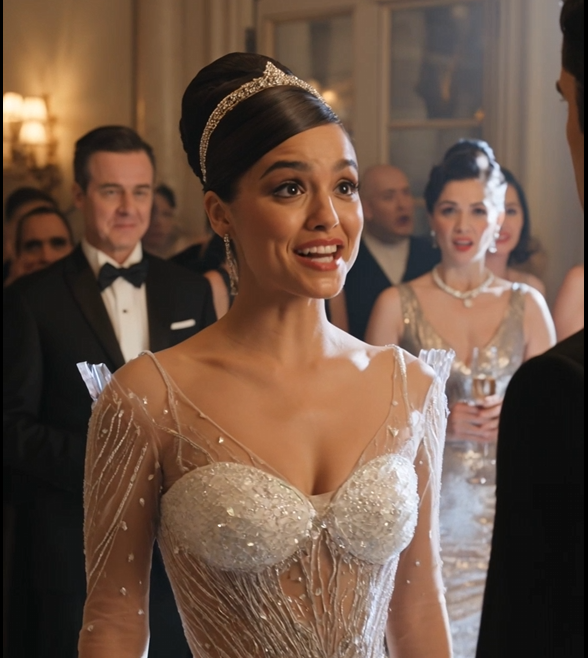
The champagne glass hit the marble like a gunshot.
In the half-second of silence that followed — that perfect, crystalline silence before a room full of wealthy people remembered how to react — Elara counted seven things. The way the stem snapped clean from the bowl. The way the liquid spread in a thin gold arc across the white floor. The way the nearest guests stepped back not from the glass, but from her. The way the woman in the silver gown covered her mouth. The way the man in the black tuxedo smiled. The way every phone in a ten-foot radius rose simultaneously, like a congregation lifting candles.
And the way none of it — not one single moment of it — was an accident.
His name was Colton Hale, and he had been born into the kind of money that makes people mistake cruelty for confidence. He was thirty-eight years old, had never waited for anything in his life, and had spent the better part of the evening watching the young waitress move through his ballroom with an efficiency and grace that irritated him in ways he couldn’t articulate and therefore didn’t try to.
He crossed the floor slowly. He had the walk of a man who had never been told to hurry.
“Quite an entrance,” he said, nodding at the shattered glass at her feet.
Elara said nothing. She had learned, in three years of working events like this one, that silence was a more powerful answer than most people expected.
Colton tilted his head. His smile was the kind that never reached his eyes because it wasn’t meant to. It was decorative. A social accessory, like his cufflinks.
“They tell me you used to dance.” He let the word used to do its work. “Professionally.”
The woman in the silver gown — his wife, or something close enough to it — shifted beside him. A small movement. The kind that meant she knew what was coming and had learned not to stop it.
“Fifty thousand dollars,” Colton said. “If you can cross this floor and make every person in this room believe you belong here.” He gestured broadly at the ballroom — the chandeliers, the orchestra pit, the marble columns, the two hundred people now watching with the careful attention of people who understood they were witnessing something. “Prove it. Right now.”
The guests laughed. Quietly, the way people laugh when they want credit for being in on the joke without the risk of committing to it fully.
Elara felt her fingers tighten around the silver tray. She felt her jaw set. She felt the particular heat of two hundred pairs of eyes and two hundred phone cameras, and beneath that heat, something older and quieter and considerably more dangerous.
She raised her eyes.
Colton Hale had expected tears. He had a talent for calibrating exactly how much pressure produced tears, and he had applied precisely that amount. What he had not expected — what made the smile flicker, just once, before he caught it — was the expression he found instead.
Not defiance. Not anger.
Something calmer than either.
“I accept,” Elara said.
She handed the silver tray to the nearest server without looking at him and walked toward the far doors of the ballroom with the unhurried posture of someone who has never once questioned whether she belongs in a room.
The orchestra, uncertain, let the music thin to almost nothing.
Colton watched her go. His smile returned, settled, confident. He turned to his guests with the expression of a man who has already decided how a story ends. Around him, people resumed their conversations, though they kept glancing at the doors.
He waited four minutes.
The doors opened on the fifth.
Later, people would struggle to describe exactly what happened in the moment Elara walked back into the Hale Grand Ballroom. Not because it was indescribable, but because every person present would remember a slightly different detail as the central one, and all of them would be right.
The dress was the color of the inside of a flame — not red, not gold, but the precise shade between them that exists only at the hottest point. It moved like water and caught light like a mirror, and every step she took sent small cascades of reflection across the ceiling and the faces of the guests. Her hair, which had been pinned back in the functional style of a working woman, now fell in a way that looked effortless and cost more than most people’s monthly rent.
She walked through the crowd and the crowd moved. Not because anyone directed them to. Because something in the architecture of her posture made parting feel like the correct response.
The woman in the silver gown had gone the color of the marble floor.
Colton Hale’s smile had not disappeared. It had simply stopped meaning anything.
When the host — sixty years old, white-gloved, unflappable by professional obligation — stepped forward and bowed at the waist, several guests audibly exhaled.
“Ma’am,” he said. “They’ve all been waiting for you.”
Colton found his voice somewhere around the third attempt.
“Who are you?”
Elara stopped directly in front of him. She looked at him the way you look at something you have already decided requires no further consideration.
“You should have asked,” she said, “before you bet against me.”
The sound came from behind her. Measured footsteps. A presence that rearranged the air in the room the way true authority always does, not loudly, but completely.
The man who stepped into the light was older. Gray at the temples. The kind of calm that comes from having nothing left to prove.
“Miss Elara,” he said. “Your father—”
The lights cut.
In the darkness, someone — no one would ever agree on who — whispered a single word.
Her father.
And in the silence that followed, two hundred people stood in a dark ballroom and understood, all at once, that they had been watching entirely the wrong person lose.
