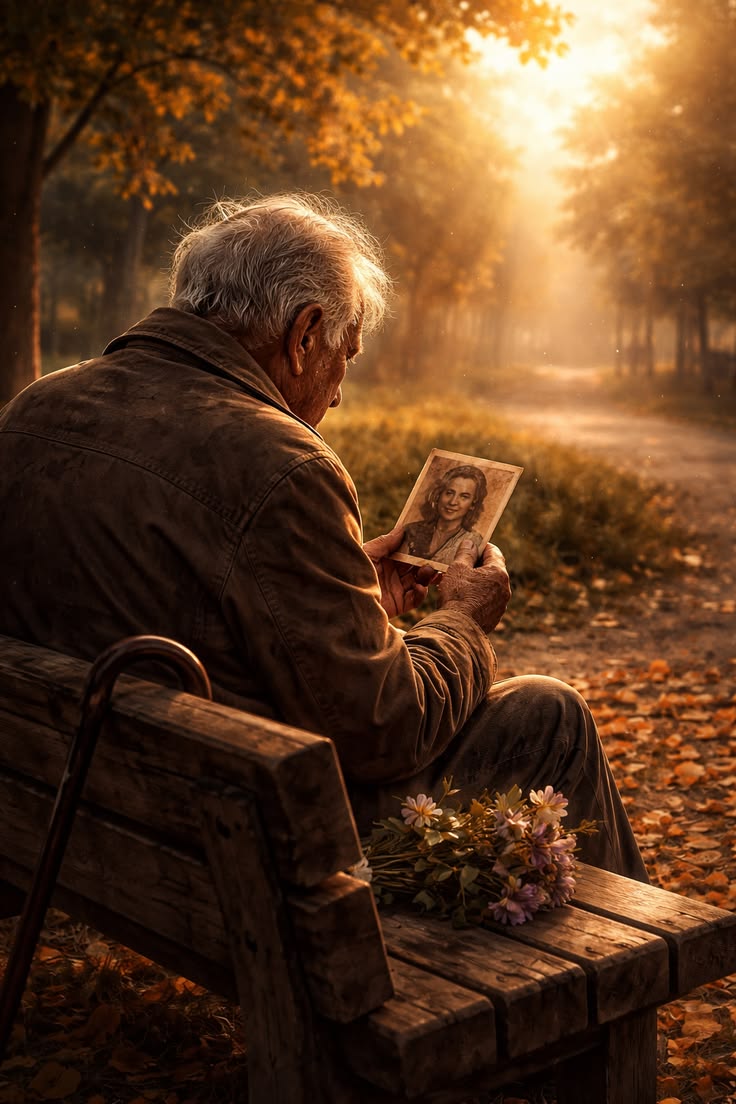
He had been coming to this bench for fifty-one years.
Same bench. Same park. Same first Saturday of October, when the maples along Ridgewood Path turned the color of embers and the morning light came through the trees at exactly the angle that made the whole world look like something you were supposed to remember. Harold Keene, eighty-two years old, settled onto the worn wooden slats with the careful deliberateness of a man who has learned that his body requires negotiation now — a slow lowering, a hand on the armrest, a breath held until everything confirmed it was alright to let go.
He set his cane against the bench’s arm.
He placed the flowers beside him — daisies and asters, purple and white, the same ones he had brought every single year because they had been her favorites and that had not changed and would not change and was, in fact, one of the few fixed points remaining in a world that seemed increasingly committed to moving everything he knew.
Then he reached into the inside pocket of his corduroy jacket and took out the photograph.
Her name was June. June Eleanor Keene, née Whitmore, of Dayton, Ohio, where she had been born in 1945 and where Harold had met her at a church social in 1967 when she was twenty-two years old and wearing a yellow dress and laughing at something her friend had said, laughing with her whole face the way some people do when they have not yet learned to be self-conscious about joy.
Harold had not been a man who acted quickly. He was an engineer by training, methodical by nature, a person who measured twice and cut once and applied that principle to most things in his life. But he had crossed that church hall in twelve seconds flat and introduced himself before his brain had fully signed off on the plan, and June had looked at him with those dark eyes and said, “I know who you are, Harold Keene. You fixed my father’s furnace two winters ago and he still talks about it.”
He had married her fourteen months later.
They had fifty-three years together. Fifty-three years of a life that was not a fairy tale — it was better than that, realer than that, built from the same materials as everyone else’s life, which is to say patience and compromise and occasional exasperation and the specific, daily, renewable choice to turn toward another person instead of away. They had two children, four grandchildren, one miscarriage they never fully spoke of and never fully forgot, three houses, two dogs, one very bad year in the early nineties when Harold lost his job and his pride simultaneously and June held the whole family together with a steadiness that he had not known to appreciate fully until much later.
She had been gone for four years.
Harold still reached for her in the night. He had stopped being surprised by the empty space and started being something else — accepting wasn’t the right word, and neither was used to it. It was something more like carrying. You carry the absence the way you carry anything that belongs to you.
He held the photograph in both hands, the way you hold something that cannot be replaced.
It was a black-and-white image, slightly yellowed at the edges, taken at a company picnic in the summer of 1969. June was twenty-four years old in it. She was looking slightly off-camera, caught in the middle of a smile that was breaking across her face like sunrise — not posed, not performed, just real, just her, just that particular light that she carried in her face that Harold had spent fifty-three years trying to find words for and had eventually concluded was simply the best argument he had ever encountered for the existence of something larger than accident.
Hello, sweetheart, he thought. I brought your daisies.
The park was quiet at this hour. A jogger passed on the path, earbuds in, eyes forward, belonging to a different decade entirely. Two young mothers pushed strollers in the middle distance, their voices carrying in fragments — something about a preschool, something about a pediatrician. A crow landed on the path ahead of Harold, regarded him with the frank assessment that crows reserve for the elderly and the stationary, and moved on.
Harold didn’t mind the solitude. He had grown into it the way a plant grows into the shape of its container — not happily, exactly, but completely.
He talked to her. He always talked to her. Not out loud, mostly, because he was a private man and the park was a public place, but in that internal register that married people develop over decades, the voice that runs just below the surface of the spoken word and carries everything the spoken word can’t hold.
He told her about their grandson Michael’s new apartment in Chicago. About the hip that had been giving him trouble since August. About the neighbors’ new dog, a ridiculous fluffy thing that barked at leaves, that he was beginning to suspect he loved despite his better judgment. About the book he was reading, a history of the Apollo program, and how he kept finding passages he wanted to read aloud to her and how that was perhaps the loneliness that surprised him most — not the silence of the house but the surplus of unreceived observations, all the small things that had no one to land on now.
You would have liked this book, he told her. You always said the moon landing was the most beautiful thing you ever watched on television. You cried, remember? Right there in your parents’ living room. You said it proved that human beings were worth the trouble.
The light through the maples shifted, and for one moment — one of those moments that you cannot manufacture and cannot explain and can only receive — the whole park went golden and still.
Harold closed his eyes.
He could hear the wind in the amber trees. He could feel the photograph between his fingers. He could smell the daisies, faintly, the way flowers smell in October when the cold is beginning to negotiate with the warmth and neither has won yet.
He stayed like that for a long time.
When he opened his eyes, a young woman was sitting at the other end of the bench.
She had not been there before. He was certain of it — Harold Keene was not a man who missed things. She was perhaps thirty years old, dark-haired, wearing a coat the color of autumn leaves, and she was looking at the photograph in his hands with an expression that was not intrusive, not curious, but something more careful than either.
“She’s beautiful,” the young woman said quietly.
Harold looked at her. Then at the photograph. Then back at her.
“She was,” he said. And then, because something about this stranger on this bench on this particular morning made the words feel not like loss but like gift: “She still is.”
The young woman smiled. It broke across her face like sunrise.
Harold’s hands went very still.
