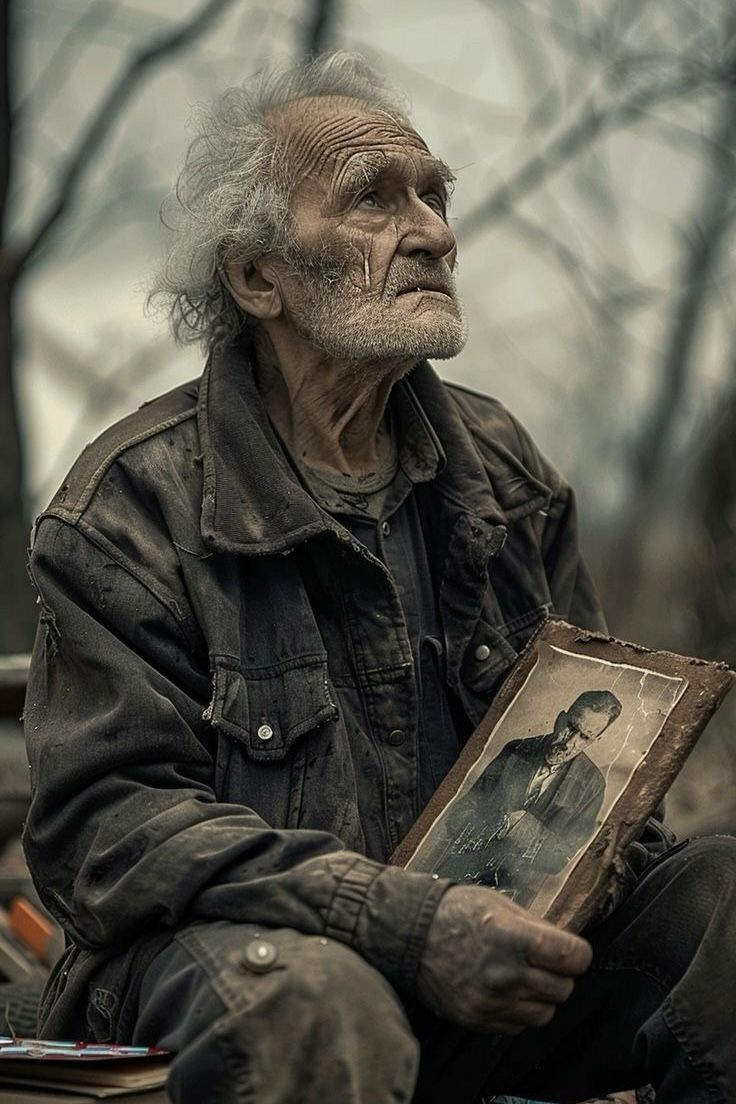
Everyone on the corner of Fifth and Madison knew his name was Walt.
That was all they knew. Walt. No last name offered, none requested — because that is the particular social contract of the street, where names are currency and most people have spent theirs down to nothing. He had been sitting on that same stretch of sidewalk outside the old Greyhound station in Memphis, Tennessee for going on six years, through four winters that tried to kill him and three summers that nearly finished the job, through two mayors and one pandemic and an economic recovery that had recovered everything except the people who needed it most.
He was somewhere between sixty-five and eighty. Nobody could say with certainty, including Walt himself, because there is a point in a certain kind of life where the years stop presenting themselves in order and begin arriving all at once, wearing the same face.
What people noticed — the ones who noticed anything — was the photograph.
Walt carried it everywhere. A large framed portrait, cracked at one corner, the glass long gone, the image protected now by nothing but luck and the careful way Walt held it against his chest when the weather turned hostile. It was a black-and-white photograph of a young man — late twenties, perhaps, dark-haired, square-jawed, wearing a suit jacket that suggested occasion, looking at the camera with the direct, undefended gaze of someone who does not yet know what is coming.
People assumed it was a son. The social worker from the downtown outreach center, a kind woman named Patricia who had been trying to get Walt into transitional housing for three years, had assumed it too, the first time she sat with him on the sidewalk and asked about it.
Walt had looked at her with those pale, sky-searching eyes — always looking upward, always, as if the answers to things were stored just above the treeline — and said, simply: “That’s who I used to be.”
Patricia had not known what to do with that. She had written it in her case notes and underlined it and returned to it more times than was strictly professional.
The story of how Walt became Walt was not a single catastrophe.
That is the thing that people get wrong about homelessness — they want a moment, a pivot point, a clean narrative of before and after. The truth is almost always slower and more complicated and more American than that. It is a series of ordinary doors closing, one after another, in rooms you didn’t even realize you were dependent on until the latch clicked.
Walt’s name had been Walter James Cobb. He had been, at various points, a carpenter, a husband, a father of two, a little league coach, a man who made his own chili from scratch every Super Bowl Sunday and took genuine pride in it. He had lived in a three-bedroom house in Bartlett, Tennessee, with a wife named Sandra and a son named Ryan and a daughter named Melissa, and if you had shown him a photograph of himself at sixty-eight years old sitting on a Memphis sidewalk holding a portrait of his younger self, he would have said you had the wrong man.
The drinking had started after the layoff. The layoff had come after the company he’d worked for twenty-two years was purchased by a larger company that had no particular use for its workforce. The drinking had accelerated after Sandra left — not cruelly, not suddenly, but with the exhausted finality of a woman who had held on past the point that holding on made sense. Ryan had stopped calling after a disagreement that had started about money and ended about everything else. Melissa sent a card at Christmas. Some years.
Walt did not tell this story as a tragedy. He told it, on the rare occasions he told it at all, the way a surveyor describes terrain — here is the elevation, here is where the ground drops away, here is where I found myself standing when the map ran out.
What he did not tell, what he kept folded inside himself like the photograph kept inside its broken frame, was the specific night he had taken that portrait down from the wall of the house in Bartlett — the last night, the night Sandra’s brother had come with a truck for her things — and held it under the single working light in the empty living room and looked at the young man in the image and made a promise.
I will not forget who you were, he had said. Even if you forget everything else.
He was looking at the sky the afternoon that the boy sat down beside him.
The boy was maybe nineteen, wearing a backpack and the particular expression of someone who has recently made a decision they haven’t told anyone about yet. He sat at the far end of Walt’s makeshift encampment — a flattened cardboard arrangement of quiet dignity — and said nothing for a while, which Walt respected.
After a few minutes the boy looked at the photograph.
“Who’s that?” he asked.
“A man I’m trying to find my way back to,” Walt said.
The boy was quiet. Then: “Does he know you’re looking?”
Walt turned his sky-searching eyes downward for once and looked at the boy directly — really looked, the way he hadn’t looked at another person in longer than he could honestly calculate. He saw something in that young face that he recognized the way you recognize a road you’ve driven once, years ago, at night.
The boy’s backpack, he now noticed, had a Greyhound tag on it. And the expression he’d clocked as recent decision was resolving itself, the longer he looked, into something more specific.
The boy was running away from something.
Or toward something.
Walt, who knew the difference better than most, set the photograph carefully on the cardboard between them like an offering — like a map, or a warning, or both — and said the only thing that felt true:
“Son, where are you going?”
The question floated up into the gray Memphis sky, past the bare and reaching branches, toward whatever it is that old men with photographs look for when they look up.
The boy opened his mouth.
And Walt, for the first time in six years, leaned in to listen.
