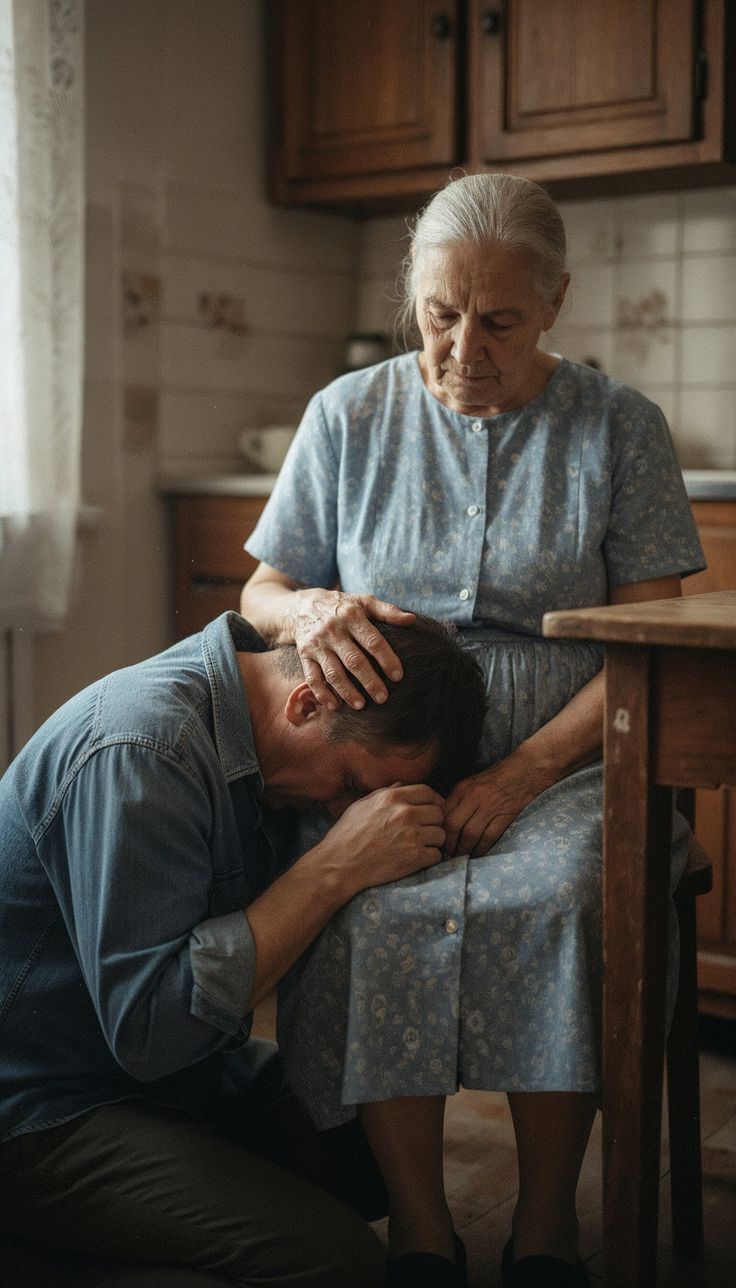
He had driven nine hours to fall apart in his mother’s kitchen.
That was the thought that moved through Nathan Cole’s mind as his knees hit the linoleum — not gracefully, not by design, but the way a building comes down when the last load-bearing wall gives way, which is to say all at once and without further negotiation. He was thirty-eight years old. He was wearing the denim shirt he’d put on three days ago and hadn’t changed since because changing clothes required a kind of forward momentum that had not been available to him. He had driven from Cincinnati to this small house in Harlan County, Kentucky, on four hours of sleep and six months of held-together, and somewhere between the front door and this kitchen chair he had simply stopped holding.
His mother’s name was Agnes Cole. She was seventy-one years old and she had been sitting at this same kitchen table since approximately 1987, in the way that certain women of certain generations seem to have selected a post and committed to it — always there, always with coffee, always with the particular quality of attention that does not ask questions first but simply opens and receives.
She did not ask what was wrong.
She put her hand on his head.
Nathan had been the kind of son that mothers brag about at church.
Scholarship to UK. Law degree from Vanderbilt. A firm in Cincinnati that had made him partner at thirty-four, which was the youngest in the firm’s history and a fact his mother had mentioned to every person she encountered for approximately eleven months. He had married a woman named Claire who was brilliant and funny and who laughed at things that were actually funny rather than just performing laughter, which Nathan had always considered a mark of genuine character. They had a daughter named Sophie who was six years old and who had her mother’s laugh and Nathan’s stubbornness and a way of looking at the world with total, unguarded wonder that made Nathan feel, every time he watched her, that he was in the presence of something he needed to be worthy of.
Six months ago, Claire had asked him to sit down at the kitchen table in Cincinnati — a different kitchen, a better one, granite countertops and pendant lights and the small potted herb garden Claire kept on the windowsill — and she had told him, with the careful, compassionate directness of a woman who has rehearsed difficult truths, that she hadn’t recognized him in two years.
Not that she didn’t love him. She did. Not that she wanted to leave. She didn’t, not yet — not yet being the phrase that had lodged in Nathan’s chest like a splinter and worked its way deeper every day since. She wanted him back. The him that had existed before the partnership, before the billing hours that turned months into spreadsheets, before the slow, unannounced migration of his attention from the people in front of him to the cases on his desk and the clients on his phone and the reputation he was building so carefully, brick by brick, that he hadn’t noticed he was building it on top of everything that actually mattered.
I feel like I’m living with someone who’s always about to arrive, she had said. But never quite does.
Nathan had done what he was good at. He had managed it. He had treated his marriage like a case — identified the problems, proposed solutions, implemented strategies, tracked outcomes. He had come home earlier. He had put his phone in a drawer during dinner. He had scheduled — and immediately recognized the grim irony of this — quality time.
Claire had watched all of it with those clear, honest eyes and said, gently, that she didn’t need a managed version of him. She needed the actual one.
He had not known, standing in the pendant-lit kitchen in Cincinnati, how to tell her that he wasn’t sure the actual one was still in there. That the person she was describing — the one who arrived fully, who was present in the complete sense of the word — felt like someone he had last seen in the rearview mirror a long time ago on a road he wasn’t sure he could find his way back to.
He had nodded and said he understood and gone upstairs and sat on the edge of the bed in the dark for a long time.
That had been six months ago.
Agnes Cole’s hand on her son’s head did not move.
It rested there with the absolute, undemonstrative certainty of a hand that has been a refuge before and knows how to be one again. No stroking, no patting — just presence, just weight, just the warm and wordless communication of I am here and you are mine and that is not a thing that circumstances can revise.
Nathan’s hands were fisted in the fabric of her dress — not violently, not desperately, but the way a person holds onto the one fixed point in a room that is moving.
He was crying in the way that men cry when they have been not crying for a very long time, which is to say thoroughly and without dignity and with the physical totality of a body releasing something it was never designed to store indefinitely.
Agnes looked at the top of her son’s head — at the hair that was the same dark brown as his father’s had been, at the place where the first threads of gray were beginning to appear at the temples — and she saw him the way mothers see their children, which is all of it simultaneously: the infant, the boy, the teenager who thought he knew everything, the young man who left for college with that overstuffed duffel bag and turned around at the end of the driveway because he forgot to hug her, the father, the partner, the exhausted human being on her kitchen floor.
She had known something was wrong for six months. She knew because Nathan had called every Sunday without fail for twelve years and in the last six months the calls had come on Wednesdays too — not for any stated reason, just checking in, Mama, just wanted to hear your voice — and Agnes Cole had not raised a child to adulthood without learning to read what the extra phone calls meant.
She had been waiting.
“Take your time,” she said.
Three words. The grammar of unconditional love, which does not require explanation or elaboration — just the plain, plain statement that here, in this kitchen, in this corner of Harlan County where the world is small and the coffee is strong and the linoleum has seen fifty years of the family’s most honest moments, time belongs to him and she is not going anywhere.
Nathan exhaled.
It was the kind of exhale that contains a season.
Outside the kitchen window, the Kentucky afternoon was doing what Kentucky afternoons do in late October — going gold and quiet, the light thickening in the way that makes everything look important, the hills in the distance holding their color like they know it’s almost over and want to mean something before it goes.
Inside, a woman kept her hand on her son’s head.
Inside, a man remembered where home was.
He had been gone a long time — not from this house, not from this county, but from something more essential and harder to map: that interior place where a person is simply themselves, without performance or strategy or the accumulated weight of who they’ve convinced the world they are. He had been gone from it so long he had stopped noticing the absence. He had furnished the empty space with achievement and filled the silence with productivity and called it, without examining the claim, a life.
His mother’s hand on his head said: you were always more than that.
His mother’s kitchen said: you can start over from here.
