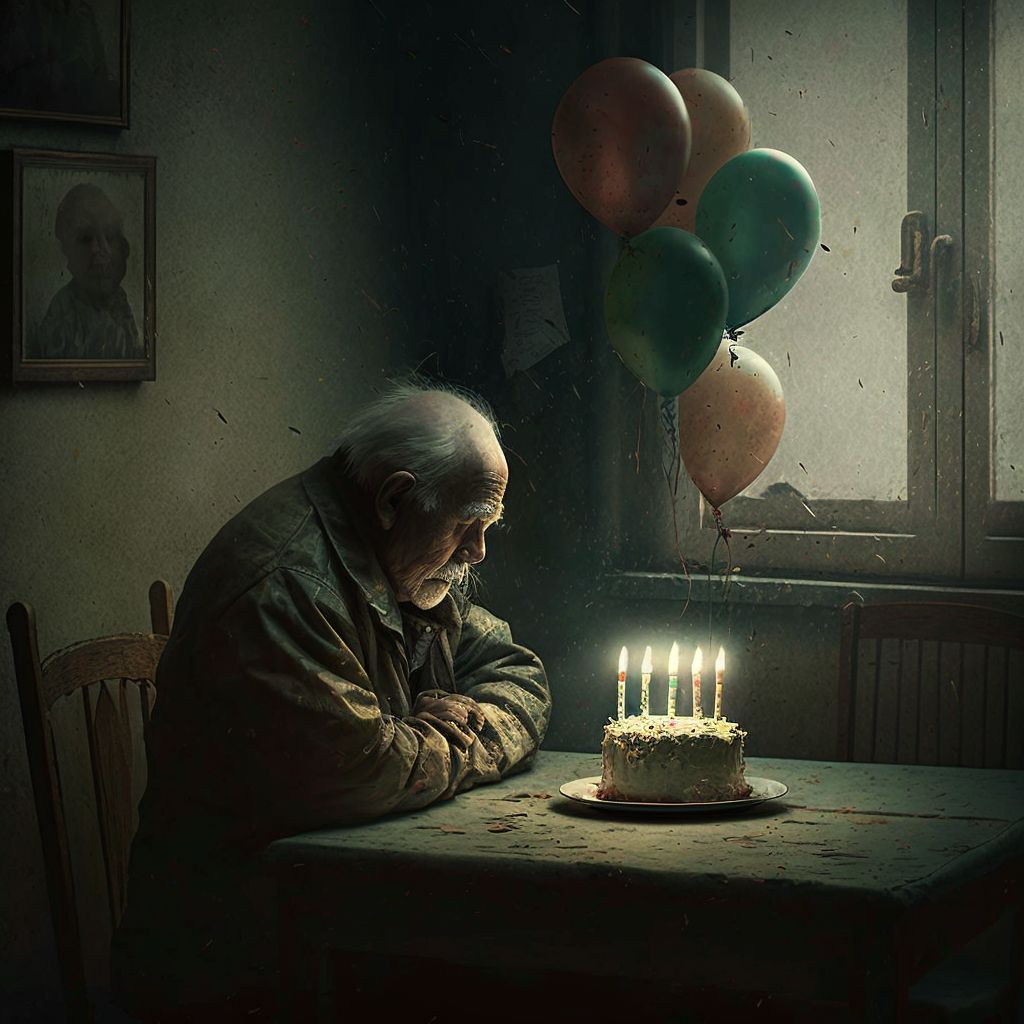
He had lit them himself.
That was the part that stayed with you, if you thought about it — and Arthur Gillam had been trying very hard not to think about it. He had gone to the grocery store on Tuesday, the one on Birchwood Avenue where the checkout girl called everyone hon and the fluorescent lights buzzed at a frequency that lived just below the threshold of conscious irritation. He had stood in the bakery aisle for longer than was strictly necessary, looking at the cakes in their plastic domes — the ones with the airbrushed roses and the cheerful piped borders and the little sugar decorations that cost extra — and he had selected a plain white one, round, undecorated, the kind that made no promises.
He had bought candles too. A pack of birthday candles in assorted colors, because the store didn’t sell individual ones and he only needed six — six candles for eighty years, one per decade, because that had been his wife Margaret’s system and he saw no reason to change it now, even though Margaret had been gone for seven years and there was no one sitting across this table to appreciate the system or question it or suggest that they should just use one candle shaped like the number eighty and be done with it.
He had come home, put the cake on the plate, tied the balloons to the chair across from him — four of them, from the gas station, red and green and teal and the pale pink that Margaret would have called blush and he called light red which she had always found endearing and a little hopeless — and he had lit the candles one by one with the long-handled lighter he kept in the kitchen drawer.
Then he had sat down across from them and looked at the small, bright fact of six flames in a dark room on a November afternoon, and he had not blown them out.
Not yet.
Arthur Gillam had been born eighty years ago today in a farmhouse outside of Decatur, Illinois, the third of five children, in a family that was loud and broke and fundamentally, stubbornly alive in the way that people are alive when they don’t have the luxury of being otherwise. His father had worked the line at Caterpillar. His mother had worked everywhere else. He had grown up understanding that love was demonstrated through presence and labor, that celebrations were made from whatever was at hand, and that the people in a room mattered more than anything put on the table.
He had carried those beliefs into a life that had, for many decades, given him abundant reason to maintain them.
Thirty-one years with Margaret. Two children — a son, David, and a daughter, Patrice — who had grown into people Arthur admired not just as a father but as a human being with discerning judgment. A career in electrical work that had kept the lights on in half of Evansville, Indiana, for four decades, and which had produced in Arthur a permanent and specific satisfaction in the act of making things work that he had never found a way to translate to people who hadn’t experienced it. A house on Sycamore Street that he had spent forty years improving with his own hands, room by room, the way you build a life — not all at once, not according to a master plan, but incrementally, with attention and care and the willingness to tear something out and start over when it wasn’t right.
That was the life.
The full version. The one that, if you had asked him at fifty or sixty or even seventy, he would have described without hesitation as enough. As more than enough. As the specific, unremarkable, irreplaceable accumulation of ordinary good fortune that constitutes a life well-lived.
But lives don’t end at seventy.
Margaret had gone first — a stroke, fast, the kind that the doctors described as merciful and that Arthur experienced as anything but. David lived in Portland now, with his second wife and her kids from her first marriage, a whole assembled life that Arthur was welcome at the edges of and sometimes appeared at Christmas. Patrice was in Tampa. She called on Sundays, mostly, and on his birthday she had called this morning before eight, which he had appreciated, and the call had lasted eleven minutes, which he was trying not to count.
The friends had gone the way friends go when you are eighty in a mid-sized Indiana city — some to Florida, some to the grave, some to the slow interior distance that illness or decline creates between people who were once close. His neighbor Frank had moved to his daughter’s house in Terre Haute in September. The chair across from Arthur — the one with the balloons tied to it — had been Frank’s chair at last year’s birthday, and the year before that, and the year before that.
The chair was empty now.
The candles burned.
Arthur looked at the flames and thought about eighty years and what they added up to and whether the sum was visible from here, sitting alone at this table in this house on Sycamore Street with a cake he had bought himself and balloons from a gas station and six small fires that were waiting, with absolute patience, for him to decide to end them.
He thought about Margaret, who would have made the cake herself — lemon, always lemon, because she knew he preferred it even when he said it didn’t matter. He thought about the farmhouse in Decatur and the sound his family made when they were all in one room — that specific, irreproducible noise of people who belong to each other, talking over each other, occupying each other’s spaces without apology.
He thought about the checkout girl who had called him hon at the grocery store and how that small word had sat in his chest for two days like a coin at the bottom of an empty pocket.
He was not a man given to self-pity. He wanted to be clear about that, even here, even in the privacy of his own kitchen with no one to perform clarity for. He had lived well. He had loved and been loved and built things with his hands that still stood. He had nothing reasonable to complain about.
But reasonable and true were not always the same thing.
And the true thing, sitting here at eighty with six candles burning down toward their own extinction, was this: he was tired of being brave about it.
He leaned forward.
He opened his mouth to blow.
And then his phone, which was on the table beside the plate, lit up with a name he had not seen on a screen in four years.
Kevin Gillam.
His grandson. David’s son from his first marriage. Twenty-two years old, last Arthur had heard — though what Arthur actually knew about Kevin’s current life would fit in a sentence, because Kevin had been the casualty of David’s divorce in the way that children sometimes are, drifting to the margins first and then past them, into a silence that nobody had officially declared but everyone had accepted.
Arthur stared at the name on the screen.
The candles burned.
He picked up the phone.
