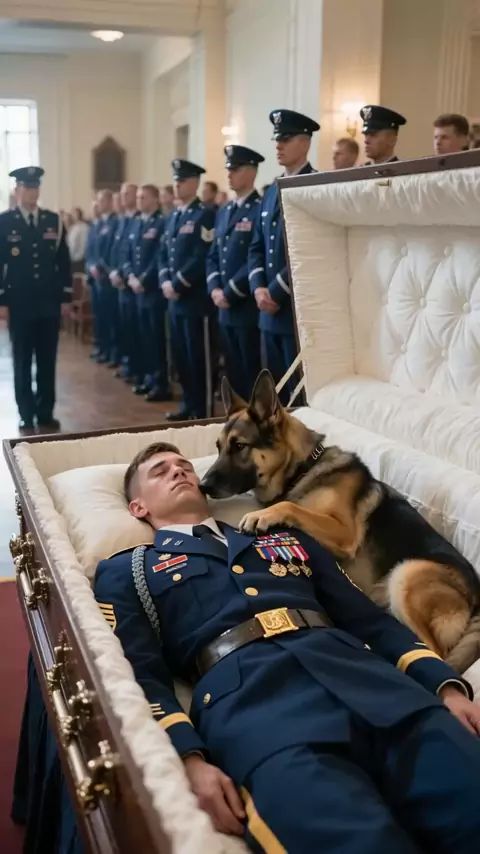
Nobody in the funeral home had moved for four minutes.
Not the honor guard — sixteen soldiers in dress blues standing at perfect attention along the wall of the Whitmore & Sons Chapel in Clarksville, Tennessee, each one of them holding the rigid stillness that military bearing demands and that military grief makes almost unbearable. Not the family in the front pews — Staff Sergeant Marcus Webb’s mother in her black dress with her hands folded in her lap and her eyes fixed on something that wasn’t in this room, his younger sister leaning into her with the particular collapse of a person whose body has stopped pretending. Not the chaplain, who had delivered the service with the practiced grace of a man who has done this too many times and has never once found it easier.
Not the two hundred people filling every available inch of the chapel — the soldiers who had served with Marcus, the neighbors from the subdivision in Clarksville where he had grown up, the high school coach who had driven four hours from Nashville, the Gold Star families who came to these things because they understood them in a way that required no explanation.
Nobody moved because Ares was in the casket.
He had gotten there before anyone thought to stop him.
The service had reached the moment when the family was permitted to approach — that final, formal goodbye that is somehow both the most necessary and the most impossible thing a human being can be asked to do — and Corporal Danny Reyes, who had been holding Ares’s lead throughout the ceremony, had felt the leash go suddenly slack. Not yanked away. Slack. The way it goes slack when a working dog has made a decision and executed it before the handler’s nervous system has processed that a decision was being made.
Ares had crossed the fifteen feet between his position and the casket in four seconds. He had put his front paws on the edge — gently, with a precision that seemed to understand the sacredness of the moment and the fragility of everything in it — and he had pressed his nose against Marcus’s dress uniform. Against the medals. Against the chest that had, for four years, been the specific geography of safety and purpose and home that this dog had organized his entire working life around.
He stayed there.
Danny Reyes stood with the empty leash in his hands and did not move.
Nobody moved.
The only sound in the chapel, after the collective intake of breath that had accompanied Ares’s movement, was the low, sustained sound the dog was making — not a whine, not a howl, but something underneath both of those, a sound from a register so fundamental that it bypassed the thinking mind entirely and arrived directly in the chest. The sound of a dog who has tracked his person across every terrain and through every condition that four years of joint deployment could produce, and has followed that scent to this place, and is working — with every instrument he possesses — to reconcile what he is finding with what he knows.
Marcus Webb had been twenty-six years old.
He had enlisted at eighteen, which his mother had opposed and his father — who died when Marcus was fifteen and who had served two tours in the Gulf — would have understood. He had done three deployments: Iraq, then Afghanistan, then Afghanistan again, the second tour being the one that produced the Silver Star on his chest and the nightmares he didn’t discuss and the way he sometimes sat on the back porch in the dark for an hour after dinner without explaining why.
He had requested Ares after his second deployment. He had gone through the handler certification with a focus that his supervising sergeant described as the most natural human-animal pairing he had seen in twenty years of MWD program work. It was not that Marcus was exceptional with dogs in general — he was, but that wasn’t the point. The point was that Marcus and Ares were exceptional together, in the way that certain partnerships produce something neither party contains alone, something that only exists in the space between them.
They had done fourteen months together in Afghanistan on the third tour. Eleven confirmed explosive finds. Three direct action operations. One incident — classified, which meant that the people who knew what happened didn’t discuss it and the people who didn’t know understood not to ask — from which Marcus had returned changed in ways that were not fully visible but were felt by everyone who knew him, and from which Ares had returned with a scar on his right flank that the veterinary report described in clinical language and that Danny Reyes described, to anyone who asked, as the mark of a dog who put himself between his handler and something that had no right to happen.
That was fourteen months ago.
Three weeks ago, on a Tuesday in October, Marcus Webb had been driving home from the base on Route 41A when a driver running a red light at sixty miles an hour had made the entire question of deployment and survival and what comes next permanently irrelevant.
Not enemy fire. Not an IED. Not the hundred dangerous things that Marcus had navigated through three deployments and fourteen months and eleven finds and one classified incident.
A red light on Route 41A in Clarksville, Tennessee.
His mother had said, in the three weeks since, that she didn’t know how to grieve it. That she had spent eight years preparing herself for a certain kind of loss, building the interior architecture for a grief that would at least make a kind of terrible sense, and that this — this ordinary Tuesday, this intersection, this driver who had survived and was in a county jail somewhere and was probably not a bad person, just a person who made one catastrophic decision at the wrong moment — this she did not have the architecture for.
She was sitting in the front pew now, watching Ares, and something in her face had shifted.
Danny Reyes had served with Marcus for two years. He was twenty-four years old and he was holding an empty leash and trying to remember his training about MWD protocol in civilian ceremonial settings, which had not covered this, because nothing covered this. He was also trying not to cry, which was a battle he was losing incrementally and without dignity.
He looked at the honor guard. At the chaplain. At Marcus’s mother.
Nobody gave him a signal. Nobody told him what to do.
He understood, in the way you understand things that your training hasn’t prepared you for, that there was nothing to do. That Ares was doing the only thing available to him — the thing that four years of partnership had made as fundamental as breathing — which was to stay with his person. To maintain the post. To keep the watch that had been keeping the two of them alive and operational through everything the world had thrown at them, right up until the moment the world threw something that a dog’s presence and loyalty and sixty-eight pounds of muscle and instinct could not intercept.
The watch had not ended.
Ares did not understand that it was supposed to.
Marcus’s mother rose from the front pew.
She walked to the casket the way she walked everywhere, which was slowly and with purpose, the walk of a woman from Mississippi who had raised two children on a teacher’s salary after her husband died and who had learned that you arrive at difficult things by putting one foot in front of the other and not looking at how far away they are.
She reached the casket. She stood beside Ares. She put her hand on the dog’s back — between his shoulder blades, where he could feel it — and she looked at her son’s face for a long moment with the expression of a woman who has been doing this in private for three weeks and is doing it now in public because there is no longer a difference, because the grief is too large to have an inside and an outside anymore.
Then she looked at Ares.
“You brought him home every time,” she said.
Her voice was steady. It was the most extraordinary thing Danny Reyes had ever heard.
“Every time,” she said again. “Thank you.”
Ares turned his head and looked at her — really looked, the way dogs look when they are receiving something — and made a sound that was small and low and final.
In the back of the chapel, someone in uniform began to cry.
Then the person beside them.
Then the next.
The honor guard held their positions. Sixteen soldiers in dress blues, eyes forward, military bearing intact, with tears running down faces that were not going to move and not going to flinch and not going to look away from the dog keeping watch over the man they had come here to honor.
Outside, in the October morning, the flag was at half-staff.
Inside, Ares kept his post.
