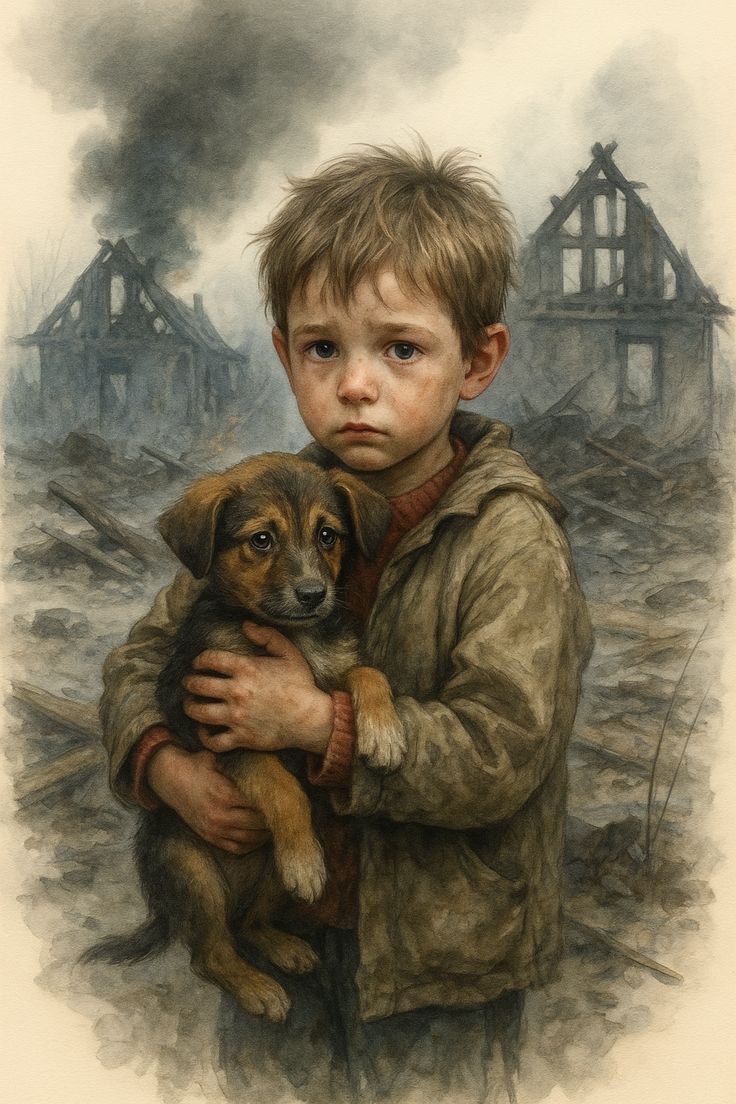
The fires had been out for three days.
What remained of the town of Millbrook, West Virginia — four streets, a hardware store, a Baptist church, a school with a hand-painted mural of the American flag on the gymnasium wall — stood in the particular silence that follows destruction, which is not the absence of sound but the presence of a new kind of it: the sound of things that are no longer moving, no longer creaking, no longer inhabited by the ordinary noise of people living inside them.
Tomás Vega was eight years old and he was standing in the middle of what had been Clement Street, holding a puppy against his chest with both arms, staring at the space where his house used to be.
He was not crying.
He had cried already — in the back seat of Mrs. Patterson’s car on the way to the evacuation shelter, and then again in the shelter bathroom with the door locked so his little sister Rosa wouldn’t see. He had decided, somewhere between the second set of tears and the moment he had slipped away from the shelter at dawn to come back here, that crying was finished for now. That there was something more necessary than crying, which was figuring out what came next, and you could not figure out what came next with your eyes full.
He was his mother’s son. That was what people said, and what it meant was this: when the world fell apart, the Vega family got very quiet and very focused, and they looked at what remained instead of what was gone.
What remained, on Clement Street, on this gray Tuesday morning in November, was Tomás and a puppy with no name and smoke that was still rising from the skeleton of the house two lots down.
The puppy had found him.
Not the other way — Tomás was clear on this detail, the way children are clear on details that matter to them. He had not found the puppy. The puppy had come out of the debris near the old Hartwell property, at approximately six in the morning, when Tomás was standing in the ash and the early light trying to remember the layout of his bedroom from the outside — where the window had been, where his desk, where the shelf with the baseball cards his grandfather had left him — and had simply walked up to him across the ruined ground and put its two front paws on his shoe and looked up.
Brown and black, maybe ten weeks old, with the oversized paws of a dog that would eventually be large and the enormous eyes of a creature that has recently learned that the world is not a safe place and has decided, on insufficient evidence, to trust anyway.
Tomás had picked it up without deciding to.
It had pressed its face into the crook of his arm and trembled for about thirty seconds and then stopped trembling, as if the warmth of being held had resolved some internal question it had been working on.
They had been standing here together since.
His mother’s name was Carmen. She was thirty-six years old and she was at the shelter right now, probably, in the organized controlled panic that she had been operating in since the fire started — accounting for children, filling out forms, talking to the FEMA representative in the careful, precise English she had spent eleven years perfecting after coming to this country from Oaxaca with sixty dollars and a six-month-old baby she was determined to raise somewhere that had more future in it than the place she’d left.
Tomás was that baby. He knew this story the way children know the foundational stories of their families — not as history but as identity, as the explanation of what they were made of.
His mother had built everything they had from nothing before. She had done it once. She would do it again. He knew this with the certainty that children have about their parents’ capabilities, which is a certainty that is sometimes wrong but in Carmen Vega’s case had never once failed to be justified.
But Tomás also knew — because he was eight and not five, because he was his mother’s son and his mother was a person who looked at things clearly — that building it again would take a long time. That the baseball cards were gone. That the photographs were gone. That the small wooden cross his grandfather had carved and his mother kept above the kitchen door was gone. That gone was the true and final word for all of it, and that this word did not become smaller the longer you looked at it.
He pulled the puppy tighter against his chest.
The puppy licked his chin once, with the focused sincerity of a creature that has identified the most efficient available form of comfort and applied it.
Tomás looked at the ruined house. At the gray sky. At the smoke that was still unwilling to fully stop.
He thought about his grandfather, who had died two years ago in Mexico and who had told him, the last time they had visited — sitting in the concrete yard behind the small house, in the heat, with the smell of his grandmother’s cooking coming through the window — that a man could lose everything and still be standing if he knew what he was standing for.
Tomás had been six at the time and had nodded in the way you nod when an adult says something you don’t fully understand but can tell is important and should be stored for later.
He understood it now.
He was standing for Rosa, who was seven and who still had nightmares and who needed her brother not to be broken. He was standing for his mother, who would come back to this street eventually and needed to see her son upright when she did. He was standing for the baseball cards that were gone and the cross above the door that was gone and the bedroom window he could no longer locate in the ruins — standing for all of it, holding all of it, the way you hold a puppy when everything else has burned: with both arms, with your whole chest, with the fierce and quiet and absolutely non-negotiable determination not to let go.
A car turned onto Clement Street.
Tomás recognized it — the shelter’s white van, the one that the Red Cross volunteers drove. It stopped at the end of the block and the door opened, and his mother got out.
She stood there at the end of the street and looked at the space where the house had been, and then she looked at her son standing in the middle of it, and then she started walking toward him — not running, not falling apart, just walking, fast and steady, the way Carmen Vega moved through everything in her life, which was forward.
Tomás held his ground.
He held the puppy.
He waited for his mother to reach him.
And when she did — when her arms came around him and the puppy simultaneously, when he felt her hands on the back of his head and her voice in his ear saying his name the way she said it when he was small and scared, the way she had always said it to mean you are here, you are mine, we are still here — he let the third set of tears come.
Not the tears of devastation. Not the tears of a boy who has given up.
The tears of a boy who has held on long enough and can finally, for this one held moment, put the weight down.
