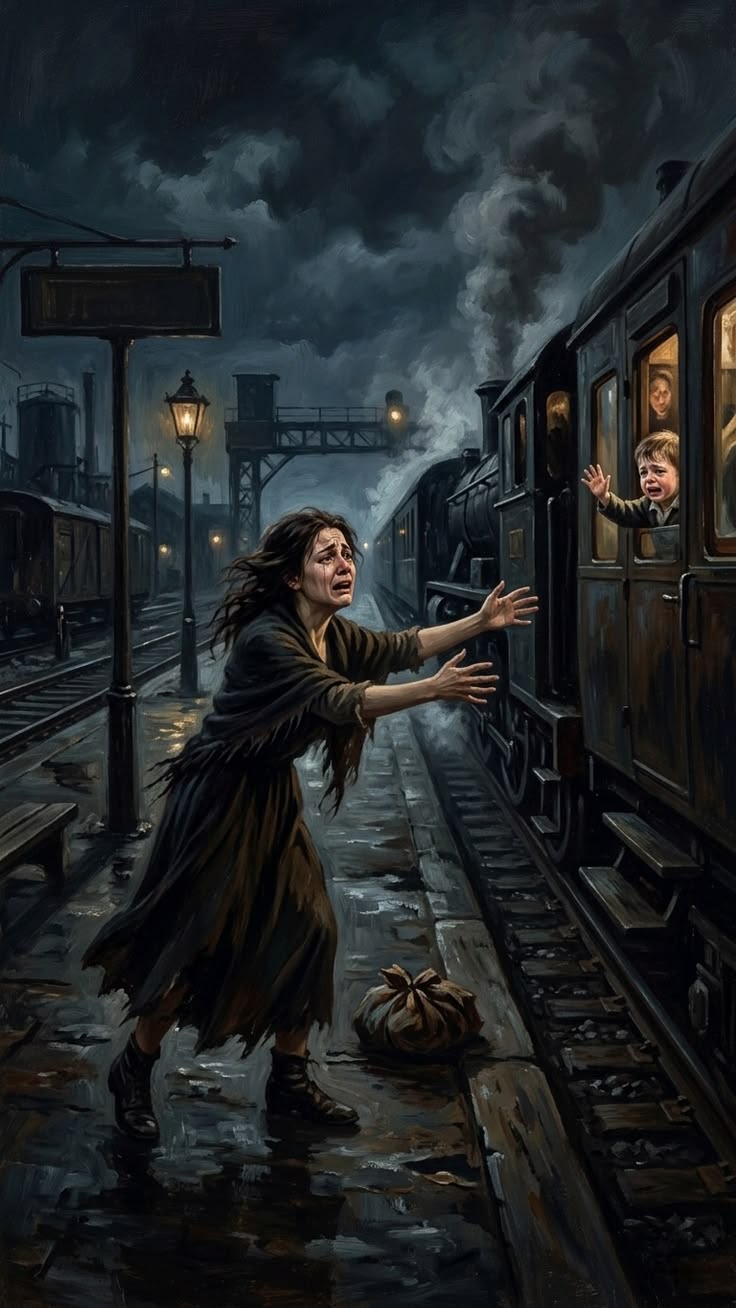
She was still running when the train left the station.
Anna Voss had dropped her bag somewhere on the platform — she didn’t know when, didn’t know where, didn’t care — because the only thing in the world that mattered was the small face in the third window of the second car, the small hands pressed against the glass, the small mouth forming a word she could not hear over the shriek of iron wheels and the roar of the engine swallowing the night.
Mama.
She reached for the train the way drowning people reach for anything — not with hope exactly, but with the body’s refusal to accept what the mind already knows. Her fingers caught nothing but cold air. The locomotive exhaled a long, indifferent breath of black smoke that rolled across the platform and blurred the lights and kept moving, kept moving, kept moving.
And then the train was gone.
The platform was empty.
Anna stood at the edge of the tracks in the dark of the Pittsburgh rail yard, her hair loose and wild around her face, her coat torn at the shoulder from where she had pushed through the crowd, and she made a sound that was not quite a scream and not quite a word — something older than both, something that came from below language entirely.
Her son was on that train.
His name was Josef. He was eight years old. He had brown eyes and a way of tilting his head to one side when he was thinking hard about something, and he was afraid of loud noises and fond of drawing maps of places that didn’t exist, and he had been taken from her on a Wednesday evening in October of 1938 by two men in gray coats who had appeared at her door with papers she did not fully understand and words she understood completely.
The boy will be placed with a proper family. You will be informed in due course.
She had fought. Of course she had fought. She had screamed and grabbed and clawed and been held back by neighbors who were themselves afraid, who whispered Anna, Anna, don’t, they’ll take you too — and she had watched Josef being walked down the stairs of their building on Larimer Avenue with his small cloth bag over one shoulder and his head turned back toward her, his face a portrait of a confusion so complete it had no room for fear yet.
He had called for her twice. Then the door at the bottom of the stairs had closed.
She had spent the next six hours finding out which train. She had spent the money she kept in the coffee tin — all of it, every saved dollar — on people who knew things and would tell them for a price. She had run fourteen blocks in the dark and arrived at the platform with forty seconds to spare, enough time to see his face in the window, enough time to reach out her hand, not enough time for anything that mattered.
Now she stood on the empty platform and the wind moved through the rail yard and the gas lamps threw circles of yellow light onto the wet pavement and Anna Voss made herself breathe.
One breath. Two.
She picked up her bag from where it had fallen. She opened it with shaking hands and checked what was inside — a change of clothes, a photograph, the small notebook Josef used for his maps, which she had grabbed from the table without thinking as she left the apartment. She held the notebook against her chest for a moment with both arms, the way she would have held him.
Then she sat down on the bench at the edge of the platform — the same bench where ordinary people sat waiting for ordinary trains going ordinary places — and she thought.
This was what Anna Voss did that the men in gray coats had not accounted for. They had seen a woman alone. An immigrant. A widow since 1935. A seamstress on the third floor of a building in a neighborhood that the rest of Pittsburgh pretended didn’t exist. They had seen someone without leverage, without resources, without recourse.
They had not seen what was underneath.
Anna had come to America from Czechoslovakia in 1928 with forty dollars, no English, and a stubbornness that her own mother had called a character defect and her father had called the family inheritance. She had built a life from those materials — not a comfortable life, not an easy life, but a real one, with her name on a lease and her boy in a school where the teacher said he was bright and her hands calloused from work she had chosen herself. She had built it once. She knew how building worked.
She opened the notebook to the first page. Josef’s handwriting — careful and slightly crooked — had labeled a hand-drawn map: The Land of Always Summer. Mountains on the left. A river through the middle. A small house at the center with two figures standing outside it, one tall and one short. Underneath, in his careful letters, he had written: Me and Mama.
She looked at it for a long time.
Then she stood up, straightened her coat, picked up her bag, and walked back through the rail yard toward the station entrance. There was a clerk behind the window — a thin man with wire glasses who had been watching her with the careful non-expression of someone who had seen trouble before and preferred not to touch it.
She stepped up to the window.
“That train,” she said, in the English she had spent ten years sharpening into a tool. “Where does it go?”
The clerk studied her face for a moment. Whatever he found there made him decide something.
He told her.
She nodded once, the way people nod when information confirms a decision already made. She pushed the last eight dollars from the bottom of her bag through the window slot.
“One ticket,” she said. “Same direction.”
