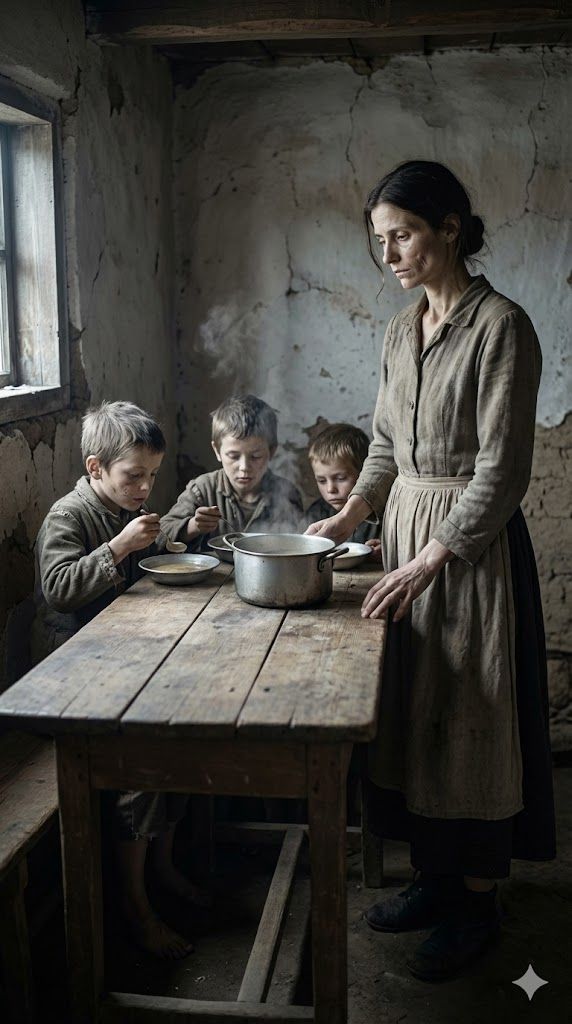
The soup was mostly water.
Ruth Hadley knew it. Her boys knew it too, though none of them said so, because they understood — even the youngest, who was only seven — that saying so would cost their mother something she couldn’t afford to spend. So they bent their heads over their bowls in the gray morning light of that crumbling kitchen and they ate without complaint, and the steam rose between them like something trying to be warmth.
It was the winter of 1934, and the Hadley farm outside Decatur, Illinois had given everything it had left to give.
Ruth stood at the end of the table with her hand resting on the pot. She had already decided she wasn’t hungry. She had made this decision four nights running, always with the same quiet logic: there were three boys and one pot and not enough of what was in it, and the math was simple. She was the one who could choose. They were not.
She watched them eat.
Owen was twelve, the oldest, with his father’s dark hair and the careful eyes of a boy who had learned to read a room before he could read a book. He ate slowly, deliberately, in a way that Ruth recognized as deliberate restraint — making it last, making himself believe it was enough. She had raised him without meaning to raise a boy who would carry weight quietly. The world had done that part for her.
Marcus was ten. He ate the way ten-year-olds eat — head down, focused, spoon moving in a steady rhythm. He had not spoken much since September, since the morning they had come home from school to find their father’s truck gone from the drive and a note on the kitchen table that Ruth had read once and then folded into the smallest possible square and placed at the very bottom of the kitchen drawer beneath everything else. She hadn’t touched it since. She didn’t need to. She had memorized every word against her will.
I can’t watch us drown. I’m sorry. Don’t look for me.
And then there was little Eli. Seven years old, still soft at the edges, with two front teeth missing and a habit of humming to himself when the world got too quiet. He was humming now — something without a melody, more like a sound his body made to fill silence. He hadn’t finished his soup. He was pushing a small piece of potato around the bowl with the concentrated attention of a boy working on a very important project.
“Eli,” Ruth said gently. “Eat.”
He looked up at her. His eyes were his father’s eyes — pale gray, almost silver — and every time she looked into them she had to make a quiet and deliberate choice to stay present. To not go somewhere far and useless inside herself.
“Mama,” he said. “Why aren’t you eating?”
The older boys went still.
Ruth pulled out the chair at the end of the table and sat down. She folded her hands in front of her. Outside the single window, the November sky was the color of old pewter, flat and low, pressing down on the bare fields like a lid.
“I ate earlier,” she said. It was the same answer she always gave. The boys accepted it with the same silence they always offered — not because they believed her, but because accepting it was their way of protecting her back.
She was thirty-four years old. She had married at nineteen, buried a daughter at twenty-two, survived a drought at twenty-eight, and been left by her husband at thirty-three. She had done all of these things inside the walls of a house that was falling apart around her — plaster crumbling from the walls, a roof that leaked in three places when it rained, a furnace that produced noise rather than heat. She had patched and mended and made do until making do was simply the name for how she lived.
What she had not done, not once in all of it, was let her boys see her break.
This was not strength in any dramatic sense. It was not courage the way people write about courage in books. It was something quieter and more stubborn than that — the daily decision to get up and put the pot on and stand at the end of the table and make sure there was something in the bowls, even when the something was almost nothing.
That afternoon, after the boys had gone to school through the cold and Ruth had washed the three bowls and the pot and set them to dry, she sat down at the kitchen table with a pencil and a piece of paper and wrote a list. Not a letter. Not a prayer. A list.
Flour. Two weeks left, maybe three if careful. Salt. Enough. Potatoes. Seven remaining. Coal. Enough for ten days. Money. Eleven dollars and forty cents.
She looked at the list for a long time. Then she turned the paper over and wrote on the other side.
What we have.
Three boys who eat without complaining. A roof — leaking but holding. A window with light. Enough for today.
She folded that side up and left it on the table where she could see it.
Then she put on her coat and walked the half mile to the Granger farm to ask if there was any work.
There was. There always was, for a woman willing to do it without being asked twice. She came home that evening with two dollars, a jar of preserved beans, and a small sack of cornmeal that Mrs. Granger had pressed into her arms without making her ask.
She made cornbread that night. The boys ate it like it was a celebration.
Ruth watched them and said nothing and felt something in her chest that was not happiness exactly, but was close enough. Close enough to keep the pencil moving. Close enough to turn the paper back over in the morning.
Close enough to last another day.
