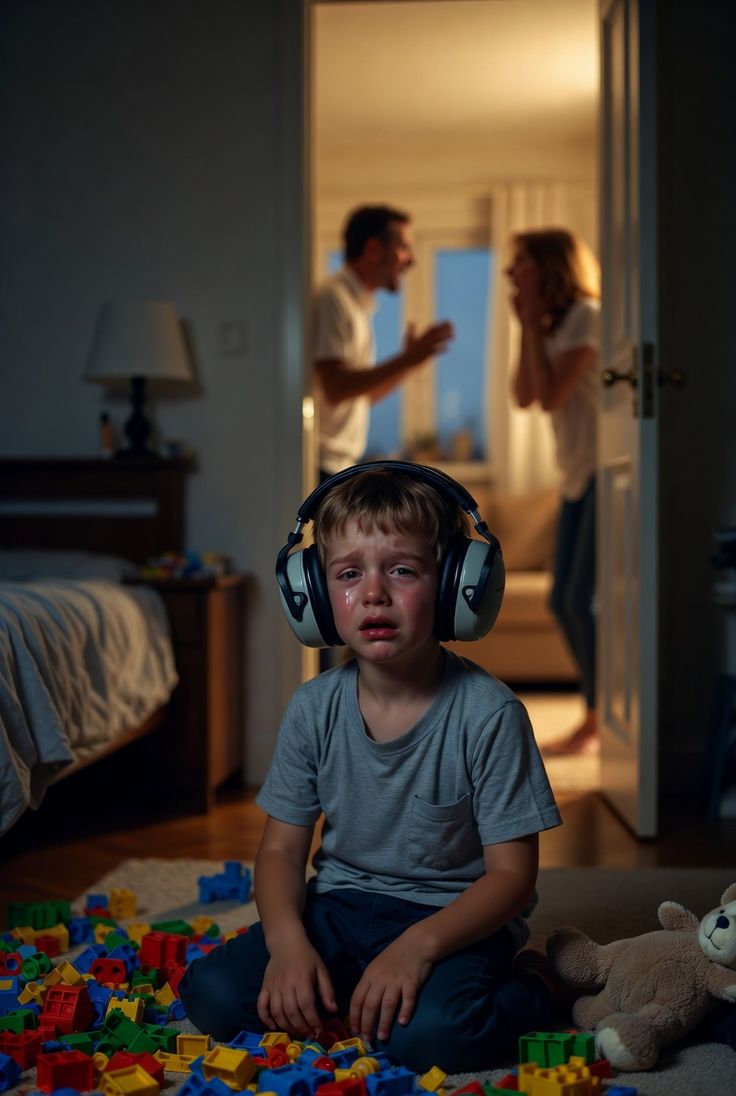
The headphones were his idea.
Not his parents’ idea, not a doctor’s recommendation — his own. He had found them in the hall closet six months ago, the big noise-canceling ones his dad used when he mowed the lawn, and he had carried them to his room without asking and set them beside his bed and said nothing to anyone about why.
His name was Noah. He was five years old. He had blond hair that never lay flat no matter what his mother did to it, and a stuffed bear named Gerald who sat in the same corner every day because Noah believed Gerald did not like to be moved, and a laugh that his grandmother called the best sound in the world. He had learned to build things with his Lego blocks by touch as much as by sight, sorting colors with his fingers before his eyes, constructing small careful worlds on the carpet that no one was allowed to step on.
He was sitting in the middle of those worlds right now. Headphones on. Tears running straight and silent down both cheeks the way tears run when a child has been crying long enough that crying has become simply the weather, something happening to him rather than something he is doing.
Behind him, through the open door, his parents were fighting again.
He couldn’t hear the words. That was the point of the headphones. But he could feel the vibration of raised voices moving through the floor and the walls and into his small body the way bass moves through a car — not heard exactly, but known. Felt in the chest. Felt in the stomach. Felt in the specific place behind the eyes where the headache always started on nights like this.
He picked up a blue Lego piece and turned it in his fingers.
He set it down.
He picked up Gerald and placed him in his lap without looking at him, the way you reach for something familiar in the dark.
Noah had understood for a long time that something was wrong in the way the house breathed. He was five, but five is not as young as adults tend to assume. Children that age are extraordinary readers of atmosphere — they may lack the vocabulary, but they possess the instrument, finely tuned, missing nothing. Noah knew the difference between the silence after a good evening and the silence after a bad one. He knew which way his father’s footsteps on the stairs meant things were okay and which way meant they weren’t. He knew his mother’s laugh had two versions — the real one, which involved her eyes, and the performing one, which didn’t — and he knew which one she used most now.
He had not told either of them what he knew. This was his way of protecting them, in the manner that children protect parents — imperfectly, invisibly, at considerable cost to themselves.
What he wanted, more than anything, was to build something that would fix it. This was his instinct when things were broken — find the pieces, figure out how they connected, make something that held. It was why he loved the blocks. Every problem had a solution if you had enough pieces and enough patience and were willing to take it apart and start again when the first version didn’t work.
He looked at the scattered pieces on the carpet around him.
He started building.
He didn’t know what he was building. He let his hands decide. A wall first — blue and red alternating, solid at the base. Then another wall perpendicular. Then a roof piece, and another, and the shape of something began to emerge from the carpet the way shapes emerge from clouds, recognized rather than designed.
It was a house.
Of course it was a house.
He worked carefully, precisely, his tears drying on his cheeks as his hands moved, because building required concentration and concentration required a kind of peace and peace was something his body knew how to find inside the act of making something. His therapist — a round-faced woman named Dr. Park who smelled like peppermint and never talked down to him — had told him once that some people think with their hands. She had said it like it was a good thing. He had believed her.
The voices behind him shifted. He felt it before he understood it — a change in the vibration, a different frequency. Louder, then suddenly not loud at all. Then footsteps. Then the particular sound of the front door.
Then a silence that was the worst kind of silence. The kind with a shape.
He sat very still.
After a while — he didn’t know how long — he felt a hand on his shoulder. Gentle. His mother’s. He knew it without looking the way he knew most things he trusted — by feel.
He took off the headphones.
The house was very quiet.
His mother sat down on the carpet beside him, in the middle of all his blocks, which she had never done before. She was still wearing her day clothes. Her eyes were red at the edges in the way that meant she had been doing what he had been doing, which was crying quietly and alone.
She looked at the small house he had built.
“That’s really good,” she said. Her voice was careful. Swept clean of everything except the thing underneath everything, which was that she loved him more than she could say correctly.
He looked at the house too.
“It needs a door,” he said. “So people can come in.”
She made a sound that was almost a laugh. He felt her arm come around his shoulders and he leaned into it the weight of him settling against her the way it always had, the way it had since before he could remember, the way that still worked even when almost nothing else did.
“Yeah,” she said softly. “It does.”
He found a door piece in the pile. He pressed it into place with both thumbs, carefully, firmly, the way you do when you want something to hold.
Then he sat with his mother in the quiet and looked at what he had made and decided that tomorrow he would make it bigger. Add rooms. Add windows. Build it up until it was something a family could actually live in, something solid, something real.
He was five years old and he already knew the most important thing about broken things.
You don’t wait for someone else to fix them. You find the pieces. You sit down on the floor. And you build.
