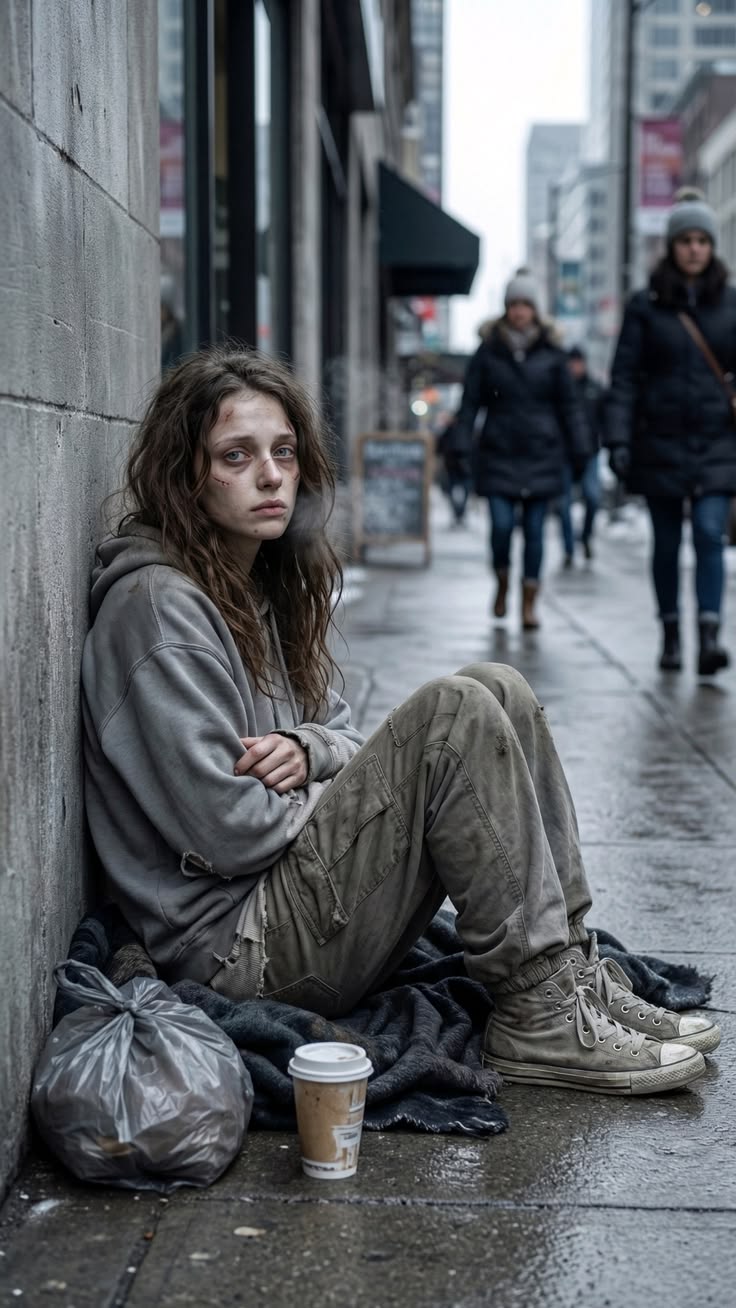
Two thousand and eleven people walked past her that morning.
She had started counting at seven a.m., not because she expected anything from the counting but because it gave her mind something to do besides the other things it wanted to do, the darker things, the thoughts that gathered at the edges when she was cold and still and had nowhere to be and no reason to move. Counting was neutral. Counting was just numbers. Numbers didn’t hurt.
Her name was Cassie. Seventeen years old. She had been on this particular stretch of sidewalk in Chicago for three days, which was not the longest she had ever gone but was long enough that her body had started to feel like something borrowed from someone who had stopped wanting it back. Her sneakers were soaked through. She couldn’t feel her left pinky toe, which she had decided not to think about too carefully.
The coffee cup in front of her had been left by a man in a blue coat who had set it down without looking at her — not unkindly, just automatically, the way you set something down on a surface. He had walked away before she could say thank you. The coffee was cold now but she wrapped both hands around it anyway for the memory of warmth it still held in the cardboard.
She watched people walk past.
This was the thing nobody understood about being invisible — it wasn’t that people looked at you with contempt, though that happened too. It was that they had developed, without apparent effort, the ability to look directly at you and process you as furniture. As part of the street’s background information, no more requiring of response than a fire hydrant or a trash can. Their eyes passed over her and moved on to the important things — the light at the corner, their phone screen, the coffee shop door, the person they were meeting for lunch — and Cassie sat in the middle of all of it and was, functionally, nowhere.
She had not always been nowhere.
Eighteen months ago she had been a junior at Riverside High School in Naperville, Illinois, with a B-plus average and a best friend named Kelsey and a bedroom with a purple comforter and a wall of photographs and a mother who made pancakes on Sunday mornings and a father who was — well. Who had been. Before the thing that happened in March of her sophomore year, the thing she did not yet have the right words for, the thing that had broken the house into before and after as cleanly as an axe through wood.
After was a series of events that moved fast and made no sense and ended with her standing outside the front door at eleven p.m. on a Thursday with a garbage bag of clothes and nowhere to go and the understanding, brand new and devastating, that the place she had called home had filed its final motion and closed its case.
She had called Kelsey. Kelsey’s parents had said two weeks, and they had meant it.
She had called her aunt in Rockford, who had said she was sorry, she really was, but her husband had just lost his job and the timing was simply — and her voice had done the thing voices do when they are preparing a no — it was simply not possible right now. She was so sorry. She really was.
After that, Cassie had stopped calling people.
The cup had exactly four dollars and seventeen cents in it by noon. She had watched every one of those contributions happen — a teenage girl who made eye contact and smiled before dropping in two dollars, an old man with a cane who stopped and fished deliberately in his coat pocket and produced a dollar with the slow dignity of someone performing a considered act, a small boy of about six who broke free of his mother’s hand and ran over and deposited seventeen cents and a crumpled receipt before being retrieved with a sharp and embarrassed Marcus, come here.
She thought about the teenage girl’s smile for a long time after. The eye contact. It had lasted maybe two seconds. It was the most seen she had felt in weeks and she was aware that this fact said something important about the shape her life had taken, though she was not ready to look at it directly.
At two in the afternoon, it started to rain again.
She pulled her hood up and her knees to her chest and made herself small against the building wall, which helped almost not at all. The rain found the gap at her collar and ran cold down the back of her neck and she thought about the purple comforter in a precise and deliberate way — its weight, its color, the specific warmth of it — the way prisoners are said to think about the places they came from. Not with hope. With inventory. Making sure the memory was still there, still accurate, still hers.
She was still there at three-fifteen when the woman stopped.
Not paused. Not slowed. Stopped. Completely. Right in front of her, blocking the sidewalk, unconcerned about the people moving around her like water around a stone.
She was maybe fifty, with a gray wool hat and a face that had the particular quality of someone who had been through things and come out the other side not hardened but clarified — like glass after the fire, Cassie thought. Stronger at the broken places.
The woman looked at her directly. Not at the cup. Not at the bag. At her face.
“How long?” the woman asked. Just that. No performance, no preamble, no careful distancing language.
Cassie looked up. Rain was falling between them.
“Eighteen months,” she said. Her own voice sounded strange to her. Too small for the city around it.
The woman nodded slowly, like a person receiving information they had already prepared themselves for. Then she sat down. On the wet sidewalk. In her good wool coat, with her bag in her lap, right beside Cassie against the cold stone wall.
“My name is Helen,” she said. “Tell me one true thing about yourself. Not what happened to you. One true thing about you.“
Cassie stared at her.
Nobody had ever asked her that before.
Not like that. Not sitting down. Not in the rain. Not as if the answer was the most important thing Helen intended to do with her afternoon.
Cassie opened her mouth. Closed it. Felt something shift in her chest — not breaking, not exactly, but moving. The way ice moves at the first hint of spring. Slow and enormous and impossible to stop once it begins.
“I used to write poetry,” she said finally. “Before.”
Helen nodded again. “Tell me one.”
And sitting on a wet Chicago sidewalk in the rain, with two thousand and thirty-four people having walked past her that day, Cassie opened her mouth and spoke the first words of herself she had offered to another human being in eighteen months. Her voice shook. The rain kept falling. Helen did not move.
For the first time in a very long time, Cassie was not invisible.
