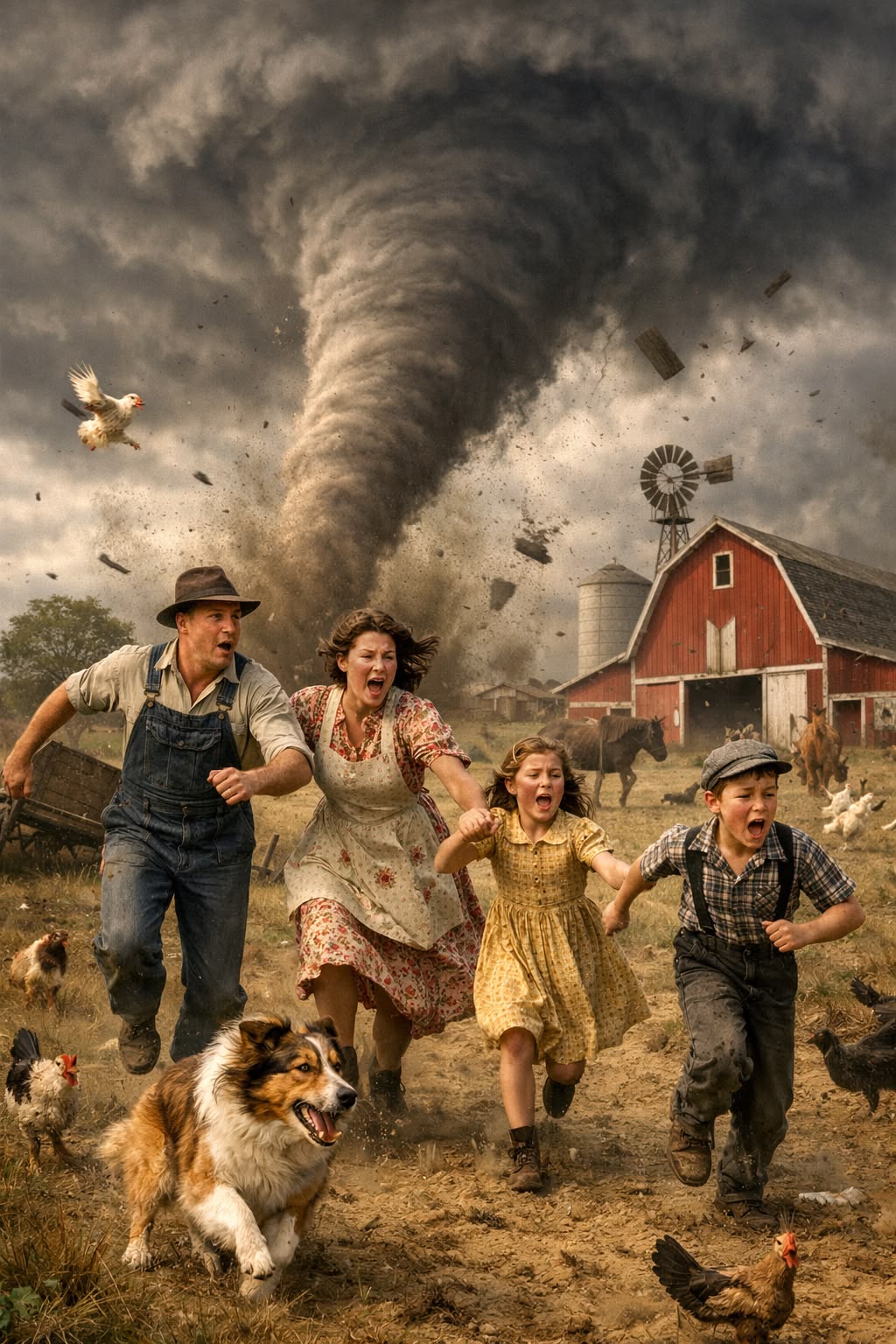
The sky turned green at half past two.
Frank Caulder had been farming the flat land outside Abilene, Kansas for twenty-two years and he knew exactly what green sky meant. It didn’t mean maybe. It didn’t mean watch and wait. It meant drop whatever was in your hands and move — right now, without discussion, without looking back at what you were leaving.
He dropped the fence post he’d been driving into the hard August ground and turned and ran toward the house already screaming his wife’s name.
“DOROTHY.”
She was in the kitchen. He knew she was in the kitchen because Dorothy was always in the kitchen at half past two on a Wednesday — flour on her apron, something in the oven, the radio playing the farm report low in the background. She appeared in the doorway before his second step, and one look at his face told her everything the sky had already told him, and she yanked the apron over her head without untying it and screamed back into the house.
“KIDS. NOW. CELLAR. NOW.”
The tornado had dropped from the clouds three miles southwest of the Caulder farm at two-seventeen p.m. It was an F4 — though they wouldn’t know that until the weather service came through two days later with their clipboards and their careful faces — a quarter mile wide at the base, moving northeast at forty-one miles per hour, carrying inside it the compressed fury of a storm system that had been building across the Oklahoma panhandle since before dawn. It had already taken a barn, a grain elevator, and a stretch of county road before it set its eye on the flat green checkerboard of the Caulder property.
It did not hurry. It did not need to.
Maggie was ten and she came out of the house first, yellow dress, braids half undone from the afternoon, her boots not fully laced because she had been sitting on her bed reading and hadn’t expected to need them properly tied. She was the kind of child who ran toward things rather than away from them — curious by nature, bold in the specific way of children who have not yet collected enough evidence to be afraid of the world. She saw the tornado and her face went through three expressions in rapid succession — wonder, recognition, pure animal terror — and then her mother’s hand closed around her wrist and wonder and recognition were gone and there was only running.
Beside her, her brother Tommy — twelve, flat cap, mud on both knees from something he’d been doing that nobody had officially sanctioned — had already broken into a full sprint without being told. Tommy was the kind of boy who processed danger at a speed that bypassed thinking entirely and went straight to feet, which was exactly the right kind of boy to be at this particular moment.
Behind them, keeping pace with the children in the specific way of dogs who understand more than they’re credited for, ran Cooper.
Cooper was a four-year-old Collie mix who had no formal training beyond the accidental education of living on a working farm, which meant he understood weather the way all farm animals do — in the body, before the mind — and he had been pacing the fence line and whining since noon. He ran now with his ears flat and his tail low and his focus absolute, staying exactly even with the children, not racing ahead, not falling behind. Staying with his people. This was the whole of his purpose and he knew it without being told.
The roar was extraordinary.
Frank had heard it before — once, when he was nine years old and his own father had thrown him under a workbench in the machine shed while a tornado passed two fields over. He had never forgotten the sound. People called it a freight train and that was accurate as far as it went, but it didn’t capture the quality of it — the way it was everywhere at once, coming from no single direction, filling the whole world and your whole chest simultaneously until it was impossible to find where the sound ended and the fear began.
It was that sound now, and it was close, and it was getting closer.
The cellar door was set into a concrete pad forty yards from the back of the house. Dorothy had built those forty yards in her mind a thousand times — crossing the distance easily on any ordinary afternoon — but under the roaring green sky with debris beginning to fall around them like the world coming apart at the seams, forty yards was its own kind of forever.
A shingle from somewhere struck Frank’s shoulder. A chicken — one of Dorothy’s Leghorns, white as a sheet — tumbled past them at eye level in the wind, wings useless and frantic, gone in an instant. The windmill behind the barn was screaming, its blades spinning far beyond their design.
“DON’T STOP,” Frank shouted, though nobody had stopped, nobody intended to stop, his voice lost almost completely in the roar.
Dorothy reached the cellar door first. She had the handle up and the door wrenched open in one motion — old muscle memory, years of tornado drills that she had never allowed Frank to call unnecessary — and she was already pushing Maggie down the stairs into the dark when Tommy hit the concrete pad and took the stairs in two jumps.
Frank grabbed Cooper by the scruff and half-threw him down the opening.
Then he looked back once.
He would think about that one backward glance for the rest of his life. The barn — his grandfather’s barn, built in 1911, red as a fire engine, solid as a promise — was gone. Not damaged. Not partially standing. Gone, as if the earth had simply revoked its permission to exist. In its place was a moving wall of black that was the tornado’s edge and it was close enough that Frank could see individual objects inside it — a wheel, a board, something white and unidentifiable — rotating with a terrible slow grace.
He went down the stairs.
He pulled the door shut over his head.
The world above ended.
