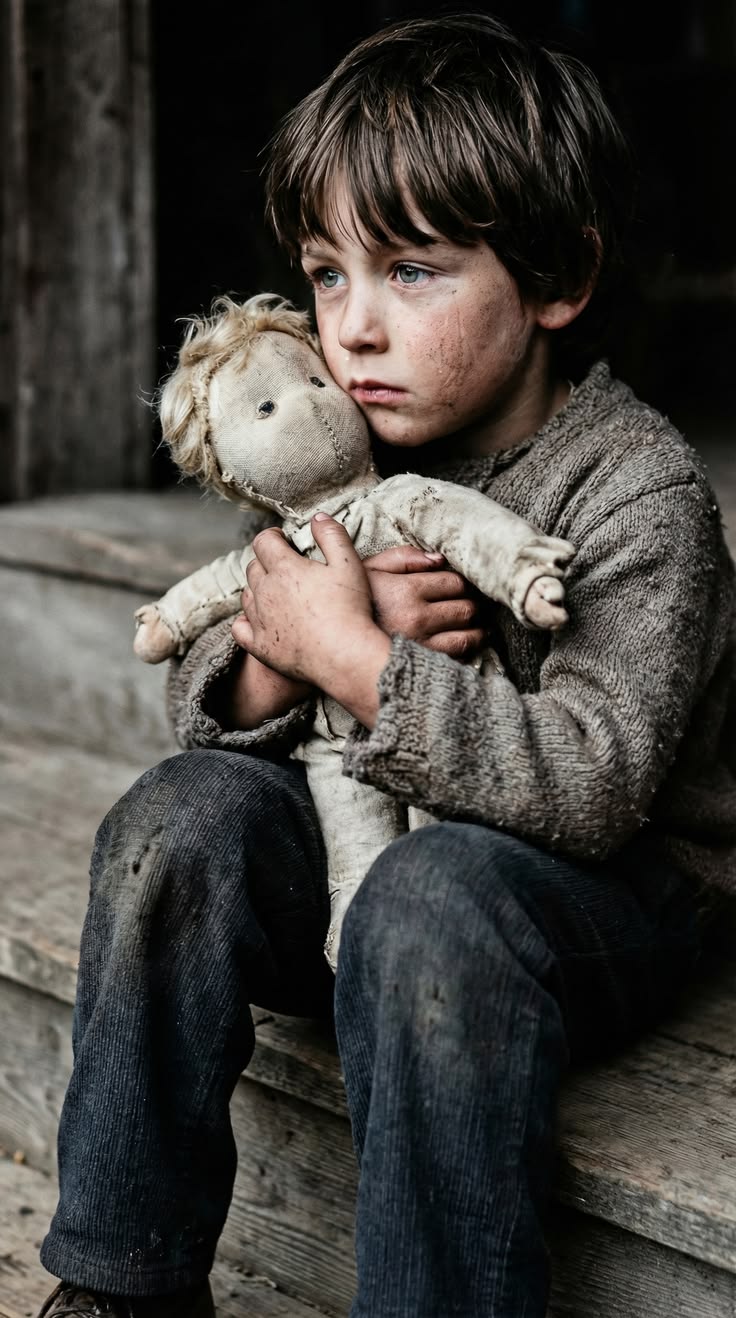
Most people who passed the old Whitfield place on the edge of Culver Creek, Kentucky didn’t notice the boy sitting on the porch steps. And the ones who did notice him — the mail carrier, the woman from the county office who drove by twice a week, the farmer from the next property over — mostly saw a quiet child with dirty knees and dark hair and blue eyes that seemed to be looking at something considerably further away than wherever they happened to be looking. They noticed him the way you notice furniture — registered, categorized, filed under not my concern — and moved on with their day.
None of them noticed the doll.
Her name was Clara. He had named her himself, three years ago, when he was four and his mother had pressed the worn cloth figure into his hands on a morning he remembered with the specific sharpness of mornings that divide your life into before and after. She had made Clara herself from flour sacking and yarn and two black buttons for eyes, sitting up late at the kitchen table while he slept — he knew this because she had told him, once, on a good day, in the voice she used when she wanted him to understand that something mattered. I made her so you’d always have someone to hold, she had said. Even when I can’t be the one doing the holding.
He was seven now. Clara was three years old and showed every one of them. Her yarn hair had thinned to a few pale strands. Her button eyes were scratched. The flour-sack fabric of her body had gone soft with handling, gray with age, fraying at the seams in places he had carefully pressed back together with fingers too small for the work. She was, by any objective measure, a ruined thing. He held her against his chest like she was made of gold.
His name was Eli. Just Eli — no middle name, which his first-grade teacher had found unusual enough to ask about, and which Eli had answered by looking at his desk and saying nothing, because the real answer was that his mother had intended to give him one and had run out of time, and he didn’t know how to say that to a person he’d known for two weeks.
The house behind him was not empty, but it might as well have been.
His grandmother was inside. Vera Whitfield, seventy-three years old, a woman who had the physical dimensions of someone who had been slowly compressed by decades of hard use — small and dense and immovable, like old wood. She was not a cruel woman. She was not a warm one. She occupied the house the way weather occupies a space — present, influential, not particularly concerned with how her presence was received. She fed him. She kept the lights on. She made sure he was at the bus stop by seven-fifteen every morning with something resembling a lunch. These were the things she understood to be required of her, and she performed them with the reliable joylessness of a person discharging an obligation they had not asked for.
She did not touch him. She did not sit beside him. She did not ask about his day or his dreams or his thoughts on any subject. She had not held him once in the eight months he had lived under her roof, and Eli — who was seven and therefore more perceptive about these things than any adult gave him credit for — had understood within the first two weeks that holding was not something Vera Whitfield kept in stock. He did not blame her for it. He simply noted it and adjusted accordingly, the way children adjust to the specific shapes of the lives they’re placed in, bending without breaking, usually, though the bending costs something they won’t be able to name until much later.
So he sat on the steps. He sat there most afternoons when the weather allowed — after school, after the bus, after the bowl of whatever Vera had left covered on the stove — and he held Clara and looked out at the gravel road and the tree line beyond it and the particular shade of gray that the Kentucky sky turned in October, and he thought his thoughts in the careful private way of children who have learned that the inside of their head is the safest place they have.
He talked to Clara. Of course he did. He was seven and she was who he had.
He told her about school — about the boy named Marcus who had laughed at his shoes, and the teacher who had read a story about a dog and how the dog finding his family at the end had made Eli’s throat close in a way he’d had to work hard not to show. He told her about the dream he kept having, the one where his mother was in a room just past a door he couldn’t open, close enough that he could hear her moving around, not close enough that he could reach her. He told Clara things he had no other place to put — not complaints, not accusations, just the plain daily facts of a life being lived without the person who was supposed to be living it alongside him.
Clara, for her part, said nothing. But she was solid in his arms. She was there. And there, he had discovered, was most of what mattered.
He was sitting on the steps on a Tuesday in the third week of October when the truck came down the road.
It was not a truck he recognized. Dark blue, older, with a crack in the passenger side window and a side mirror held on with electrical tape — details he catalogued automatically because he had learned to pay attention to what arrived on this road, since what arrived on this road had, in the past, tended to change things. His grandmother’s county caseworker drove a silver car. The mail carrier drove a white jeep. The farmer from next door drove a green pickup that coughed when it downshifted.
This truck was none of those.
It slowed. It stopped in front of the Whitfield house.
A man got out. Tall, with dark hair that went in several directions at once and a jaw that needed attention and the careful eyes of someone who has been practicing being calm for long enough that it has mostly taken. He stood by the truck for a moment and looked at the house and then looked at the boy on the steps, and something in his face changed — subtly, the way light changes when a cloud moves — and he stood very still.
Eli looked back at him.
Clara was in his arms. His chin was up — not defiantly, but in the particular way of a child who has decided not to make himself smaller than he already is.
The man took a breath.
“Hey,” he said. His voice was careful. Not the careful of someone performing gentleness, but the careful of someone who understood that the wrong word could close a door that might take a long time to reopen.
Eli said nothing. He waited. He was good at waiting.
The man crouched down to his level — actually crouched, right there on the gravel, without worrying about his jeans — and looked at him directly the way very few people bothered to do.
“My name is Daniel,” the man said. “I think I might be your father.”
The October wind moved through the tree line.
Clara was solid in his arms.
Eli looked at the man named Daniel for a long moment — studying him the way he studied everything that mattered, slowly, completely, missing nothing — and said the first thing that came into his mind.
“Clara says she needs to hear more before she decides,” he said.
The man named Daniel looked at the doll. Then at Eli. And for the first time in longer than Eli could remember, an adult looked at him and laughed — not at him, not past him — but with him, genuine and surprised and warm as anything.
“That’s fair,” Daniel said. “That’s completely fair.”
And he sat down on the gravel, right there, and waited for Clara to be ready.
