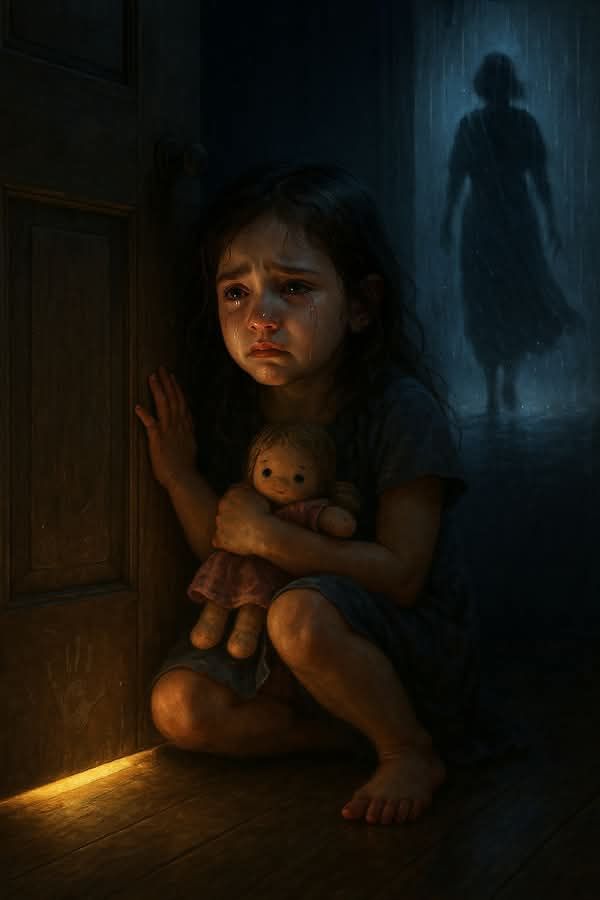
She had learned to make herself very small.
Not small the way children are small — not the ordinary smallness of a six-year-old body in a house built for grown people — but small in the deliberate way, the practiced way, the way that comes from understanding that being noticed and being safe are sometimes opposite things. She could press herself into the corner beside the door and become almost nothing. Just shadow. Just the sound of breathing too careful to be heard.
Her name was Grace. And she was waiting, the way she always waited, for the storm outside to decide what it was going to do — not the storm in the sky, though that one was real, rain driving against the windows in waves, lightning whitening the curtains every few minutes. The other storm. The one that walked on two feet and moved through the house in a pattern she had memorized the way sailors memorize weather — reading the signs before the worst arrived, calculating which way to move, how much time she had.
She held her doll against her chest. The doll had no name because naming things made losing them worse, and Gracie had learned that things got lost. But she held her anyway — held her in the specific grip of a child who has discovered that the world offers very little that stays, and clutches what it does offer accordingly.
The silhouette in the rain had been her mother.
She knew the shape of her mother the way you know a shape you have spent your entire life reading — knew it even in the dark, even through glass blurred with rain, even at this distance and in this low blue light that turned everything uncertain and strange. Her mother was out there. Standing in the yard in the rain without a coat, which meant the night had gone the way some nights went — past the point of coats mattering, past the point of most practical things mattering — and Gracie had come to the door and pressed her hand against the wood and looked through the gap at the bottom where the warm light leaked out onto the porch boards and she had done what she always did.
She had stayed.
Not from fear of going out. She knew how to go out — knew how to open the door quietly, how to move across the porch without the board near the left railing making its noise, how to cross the wet grass in bare feet without slipping. She had done all of these things before, on other nights, other storms. She had gone to her mother and taken her hand and said come inside, Mama in the small steady voice she used when she was trying to be bigger than she was, and sometimes it had worked and sometimes it hadn’t and the difference between those two outcomes was not something Gracie had ever been able to predict or prevent.
So tonight she stayed. She pressed her hand to the door and she looked at the silhouette in the rain and she waited to see which kind of night this would be.
Gracie was six years old and she knew things that six-year-olds are not supposed to know.
She knew that the third step from the bottom made a sound that carried and to skip it always. She knew that certain hours were safer than others and which hours those were. She knew the difference between the kind of crying that meant the worst was over and the kind that meant it was still coming. She knew how to heat soup on the stove and how to get her own cereal and how to call 911 from the telephone in the kitchen — she had memorized this number at age four, not because anyone had told her to, but because she had overheard something on the television once and understood, with the animal instinct of a child in a complicated house, that knowing it mattered.
She also knew, in the complicated way that children hold contradictory things simultaneously, that her mother loved her.
She knew it the way you know something that doesn’t always look like what it is. On the good days — the clear days, the days when her mother’s eyes were focused and her voice was soft and she sat on the kitchen floor with Gracie and they built things with blocks and she sang the song about the mockingbird — on those days, the love was so present and so simple that Gracie could almost believe it was the whole story. That the other days were the exception. That the good days were what was real and true underneath everything else.
She was six. She needed to believe that. So she did.
The lightning came again and the yard went white and she saw her mother clearly for a single second — head tilted back, rain on her face, arms at her sides — and then the dark came back and she was just a shape again, just a shadow standing in the wet grass doing whatever it was she was doing out there in the middle of the night in the rain.
Gracie pressed her forehead against the door.
The wood was cool and solid. She had done this before — pressed herself against solid things when the world became too much of itself — and it helped the same way it always helped, which was only a little, but a little was what there was.
She thought about Mrs. Alderman.
Mrs. Alderman was her first-grade teacher, a wide-armed woman who smelled like coffee and wore the same three cardigans in rotation and had a way of looking at Gracie during morning circle that felt different from how the other teachers had looked at her — more direct, more careful, like a person looking at something they are trying to understand rather than something they are trying to overlook. She had kept Gracie in from recess twice in the past month, not as punishment but as something else, something Gracie didn’t have the word for — sitting at her desk beside her and asking about her weekend in a voice that seemed genuinely interested in the answer, which was not how adults usually asked about weekends. Usually they asked while doing something else. Mrs. Alderman had put her pen down.
Last Thursday she had knelt beside Gracie’s desk at the end of the day and said, very quietly, You can always tell me things, you know. Anything at all. That’s what I’m here for.
Gracie had looked at her hands and said nothing. Because saying something was a door you couldn’t un-open, and she had not decided yet whether she was ready for what was on the other side.
But she had thought about it every day since.
She thought about it now, crouched in the corner with her hand on the door and the rain coming down and her mother standing in the wet yard and the doll pressed against her chest.
She thought: Mrs. Alderman comes early on Fridays. Before the bell. She said so.
She thought: Tomorrow is Friday.
She thought: A door you can’t un-open might also be a door that lets the light in.
She pressed her hand flat against the wood.
Outside, her mother turned from the rain and began walking back toward the house. Gracie watched the shadow grow larger in the gap under the door. She made herself very still. Very small.
She held her doll.
She thought about Friday.
