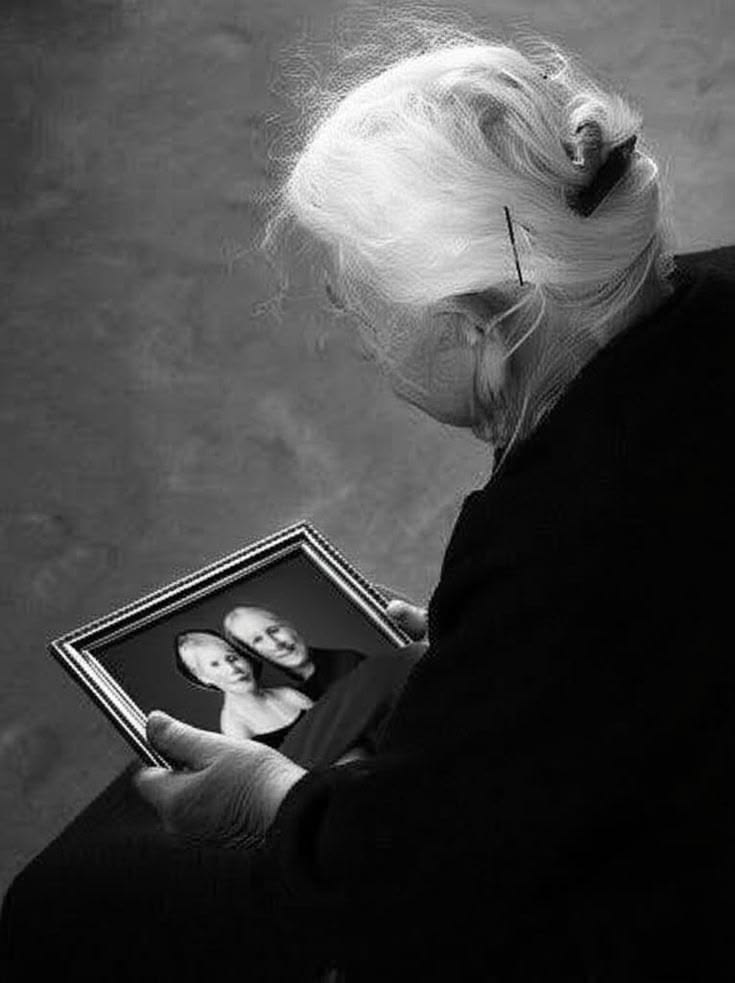
She talked to him every morning.
Not out loud — or rather, not always out loud. Sometimes it was just a thought directed toward the photograph, a brief interior motion the way you turn toward a window without deciding to. Other times, on the harder mornings, she did speak. Quietly, in the particular tone she had used for private things their whole marriage, the low register she saved for conversations that were only meant for him. She was not confused about whether he could hear her. She was eighty-one years old and she had no illusions left about the mechanics of death. She simply found that the speaking helped, and she had long since passed the age of caring whether anything she did in the privacy of her own home made sense to anyone else.
His name had been Robert. Everyone called him Bob except her. She had always called him Robert, from the very first conversation in the fall of 1959 when they had stood beside each other at a punch bowl at a dance neither of them had wanted to attend, two people making the best of an obligatory evening, and he had said something that made her laugh so suddenly that punch had threatened her dignity, and she had looked at him and thought — with the calm certainty that visits you so rarely in a lifetime and is so unmistakable when it does — this one.
Sixty-one years. They had been married for sixty-one years when he died on a Tuesday morning in March, quietly, in the bed they had shared for six decades, while she was in the kitchen making his coffee.
She had not known, going to the kitchen, that she was walking away from the last moment. That was the thing nobody told you about loss — not the loss itself, which was enormous and real and permanent, but the particular cruelty of the ordinary moment just before. She had been thinking about whether they needed more half-and-half. She had been thinking about the grocery list. She had been carrying two mugs and thinking about half-and-half and her husband had been dying in the next room, and she had not known, and she could never unknow the not-knowing, and this was the thing she turned over in her mind more than anything else in the four years since.
Her name was Eleanor. Eleanor Marsh. She lived in the same house in Dayton, Ohio where she and Robert had raised three children and weathered eleven moves-that-never-happened and two recessions and one cancer scare in 2003 that had turned out to be nothing, thank God, though the six weeks of waiting had taught them both something about what they would miss most if the answer had been different. The answer to that question had been simple and identical for both of them, which was each other, which was the kind of thing that sounds obvious until you are sitting in a doctor’s office waiting room holding your spouse’s hand and discovering that obvious things can still break you open with their clarity.
The house was too big for one person. Her daughter Carol had said so, gently, approximately forty times in four years. Her son David had said so more directly, in the way of youngest children who have decided that someone needs to speak plainly. Her son Michael said nothing, because Michael understood without being told that the house was not just a house and never had been, and that what Carol and David were really asking Eleanor to give up was the accumulated geography of a life — the kitchen where she knew exactly where everything was, the garden Robert had planted in 1987 and which she had tended alone every spring since, the bedroom window that faced east and let in the particular morning light she had woken to for decades, the third step on the staircase that creaked in a way Robert had always meant to fix and which she had not fixed on purpose because the sound of it in the night when she got up was still, in some private irrational corner of her, the sound of him.
She was not ready to leave those things.
She was not sure ready was something that was going to happen.
She held the photograph with both hands because her grip was not what it had been — the arthritis in her left thumb had made its opinion known progressively over three years and she had accommodated it without complaint, adjusting her grip on coffee cups and door handles and this frame, this silver frame she had bought at a shop on Fifth Street in 1987 specifically for this photograph, specifically because she had looked at it and thought that a photograph this good deserved a frame that took it seriously.
They looked happy in it. They were happy in it. That was not the performance of two people who had learned to perform happiness — she had known those couples, had seen the careful curation of it, the slight strain at the edges of the smiles — but the unguarded, inconvenient happiness of two people who had simply ended up, after all the ordinary difficulty of a shared life, genuinely glad about each other.
She had taken that for granted. She knew that now. Not in the way of self-recrimination — she refused to spend her remaining time on self-recrimination — but in the honest way of a person doing accurate inventory. You take things for granted because they are there every morning. You are not careless. You are human. And then the morning comes when the thing is not there, and you understand in retrospect the precise weight of what was given to you, and the understanding does not help in any practical sense but is true anyway, and truth was something Eleanor Marsh had always been willing to stand inside even when it was uncomfortable.
She ran her thumb along the edge of the frame.
“Carol wants me to come for Christmas early this year,” she said. “She says she’ll come get me if I don’t drive.” She paused. “You would take her side. I know you would. You always took her side when she was right.”
The house settled around her. The particular creak of an old house in autumn, cooling at the edges.
She looked at his face in the photograph. The way he was looking at her in it — not at the camera, at her, caught mid-turn, caught being himself — was the thing she came back to. He had looked at her that way their whole lives. Like she was the direction he was always already facing. Like she was the thing the room organized itself around without anyone asking it to.
She had not understood, while it was happening, that she was living inside something irreplaceable.
That was the lesson, she thought. That was the only lesson, really, underneath all the others.
You are always, right now, living inside something irreplaceable.
She set the photograph down carefully in its place on the side table — the same place it had been for four years, the same place it would be tomorrow morning when she came to it again — and she stood up slowly, with the deliberate dignity of a woman who has decided that how you stand up from a chair in private is as much a matter of character as how you stand up from one in public.
She went to make her tea.
She left the photograph where he could see the room.
