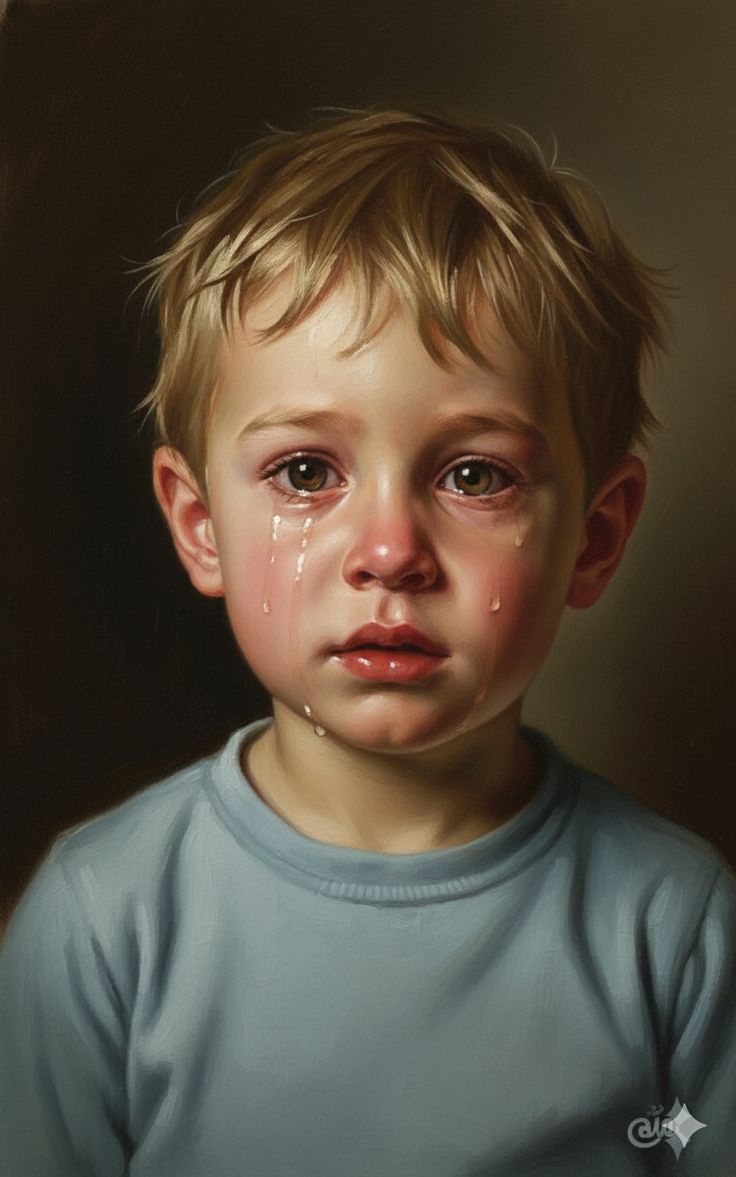
He didn’t know the word for it yet.
That was the thing about being four years old — the feeling was enormous and real and taking up every available inch of the inside of him, and he had no container for it, no language that fit around it properly, no way to hand it to someone else so they could look at it and tell him what it was. He just had the wet on his cheeks and the ache behind his eyes and the way his breath kept catching on something invisible, like a sock on a splinter, hiccuping in his chest in a rhythm he couldn’t control.
He was standing very still.
This was what he did when the big feeling came — went still, the way small animals go still when something larger moves nearby. Not hiding exactly. More like waiting for the world to stop being so loud, even when the loud was happening entirely inside him.
His name was Sam. Samuel James Holt, if you asked his mother, who used his full name only when she was very serious or very proud and he was never entirely sure which one was coming. Just Sam, if you asked him. Four years old, blond hair that grew in every direction regardless of what was done to it, brown eyes that his grandmother said were his grandfather’s eyes exactly, which was information Sam held without knowing quite what to do with it.
He was crying because of the truck.
Not a real truck. The small red one — the one that fit in his palm, the one with the wheels that actually spun, the one his father had given him on a morning Sam was already starting to lose the edges of, because four is too young to hold mornings in proper detail and time was already smoothing that one down to impressions. Red truck. His father’s hand. The words this one’s yours, buddy in a voice Sam could still hear clearly even though other things about that morning were already going soft at the edges.
The truck was gone. He had left it at the park. He hadn’t meant to — he had set it down on the bench while he climbed the structure and then the afternoon had moved the way afternoons move when you’re four and running and everything is immediate and by the time his mother was calling him to leave the truck was already behind him, already sitting on that bench alone, and he’d only remembered it in the car and by then the park was in the other direction and his mother had said we’ll get it tomorrow, sweetheart in the tired voice she used at the end of long days, which meant tomorrow and meaning it were two different things.
They had not gone back.
This was three days ago. The truck had been gone for three days. Sam had not told his mother why it mattered — not specifically, not the part about his father — because explaining required words and the words for that particular thing did not exist yet inside him. He just knew the truck was gone and the gone felt too big for the size it should have been, too big for a small red toy with spinning wheels, and the bigness of it had been building behind his eyes for three days and tonight at bath time it had finally arrived.
His mother found him in the hallway.
She came around the corner carrying a towel and nearly walked past him before she caught the quality of his stillness — that particular stillness, the one she had learned to read the way she had learned to read all of him, through repetition and attention and the ongoing education of loving a specific person. She stopped. She looked at him properly.
The tears were running straight down, unhurried, the way tears fall when crying has been happening long enough to find its rhythm. His face was not crumpled the way faces crumple in the first moment of falling apart. It was open. Still. The face of a child bearing something without quite knowing that bearing is what he’s doing.
She set the towel down on the floor right there in the hallway and sat on it cross-legged, which put her at his level, which was deliberate. She had learned that the worst thing she could do in these moments was look down at him. He needed the horizon to be even.
“Hey,” she said.
He looked at her.
“Can you come here?”
He crossed the three feet between them and let himself be pulled into her lap, and she felt the full weight of him settle against her — the specific weight of a four-year-old that is somehow heavier than the number suggests, dense with the particular gravity of a small body seeking its anchor. She put both arms around him and did not say anything for a moment. She had learned this too. That the first thing was not words. The first thing was just the being there. The being a solid place.
His breath hitched. She felt it against her collarbone.
“The truck,” he said. Finally.
“I know,” she said.
“It was Daddy’s.”
And there it was. Sitting in the hallway between them, small and true and enormous.
She pressed her lips to the top of his head and held them there and breathed. She was thirty-one years old and she was a good mother — she worked hard at it in the daily unglamorous way, the way that doesn’t photograph well, the way that is mostly just showing up in hallways and sitting on towels and getting the level right — and she was also a woman whose husband had moved out eleven months ago and who was still figuring out what the rest of her life was shaped like and who had been so focused on the practical architecture of survival that she had not fully accounted for what the small red truck on the park bench meant to her son.
She had not gone back.
She held him tighter.
“Buddy,” she said carefully, “why didn’t you tell me it was Daddy’s?”
He was quiet for a moment in the way he was quiet when he was thinking hard — she could feel it, the slight tension of processing, like a gear finding its catch.
“Didn’t know how,” he said.
She closed her eyes.
She thought about all the things she also didn’t know how. All the words she had not found yet for her own enormous feeling that lived in the place where her marriage used to be. All the things she was bearing without a container that fit. She thought about how she had told Sam — more than once, with the conviction of someone trying to believe what they were saying — that it was always okay to cry, that feelings were not problems, that you could bring her the hard things and she would help carry them.
She thought about how she had not, in eleven months, cried once in front of him. Had not brought the hard thing into the room. Had smiled the performing smile and used the steady voice and kept her own enormous feeling on the other side of a door she kept carefully shut because she was his mother and her job was to be the solid place.
She thought: maybe the solid place is allowed to shake a little. Maybe that’s not the same as falling.
She pulled back just enough to look at his face. Blotchy, still wet, those brown eyes that were his grandfather’s eyes finding hers with the absolute trust that is the most humbling thing a small child can offer you.
“Me neither sometimes,” she said. “I don’t know how either. So we’ll figure out the words together, okay?”
He looked at her for a long moment. Something in his face shifted — subtle, like light moving — and he leaned back into her and exhaled.
“Okay,” he said.
They sat on the hallway floor for a long time. The towel was uncomfortable and her left foot fell asleep and neither of them moved. Outside the window the neighborhood went about its evening, indifferent and ordinary and ongoing, the way the world always is when something small and important is happening inside a house that looks just like all the others.
She held her son.
She let herself feel the full weight of him.
She thought: I should have gone back for the truck.
And then: Tomorrow. First thing. I’ll go tomorrow.
And she meant it. Every word.
