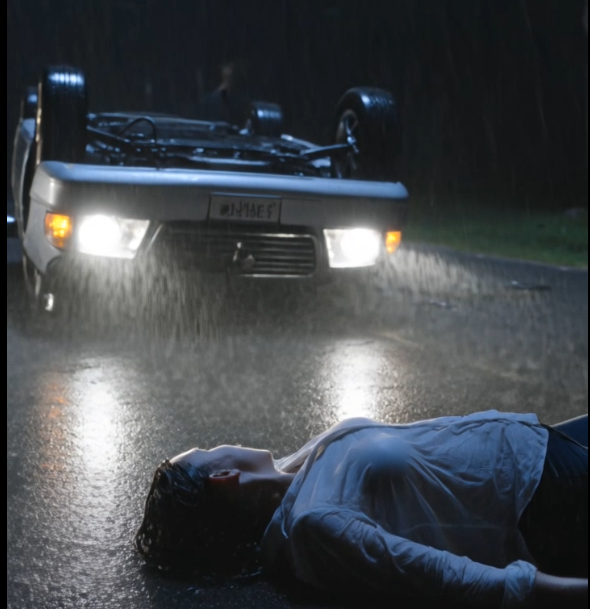
The road came back in pieces. The rain first — she was aware of rain before anything else, the specific cold weight of it on her face, which meant her face was turned upward, which meant she was on her back. Then sound: the tick of cooling metal somewhere close, and water moving through a ditch, and her own breathing, which was faster than it should have been and irregular in a way that frightened her once she noticed it. Then pain, arriving in sequence like lights coming on in a building — her right shoulder, her temple, her palms, her knee. She turned onto her side and pushed herself up. The car was twenty feet away, resting on its roof in the shallow ditch at the road’s edge, the headlights still on and cutting twin tunnels through the rain that served no purpose now for anyone. One wheel was still turning. She watched it slow. She had been going too fast for the bend. She knew it even now, could reconstruct the precise second of understanding — the rear coming loose, the correction that overcorrected, the particular silence inside a vehicle that is no longer in contact with the road. Then the impact, and the world reorienting itself in a way that physics permitted but the mind took longer to accept. She was on her hands and knees in the wet road. She looked at her palms — gravel in the skin, bleeding in several places, but her fingers moved when she asked them to. She touched her temple and her hand came back dark in the dim light. Head wounds bled excessively; she knew this, held it as a fact against the panic. She needed her phone. She needed to stand up. She needed to assess, practically, what was damaged and what was merely hurt. She planted one foot, then the other, and got herself upright. He was standing at the edge of the tree line. She saw him the way you see something your brain refuses initially to categorize — as a shape first, then a silhouette, then a person, then — by degrees, the way a photograph develops — as a face she knew. Had known. A face she had last seen in a casket, arranged with the particular careful neutrality of the professionally prepared dead, wearing a suit he would never have chosen for himself. Liam. He was wearing the grey jacket he’d had in college. His hands were in the pockets. He was watching her with an expression she couldn’t name from this distance, in this rain, with blood running into her right eye. She heard herself say it before she decided to. “You died last year.” He looked at her calmly. “Are you sure it was me in the car?” The road was empty in both directions. No other headlights. This was the kind of route that people used to cut time off the drive between Dalton and the coast, and at this hour, in this weather, she had been the only one using it. She walked toward him, and he didn’t move, and she stopped six feet away and looked at his face. It was his face. She was concussed — she understood this, filed it — but the concussion was a fact about her current neurology, not an explanation for what her eyes were reporting. She had looked at this face for three years. She knew its specific geometry: the slight asymmetry of his mouth, the scar through his left eyebrow from a childhood bicycle accident, the way his eyes were darker in low light than they appeared in day. This was not an impression of his face. This was his face. “You’re not real,” she said. “You just watched me walk here from the trees,” he said. “What part of that isn’t real?” “You’re —” She stopped. Her head was hurting with a focused, particular intensity that she was trying not to examine too closely. “I identified your body. I was there. I saw—” “What did you see?” She opened her mouth. Closed it. She had seen what they showed her. A form beneath a sheet, and then the sheet folded back to the collarbones. A face. His face — she had been certain, had not questioned it for a single second, because nothing about that moment had provided space for questions. Grief didn’t ask you to audit what it showed you. Grief simply presented things and watched you receive them, and she had received it and then she had gone home and she had spent twelve months rebuilding herself around the absence of him. “Are you sure it was me in the car?” he said again. The night of his accident: October, rain not unlike this one, a road not unlike this one. He had been driving back from his brother’s place, a route he knew, a car he’d driven for years. They had not been together that night — they had fought two days before, something small escalating into something larger, and she had not yet called to resolve it, had been waiting for the anger to metabolize fully before she reached out. She had been waiting. And then his brother had called at eleven-forty, and she had heard it in his voice before he said anything, the tone that preceded the words the way thunder preceded lightning — something at a distance, something coming — and he had said there’s been an accident and the words after that had arrived without order. “The identification,” she said carefully. “His brother was there. Your brother was there.” Liam looked at her steadily. “Cian was there.” “He confirmed—” “Did he?” A pause. “Or did he look at what they showed him, in that room, in that state, and understand what he was expected to confirm?” The rain had intensified again, running off her hair into her face, and she was cold in a way that had moved beyond physical discomfort into something almost abstract. She needed to sit down. She needed help. She was aware of these things as facts about her situation and she could not attend to them yet. “Why,” she said. “If this is real, if you’re — why?” He looked away for the first time, toward the inverted car in the ditch. Its headlights were beginning to dim. “Because I let everyone believe it,” he said. “Because I stood at that distance and I let it happen and I didn’t stop it, and there is no version of that I can explain to you that makes me someone you should be standing in the rain talking to.” “Try,” she said. Her voice had no heat in it. It was flat and entirely serious. “Try.” He had owed money. That was the beginning of it, the mundane and humiliating root of the thing — not drama, not tragedy, just a series of bad decisions made at twenty-six when he’d believed that certain situations could be managed, that debt was a temporary condition you outran through optimism and time. He had been wrong about that, and the people he’d owed had been the kind who communicated the wrongness of it in specific, non-negotiable terms. Someone had offered him a way out. Leave. Not just the city — the country. Leave and the debt dissolved and the people he owed lost interest, because a man who had ceased to exist could not be made to pay, and it was simpler than the alternative they were also prepared to offer. “There was a man,” he said. “A car accident two days before. Someone without family, without anyone who would look closely. Cian was—” He stopped. “Cian was not in a state to look closely. And I had already decided. I had already decided before they called him in.” “You chose this,” she said. “I chose to live.” “You chose to let us grieve you. You chose to let me—” She stopped. She was not going to do this on a wet road in the dark with blood on her face. She refused. She held everything behind her back teeth and breathed through it. “Where have you been.” “Portugal, first. Then north. A small place.” He paused. “I watched, sometimes. Online. I know that’s — I know what that is.” “You watched.” “I watched you put flowers at a grave that isn’t mine and I—” His voice changed. For the first time since she’d seen him standing at the tree line, the uncanny calm shifted, something underneath it moving. “I couldn’t. I couldn’t keep not — and then tonight I was on this road and I saw the lights and the car and I saw you crawl out, and I thought —” He exhaled. “I thought, this is what it costs. This is what my being dead costs. And I couldn’t walk back into the trees.” She looked at him for a long time. The thing was, she had known something. Not this — not anything close to the specific shape of this — but a wrongness she had never been able to name, a quality to her grief that differed somehow from what she understood grief to be. She had thought it was guilt, about the fight, about the two days of silence. She had carried that guilt carefully, turned it over, learned to incorporate it. It had not been guilt. It had been the particular unease of a body that knows something the mind has not been given. “You need to call someone,” he said. “You’re hurt. You need—” “I know what I need.” She looked at the road, looked back at him. “Give me your phone.” He reached into his jacket pocket and held it out. She took it. His hand was warm. That registered somewhere — that she had felt his hand for the first time in fourteen months and it was warm, ordinary, the hand of a living person. She called the emergency line and gave the road number and her location and said she’d been in an accident and needed an ambulance, and the dispatcher said fourteen minutes, and she said she’d be here, and she ended the call. She held his phone. “Fourteen minutes,” she said. “Mara—” “Don’t.” She looked up at him. “Don’t say my name yet. I’m not — I can’t hear you say my name yet.” He closed his mouth. They stood in the rain on the empty road. The car’s headlights died finally, and without them the darkness was almost total — just the ambient grey of clouds lit from below by a distant town, and the rain making its sounds, and somewhere in the ditch water moving purposefully toward somewhere else. She had a thousand questions. She understood that they would take a very long time to ask and an even longer time to answer, and that there was no version of this road that led quickly somewhere bearable. She understood that she had twelve months of grief to re-examine in the light of a fact that changed its meaning entirely, and that this was not a night’s work or a month’s work. She understood that the person standing across from her had done something she did not yet have the right word for — not dead, not gone, not the thing she’d thought — and that whatever she felt about it was not yet available to her because her head was bleeding and she was standing in the rain on a dark road. She also understood that he had walked out of the tree line. That he had seen her and walked toward her, in the rain, on this particular night. She did not know what to do with any of it. So she stood on the road and she held his phone and she watched the direction the ambulance would come from, and he stood across from her without speaking because she had asked him not to, and the rain came down on both of them equally — on the girl who had spent a year grieving, and the boy who had spent a year watching her do it — and fourteen minutes away, someone was driving through the dark to find her. She was still here. That was enough to work with.
