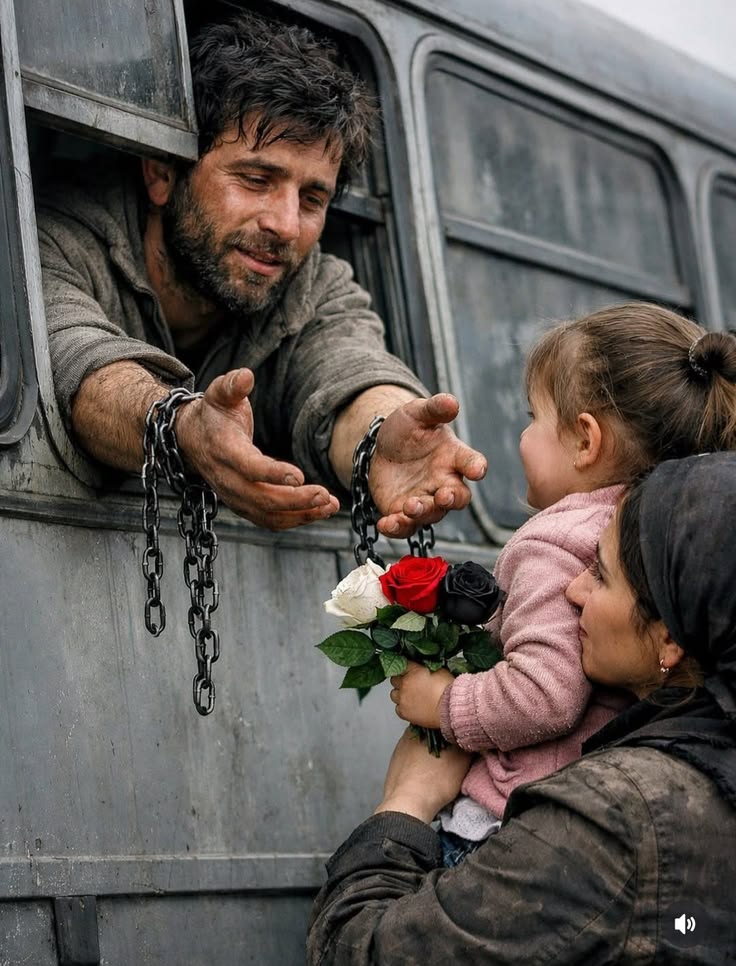
The little girl had chosen three roses from the vendor’s bucket outside the station — one white, one red, one black — and her mother had not had the heart to tell her they only had money for two.
The vendor, an old woman with a face like weathered bark, had looked at the child and then at the mother and then placed the third rose in the girl’s hands without a word and turned away before anyone could make the moment awkward with gratitude. That was the kind of small, quiet grace that still existed in the world, even on days like this one — gray and cold and smelling of diesel and the particular sorrow of departure.
Lena Vasik was thirty-two years old and had not slept in two days. She held her daughter Mira on her hip the way she had been holding her for the past eighteen months — constantly, instinctively, the way you hold the one thing in your life that cannot be set down. Mira was three. She had her father’s dark eyes and her mother’s stubbornness and a laugh that, when it came, was so complete and so sudden that it made strangers on the street turn and smile without knowing why.
She had not laughed much in the past year.
Lena had known the transport would be here. She had not known if Aleksy would be on it. The list she had been given — a handwritten thing passed through four sets of hands before it reached her, each transfer a small act of courage by someone risking more than she could calculate — contained forty-seven names. His had been near the bottom. She had read it so many times that the paper had softened along the fold lines, had begun to feel like cloth rather than paper, the way things feel when they have been worried over enough.
She saw the transport before she saw him. Gray and hulking and indifferent, the kind of vehicle that has no interest in the human weight it carries. There were faces at the windows — men, most of them unshaven, all of them carrying in their eyes the particular expression that belongs to people who have been in confined spaces too long, who have had their freedom reduced to a small rectangle of daylight above a sill.
Mira saw him first.
Children have a frequency for the people they love — a signal that bypasses the ordinary channels of recognition and goes somewhere deeper, somewhere that does not require clear sight or full understanding. Mira simply turned her head toward the third window from the front and said, with absolute certainty, “Papa.”
Lena looked. And there he was.
Aleksy Vasik had lost weight. His beard was longer than she had ever seen it — he had always been clean-shaven, a habit from his years working in the city, a point of quiet professional pride. His clothes were the same ones he had been wearing the last time she saw him, which had been fourteen months, two weeks, and four days ago, a count she had not chosen to keep but had kept anyway, the way the body keeps track of pain without consulting the mind. His wrists, extended through the window, were bound with a chain that was heavy enough that she could hear it against the metal sill.
But he was smiling. That was the thing that broke her completely and put her back together in the same instant. Through everything — through the fourteen months and the weight loss and the chain and the gray sky and the diesel smell and all the things she did not yet know about what had happened to him in the places they had kept him — he was smiling at his daughter.
Mira was already reaching for him, her small arms extended, the three roses clutched in her fist like a tiny triumphant flag.
Lena stepped forward. She lifted Mira higher, close enough that Aleksy could reach through the window, and his chained hands came forward and cupped his daughter’s face with a gentleness that seemed impossible given the weight of what was on his wrists. He said her name. Just her name. Mira. The way you say a word that you have been saying silently for over a year, that has been the rhythm beneath every other thought.
“I brought you flowers, Papa,” Mira said, with the calm gravity of a child delivering an important report. “One white and one red and one black. The lady gave us the black one for free.”
Aleksy looked at the roses. Something moved across his face that Lena recognized — the way he processed things that were too large for immediate response, that required a moment of internal accounting before he could answer. He had always been that way. It was one of the things she had first loved about him, that he took things seriously. That he did not deflect from what mattered.
“They’re perfect,” he said. His voice was rougher than she remembered. “They’re exactly right.”
“I picked them myself,” Mira said.
“I know you did. I can tell.”
Lena reached up and put her hand over his. The chain was cold. She had known it would be cold and it was still a shock, the temperature of it, the weight. She pressed her palm flat against the back of his hand and felt his fingers curl around hers and she did not say anything because there was nothing in language adequate to this moment, to fourteen months folded into a single point of contact.
“How long?” she asked. Her voice was level. She had practiced being level.
His smile shifted — still there, but carrying more now. “Soon,” he said. “The lawyer says soon.”
She nodded. Soon was not a date. But it was more than nothing, and for now it was enough to stand in the cold with her daughter on her hip and her husband’s hand in hers and three roses between them — white for what had been, red for what still burned, black for everything they had survived.
The transport engine turned over. Beginning to move. Her hand stayed on his until the distance made it impossible.
Mira waved with the roses until the vehicle was gone.
Then she looked at her mother and said: “He’s coming home soon, right, Mama?”
Lena looked at the empty road. She thought about the word soon. She thought about the lawyer and the list and the four sets of hands that had passed it to her.
“Yes,” she said. “He’s coming home.”
She said it the way you say things that you are determined to make true by the force of saying them — with your whole body, with everything you have, with the absolute refusal to consider the alternative.
She took her daughter’s hand and walked back through the gray morning, and the three roses went with them.
