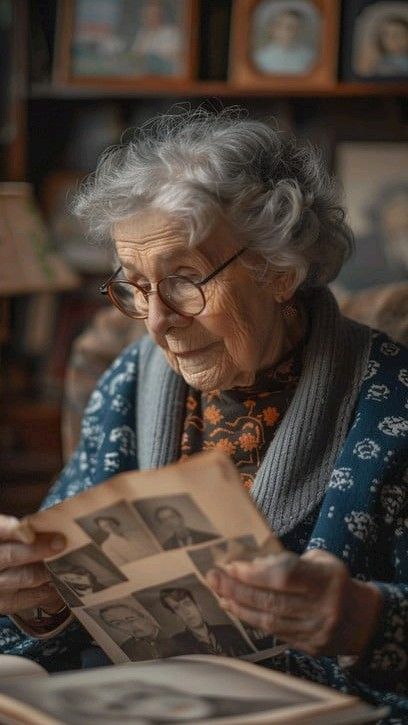
The photographs had been in the attic for forty years, and Edith Crane had never once gone looking for them.
That was the important thing to understand about Edith — she was not a woman who avoided things out of fear. She had raised four children largely alone after her husband Raymond had his first stroke in 1974. She had managed a household on a teacher’s salary in a small town in central Ohio where everyone knew your business and some of them enjoyed knowing it a little too much. She had buried her mother, her brother, and one of her dearest friends in the span of three years in the late eighties, and she had kept going through all of it with the steady, unhurried persistence of a river that has decided where it is going and cannot be meaningfully argued with.
She had not gone looking for the photographs because she had not been ready. That was all. There was no shame in understanding the difference between avoidance and timing.
But she was eighty-six years old now, and on a Tuesday morning in early November, while her grandson Marcus was up in the attic looking for the box of Thanksgiving decorations, he had called down the stairs: “Grandma, there’s a whole bunch of old pictures up here. You want me to bring them down?”
And she had said yes.
The box sat on the coffee table in front of her now. It was a cardboard box, once used for reams of typing paper, reinforced at the corners with the kind of brown tape that spoke of a different era of careful preservation. Marcus had gone back to his apartment in Columbus after lunch. Edith sat alone in the late afternoon light with her reading glasses on and the box open and a sheet of old photographs in her hands.
The photographs were arranged in a grid — small portrait shots, the kind produced in strips, the kind you got from the photo booths that used to exist in every Woolworth’s and Kresge’s department store across America. Eight faces per sheet. Some sheets had names penciled lightly on the back in handwriting she did not recognize. Some had dates. Most had nothing — just faces looking out from the past with the particular seriousness that people used to bring to having their photograph taken, when it still felt like an occasion.
She did not recognize most of the faces. That was the thing. She had expected to recognize them — had assumed, in the vague way you assume things about your own family history, that the faces in an old family box would be familiar to her. Ancestors, relatives, people she had heard named at Sunday dinners. But these faces were largely strangers. Men and women of various ages, captured in the flat, high-contrast light of photo booth cameras, looking at a lens with expressions ranging from solemn to faintly uncomfortable to — in one case, a young woman with dark curled hair — something that might have been barely contained amusement, as if she knew something the camera did not.
Edith studied that face for a long time.
She turned the sheet over. On the back, in the handwriting she did not recognize, was a single word: Vera.
Edith set the sheet down on her lap. She looked out the window at the November yard, the oak tree she had planted with Raymond the spring they moved in, now enormous and bare, its branches making their familiar map against the gray sky.
Vera. She turned the name over in her mind the way you turn a stone over in your hand, feeling its weight and texture. It meant nothing to her. And yet the handwriting that had written it — she picked up the sheet again, looked at the back more carefully — had something about it. Not familiarity exactly. More like the echo of familiarity. The feeling of hearing a piece of music that you cannot name but are certain you have heard before, in a different context, in a different life.
She went through the rest of the box methodically, the way she had always done things that required care. Sheet by sheet, examining each face, turning each one over to check for writing. Most were blank. A few had names. Three had names she recognized from her husband Raymond’s family — an aunt, a cousin, a man named Harold who Raymond had mentioned once or twice in the context of some old and unspecified falling out that the family had never discussed directly.
At the bottom of the box was an envelope.
It was sealed. It had been sealed for what appeared to be a very long time — the gum on the flap had dried and darkened and the paper had the soft, slightly fragile quality of something that has waited patiently for decades. Written on the front, in the same unrecognized handwriting that had written Vera, were three words:
For Raymond’s wife.
Edith sat with the envelope in her hands for a full five minutes without opening it. This was not avoidance. This was the appropriate acknowledgment of a threshold. Some things, once opened, rearrange the furniture of your understanding permanently, and a person deserved a moment to stand in the doorway before walking through.
She thought about Raymond. About the forty-one years they had been married, the ordinary extraordinary texture of a long shared life. About the things she had known about him and the things she had not known and the comfortable assumption she had always made — the assumption almost everyone makes about the people they love — that the unknowns were small. Peripheral. Unimportant to the essential story.
She opened the envelope.
Inside was a single sheet of paper, folded twice. She unfolded it carefully. The handwriting was the same. The letter was dated March 1961 — thirteen years before she had met Raymond, seven years before he had, according to everything she had ever been told, arrived in Ohio from Pennsylvania with one suitcase and no family to speak of.
She read the letter once. Then she took her glasses off and pressed her fingers against her closed eyes and sat very still in the November light.
Then she put her glasses back on and read it again.
